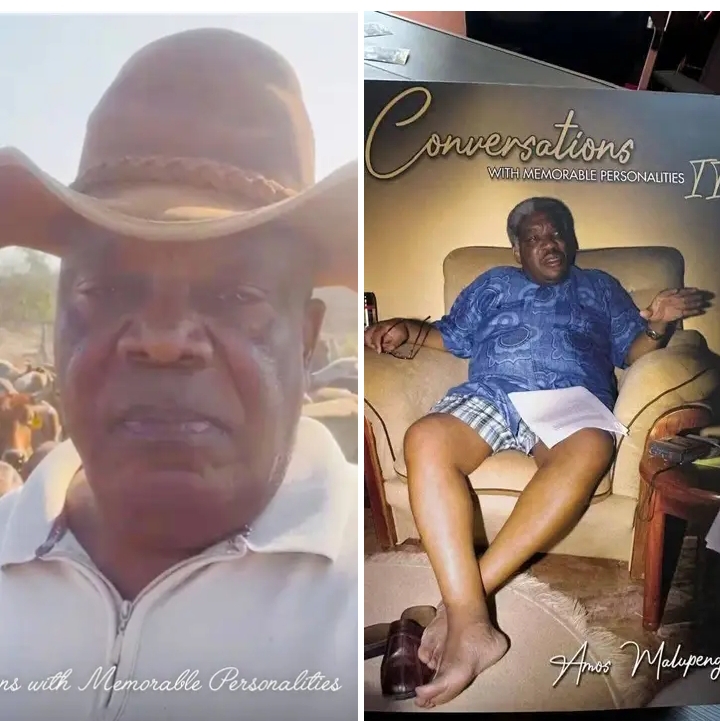

Due To Popular Demand:
DAVID DIANGAMO EXPLAINS HIS INNOCENCE
Hey Folks,
Yesterday, I shared how former ZNBC Director General, the late Dr. Mannaseh Phiri was unceremoniously fired in 1993 (Conversations Part 1).
That post sparked a wave of messages into my inbox from readers wanting to know what happened to another high-profile figure in Conversations Part 2: former Deputy Secretary to the Cabinet, David Diangamo.
One reader, Matthews Banda, noted: “You shared Mr. Diangamo’s rich CV and how he was implicated in corruption by the Task Force, but not how it ended. I was surprised such an experienced official was implicated. Before I buy the book, can you share how his matter was concluded?”
While excerpts are just a sneak peek to show you why you need these books on your shelf, I love breaking the rules for my readers!
Below is an exclusive excerpt from Part 2 of Conversations with Memorable Personalities (Pages 247–248).
Here, Mr. Diangamo explains how a total misunderstanding of government financial procedures led to his arrest in 2003—and why the State ultimately dropped the case.
As Mr. Diangamo reveals: “Even President Mwanawasa wrote to the Task Force advising them that… there was no issue with me.”
👇 Read the dramatic breakdown below:
***
David Diangamo: In June 2002, I was appointed Acting Secretary to the Treasury with a view to substantive promotion and finally became Secretary to the Treasury until I was arrested in January 2003.
Amos Malupenga: Why were you arrested?
Diangamo: I was alleged to have connived with others in defrauding the government out of K4.3 billion [unrebased] through the Zambia National Commercial Bank [ZANACO].

I couldn’t understand this charge because there is no way you can steal money and, at the same time, use the same money to clear an overdraft. The two things cannot happen simultaneously.
But let me give you some background. Prior to my being Secretary to the Treasury, I
had acted as permanent secretary in charge of Budget at the Ministry of Finance in May
2000. During that period, the IMF [International Monetary Fund] team was coming to visit Zambia to check on the performance of the programme.
At that time, we had to ensure that the programme’s benchmarks were met. I only acted for one week and during that one week, I had to carry out these preparations. I had to co-ordinate the work programme to ensure that all benchmarks were as expected and that the IMF and the World Bank would find the Zambian team ready.
Unfortunately, during the month of May it was discovered that the Office of the President [OP] had overdrawn their account to the tune of K4 billion. This issue was brought to my attention and they asked me to give them money to clear the overdraft because under the IMF, we are not allowed to have a government institution incur an overdraft.
ZANACO needed a letter from the permanent secretary in charge of Budget who was the controlling officer over such funds. Then a letter was prepared for me on the 29th of May 2000, instructing ZANACO to debit the ZCCM [Zambia Consolidated Copper Mines] account with K4 billion to clear that overdraft.
That letter was addressed to Mr. [Samuel] Musonda [the then ZANACO managing
director] and copied to Xavier Chungu [the then OP director general] and a copy was put on the file in the ministry.
It is this letter I issued that the Task Force misunderstood completely. The letter was
purely conveying a management decision made in the Ministry of Finance. There was no outflow of cash. Money moved from one ZANACO account to another ZANACO account just to regularise the government’s position in the bank. It was a relief measure during the IMF visit.
Thereafter, arrangements would be made for how we would restore everything,
meaning we had to get the money back into the retrenchment account and, at the same time, close the ZANACO account.
Since I was only acting for a week, I left. But records show that about seven days after I left, the money was reversed to the ZCCM account, resulting in the OP overdraft resurfacing. And it kept operating for some time until, finally, the Ministry of Finance cleared it when it stood at K4.3 billion. I was not party to the K4.3 billion transaction.
That is when they charged me with others. Unfortunately, and even technically, this is
where I said there was a lack of appreciation of what was being resolved as well as a failure to understand government accounting procedures and financial management. In my letter, the figure was K4 billion, but the charge against me was for K4.3 billion.
These are two different figures transacted at two different times and by different officials.
When I studied the situation, I found that at the time I authorised K4 billion for the
purpose of managing the IMF programme, and when the K4 billion was reversed, the OP again went to obtain another overdraft of K300 million, which brought the overdraft to K4.3 billion.
And when they finally cleared the overdraft, they paid K4.3 billion. But they charged
me with the K4.3 billion, which was paid by the Ministry of Finance, to clear the overdraft.
If you go to the books of account, you will not find that somebody withdrew K4 billion
or indeed K4.3 billion. That was the bottom figure. You can call it the net position of credit facility at the time it was liquidated. I was not part of the payment of the K4.3 billion.
My job was to regularise the government’s position when the IMF team was about to come. I did this very well. The programme was assessed positively and later we managed to draw the Balance of Payments support. We initially got US$70 million, which came to the economy, and it was used through the banking system for imports of various goods and services.
I explained all this to the Task Force officers, but to my surprise, they still thought I
benefited somehow. I don’t understand this. That was the problem.
Malupenga: So how was this issue resolved?
Diangamo: As you recall, they arrested me together with former president Dr. Frederick Chiluba and others. In the process, the DPP [Director of Public Prosecutions] directed that they enter a nolle prosequi. So it ended up in a nolle.
Malupenga: From your own understanding, how was that nolle entered?
Diangamo: My understanding is that they realised it was not an issue. That there was no wrongdoing on the part of the Ministry of Finance or indeed myself. It was a collective decision made in good faith to sustain the economic programme. And it was sustained because there is no record of the IMF programme being suspended in 2000. …”