
ELECTRICITY BILLS RISE AS ZESCO ADJUSTS RESIDENTIAL TARIFFS.
The increase in electricity bills being experienced by many households has been attributed to adjustments in ZESCO’s residential electricity tariffs, combined with higher power consumption following the return of more stable supply.
During the extended period of load shedding, most households used fewer electricity units and largely remained within the lower and cheaper tariff bands. However, with improved power availability, consumption has increased, pushing many customers into higher tariff categories where electricity is significantly more expensive.
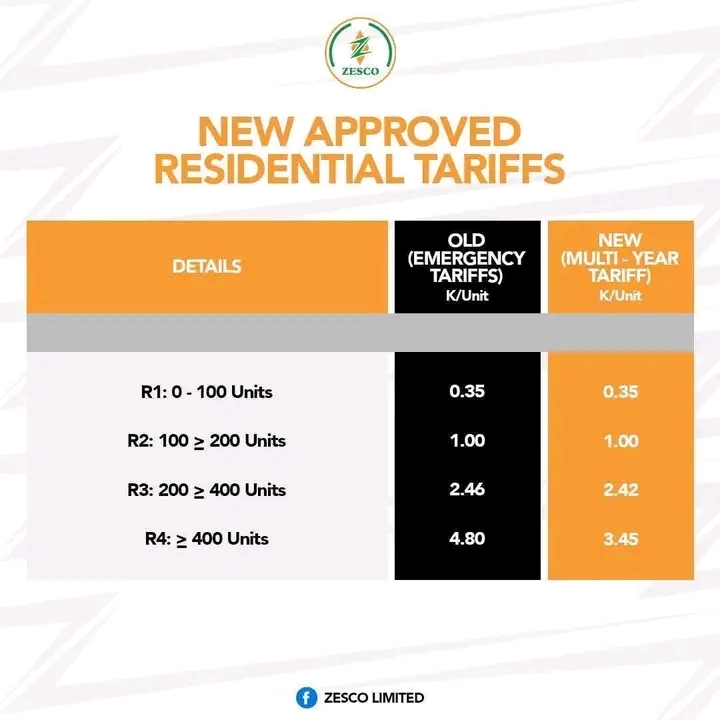
ZESCO applies a progressive tariff system, meaning the price per unit rises as monthly consumption increases. Under the adjusted structure, residential electricity is charged across four bands, applied incrementally rather than at a single flat rate.
The first 0–100 units are charged at K0.35 per unit, costing K35. Units 101–200 are charged at K1.00 per unit, bringing the total cost for 200 units to K135. Consumption between 201 and 400 units is billed at K2.42 per unit, adding K484 and taking the total cost for 400 units to about K619. Any usage above 400 units is charged at the highest rate of K3.45 per unit.
Energy analysts explain that while the lower bands remain relatively affordable, the adjusted tariffs above 200 units result in a sharp increase in expenditure once households cross the 400-unit threshold. This has led to public perceptions that electricity units are “finishing faster” than before.

Practical illustrations show that a household purchasing electricity worth K300 remains below 400 units, while K600 places consumption close to the upper limit of the third band. A purchase of K800, however, means part of the electricity is billed at the highest tariff, rapidly increasing costs.
Observers note that the tariff adjustment, coupled with increased electricity use under stable supply conditions, has effectively raised household electricity bills even where buying patterns appear unchanged.
Consumers are being advised to closely monitor monthly usage and adopt energy-saving measures to avoid crossing into the most expensive tariff band, as pressure on household incomes continues to mount.