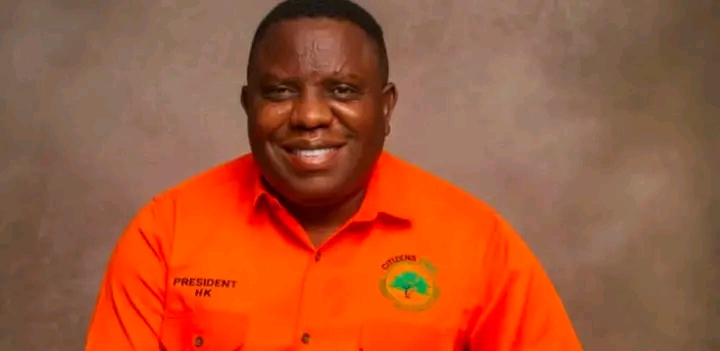

HARRY KALABA SHOULD QUESTION THE NORMALISATION OF IMINGALATO, NOT ECHO THE VICE-PRESIDENT’S ATTACK ON THE OPPOSITION
President Harry Kalaba’s decision to agree with Vice-President Mutale Nalumango that the opposition, in its current state, should forget about forming government in 2031 is unfortunate and politically misplaced. Instead of endorsing a narrative that appears to celebrate the weaknesses of the opposition, Kalaba should be asking critical questions about who is actually responsible for weakening the opposition in Zambia.
President Kalaba must understand that opposition disunity does not happen in a vacuum. There are deliberate political manoeuvres, questionable alliances and what many perceive as the normalisation of the Imingalato formula aimed at weakening, dividing and destabilising opposition political parties.
Before agreeing with the Vice-President, Kalaba should ask himself: Who started this culture of political interference in opposition affairs? What role have Miles, Chabinga, the Restoration Party President and NRPUP President Ezra Tembo played in the political developments that have contributed to opposition divisions?
And who benefits when the opposition is weakened, divided and distracted by internal conflicts?
President Kalaba cannot speak about opposition leaders pursuing personal ambitions, self-enrichment and individual political interests without acknowledging the political circumstances surrounding these accusations. Whenever he speaks about selfishness and personal ambition within the opposition, many Zambians will naturally wonder whether his remarks are directed at Brian Mundubile and Makebi Zulu, who have emerged as prominent opposition figures. If so, he owes the public a clear explanation rather than making broad accusations that risk discrediting the entire opposition.

More importantly, Kalaba should be asking whether the opposition is genuinely being given a fair political environment in which to organise, mobilise and compete.
Was it the opposition that subjected Citizens First Muchinga Member of Parliament, Madam Faith Munthali, and her campaign team to the treatment they experienced? Was it opposition disunity that created those circumstances? These are important questions that cannot simply be swept aside whenever opposition leaders are accused of failing to organise themselves.
It is contradictory to condemn opposition leaders for failing to unite while remaining silent about actions and political practices that contribute to weakening opposition parties in the first place.
President Kalaba must appreciate that unity cannot be demanded from the opposition while political manoeuvres that undermine opposition solidarity are being normalised. Democracy requires a strong opposition, not an opposition that is expected to remain divided, intimidated or politically disadvantaged.
If Vice-President Nalumango believes the UPND will comfortably win the 2031 elections because of the opposition’s current weaknesses, Kalaba should challenge the circumstances that have created those weaknesses rather than reinforce her political argument.
The responsibility of a genuine opposition leader is not to help the ruling party legitimise the idea that it has already secured victory in 2031. It is to demand accountability, defend democratic space and help build a credible alternative government.
President Harry Kalaba should therefore be asking himself one fundamental question: WHO IS REALLY WEAKENING THE OPPOSITION?
Is it simply opposition leaders pursuing personal ambitions, or is it also the growing culture of political manoeuvres, interference and the normalisation of the Imingalato formula?
Zambians deserve honest answers.
The opposition must certainly put its house in order, but putting its house in order must also mean confronting those who contribute to its weakening. It cannot mean blaming opposition leaders for every political problem while ignoring the wider circumstances.
President Kalaba should be championing a strong, independent and united opposition, not lending his voice to a narrative that risks normalising the weakening of democratic competition in Zambia.
The fight for democratic change in 2031 should not begin by declaring the opposition defeated. It should begin by confronting everything that threatens the existence of a strong and credible opposition.
Kawimbe Chanda
Tonse Pamodzi Alliance Member