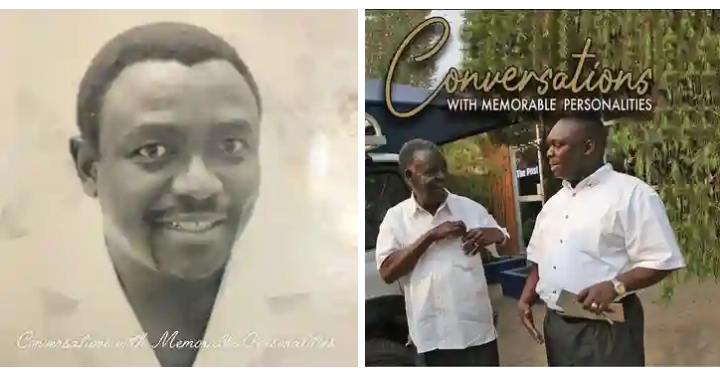

HOW CONDOM ADVERTS COST DR MANNASEH PHIRI A JOB AS ZNBC DG
… After Receiving Letters That Called Him A Devil Who Had Come To Destroy The Declaration of Zambia As A Christian Nation And Threatened Hell-Fire on Him
***
An excerpt from the book: Conversations with Memorable Personalities, Part 1 (2022) by Amos Malupenga, Pages 128 – 133.
***
Hey Folks,
Yesterday, I met an avid reader who asked me to autograph his copy of Conversations Part 2 after he bought it from Bookworld.
He told me he has spent the last four years re-reading the 652 pages of Conversations Part 1, getting to know better the 45 memorable personalities featured inside, and, therefore, he could not wait to dive into Conversations Part 2.
His absolute favourite takeaway?
The jaw-dropping story of the late Dr. Mannaseh Phiri, that prominent medical practitioner and broadcaster. This avid reader found Dr. Phiri’s story to be a masterclass in integrity, political pressure, and standing by one’s principles.
So, in 1993, the late Dr. Phiri took a massive leap of faith. He left a lucrative career in ZCCM to become the Director General of the Zambia National Broadcasting Corporation (ZNBC). He wanted to bring freshness, quality, and independence to the nation’s airwaves.
His elder brother, the late David Phiri (former Bank of Zambia Governor and former FAZ president), advised him it was a mistake. He issued a chilling warning: “These politicians will take you in their mouth, chew you, spit you out, and you will be badly hurt.”
David was right.
Within weeks, Dr. Phiri was caught in a political firestorm. By attempting to clear the airwaves for equal religious broadcasting and introducing condom advertisements on television to fight a health crisis, he became the target of powerful tele-evangelists like Pastor Nevers Mumba, ministers like Dan Pule, and eventually, President Frederick Chiluba himself.
Letters poured in threatening “hellfire” and calling him “a devil” who had come to destroy Zambia as a Christian nation. A public petition demanded his removal. And just like that—he was fired publicly.
I am sharing this excerpt from my 2006 conversation with Dr. Phiri primarily for the benefit of those who have not yet read this book, so they can also draw their own lessons from Dr. Phiri’s experiences.
The excerpt is lengthy, but you will not realise so because it is so revealing and gripping.
If you love rich Zambian history, unpolished truths, and leadership lessons from those who lived them, this book belongs on your shelf.
Enjoy the excerpt:
Picture caption: Young Dr Mannaseh Phiri as Chief Medical Officer in the 1980s.
***
Amos Malupenga: Just quickly run through the various roles you played as a doctor after the internship at Ndola.
Dr Mannaseh Phiri: I started work as a junior doctor, what was then known as general duties medical officer. This meant that I would be attached to a particular consultant. In fact, when I joined I was working with Dr. Steward Fisher, one of the famous doctors in Kitwe.
I also worked in the obstetrics and gynaecology departments under another consultant.
In 1982, I was sponsored by the mines to go to England to study occupational health
because I was interested more in the administration of medicine and health services in the mining industry. I had gone for a year but I didn’t do very well so I was called back to come and be assistant chief medical officer which was like deputy superintendent at Wusakile Mine Hospital. I was only 33 years at the time.
In 1984, I was transferred to Kalulushi Mine Hospital in the same capacity to take over
from an expatriate but I was still living in Kitwe. At the end of 1985, I was transferred to
Luanshya still as chief medical officer. In 1989, I was transferred back to Kitwe as chief
medical officer at Nkana and Wusakile Mine hospitals. I served in that capacity until March in 1993 when I resigned to go to ZNBC.
Malupenga: How did that come about?
Dr Mannaseh Phiri: It’s funny because when ZNBC became a corporation, one of my closest friends in life was the late Charles Mando who approached me when I was working in Luanshya. And Charles told me that he thought I should apply to become Director General of ZNBC. This was around 1988.
I said, ‘You are working there; how can you ask me to come and be your boss, even if I
am your friend?’ He said, ‘I have looked at what is happening at ZNBC because it is turning into a corporation and, therefore, it needs someone who can make it move away from a government controlled broadcaster and I think that you can do it.’
I said to him that I was in the middle of my medical career and it wasn’t interesting
very much for me to go to ZNBC.
And in 1993 after the change of government, there was an advertisement for a job of ZNBC Director General. A few friends, including the late Jeff Zulu who was a journalist with Zambia Daily Mail, phoned me saying, ‘Your job is being advertised.’
I consulted members of my family because by that time, I was already converted to
taking the job. So, what I did was to consult those members of my family who I knew would not say no. There were those, including my late father who was alive then, who would say, ‘You cannot leave a medical career to go into broadcasting.’ So, I didn’t consult my father and my brother David.
But on the day I was going for the interviews, I flew to Lusaka and unfortunately I met
David at the airport and he said, ‘I know exactly why you are here and I want to tell you that you are making a very big mistake. These politicians will take you in their mouth, they will chew you and they will spit you out and you will be very badly hurt.’
I was 43 years at the time so I said, ‘David, at my age, give me a chance to try that. If I will get hurt, let me experience it because I think I can make a difference.’
And I had a very interesting interview. I remember one of the panellists asking me if I
would be disappointed if I didn’t get that job. I thought for a while and then I said, ‘Yes, I will be disappointed for you.’ He sat back and said, ‘What do you mean?’
I said, ‘I know everybody else whom you are interviewing and I want to tell you that I
will bring a freshness in the thinking and management of ZNBC, if I get this job. I think I
know what you are looking for and I can provide it. I am not a journalist, I am a doctor. I
have management experience although I am not a trained manager.’
And I think that that kind of arrogance is what won it for me. I didn’t need the job
because I had a very good career in the mines as a doctor and I was being paid very well. And I knew that I would go for this job at ZNBC and come down in salary but I had this love for broadcasting, remember I had done broadcasting since 1970. I also thought that with the coming of the new dispensation, the government would let broadcasting be as it should be.
But unfortunately, that is the story everybody knows because it didn’t turn out to be.
Malupenga: Maybe for the benefit of those who were a little younger at the time, I will ask you to refresh our minds on the events that happened soon after you got this job as ZNBC director general, as you remember the prophetic words of your brother David.
Dr Mannaseh Phiri: Absolutely. The job was stressful but it was fun and a great challenge. I was coming from a private industry into the civil service kind of operation. So, to change the mindset of people that I had to work with was quite difficult. It started by getting people to love what they did because there were a lot of complaints that ZNBC was under-funded and that is why they didn’t perform.
I used to say to my staff meetings that, ‘We get so little and we don’t produce many
products. We produce one product because most of the products we show on television are repeats and are imported so we have the news as one product that we produce.
And it doesn’t require many resources for us to do a good news bulletin.’
When I joined ZNBC, a newsreader would come five minutes before the news and pick
up the bulletin and go on screen and read it. But I said, ‘That was an insult to the people of Zambia. We should be starting the news bulletin by 18:00 hours so that by the time you are reading it on camera, you already understand the story.’
In fact, we tried to introduce a culture where the people who were to read the news
became part of the news-gathering and preparing process. And I ensured that readers
rehearsed the news in good time. I also used to sit in on editorial meetings because I thought we needed to produce well the one product that we were producing.
And one thing I did in the short time I was there was to ask why we were showing on
television what we were showing. I remember asking in one senior management meeting why we closed the station at 23:00 hours, ‘Where is it written that we should close that time? Where are the rules?’ And nobody could produce them for me.
And I told them, ‘From now, we will show the best that we can even if it means closing
the station at 21:30 hours because we have no right to bore our listeners or viewers, we have no right to show them rubbish just to fill the time.’
We started doing that. People then realised that there were certain things we could do
without too much in the way of money.
And if you recall so well, that time there were religious programs on television about
an hour or less just before the news. We tried to do what I called: ‘rationalise religious
broadcasting’. When I joined broadcasting in 1970, there used to be a broadcasting
department headed by Fr. Emmanuel Milingo who is now archbishop. He used to be the
person that advised ZNBC on the content, quality and airtime in terms of religious programs.
When I came back in 1993, there was no such a department. All the religious programs
used to go through the commercial department. So, anybody who had the money and the program to show paid the money and the program was shown. And people who were paying the money could dictate what time the program should come on air. But I said, ‘No, we are the ones running the broadcasting station and we have the responsibility to Zambians on quality, so how can other people dictate to us what time they want their program shown?’
So, we agreed in the executive committee that we would begin to phase out some of
the religious programs while we tried to rationalise and establish a religious broadcasting department through which these programs would go.
And the other thing that happened was that through the increase in popularity of tele-
evangelism, the Pentecostals had completely taken over the air waves because they had the sponsorship and the money from abroad and the orthodox churches were pushed out of broadcasting.
Catholics were not there, UCZ was not there, neither were the Salvation
Army and people like that. These used to have an association called Christian Broadcasters Association and I used to go to their meetings. They were struggling to raise the money.
So, I said, ‘What we need to do is to bring on board the Christian Broadcasters Association, the evangelicals and let’s rationalise so that everybody has a share.’
But this was the biggest mistake of my life although I don’t regret anything. One of the
programs that had to go was “Zambia Shall be Saved”. The contract was finishing in June 1993, so I had said, ‘When the contract finishes, please inform the sponsors that we shall not be renewing, perhaps until the end of another quarter when we would be ready with the new broadcasting policy.’
But all hell broke loose. I got a phone call from Pastor Nevers Mumba who was a friend
of mine. He was within the building and I invited him to come upstairs so I could explain
what we were doing. But Nevers refused to have a meeting with me. He started to preach against me and I started receiving letters threatening hell-fire, that I was a devil who had come to destroy the declaration of Zambia as a Christian nation.
I tried to explain that what we were trying to do was to rationalise religious broadcasting so that we can improve the quality.
The other program whose contract was finishing at the time was “Praise the Lord” and it
was being sponsored by Reverend Dan Pule who was a minister in government. He also phoned me and threatened me with all kinds of things. I said, ‘If you are speaking to me as minister of religion please come and can we talk, but if you are speaking as a minister of government then you should be speaking to my Minister of Information plus the board.’
I had the support of the then minister, the late Remmy Mushota and the board because
a lot of Zambians were worried about religious programs. But Pule threatened me with all kinds of things and life became difficult.
Unfortunately, the State President at the time [Dr. Frederick Chiluba] got involved in
this. I don’t know what he was being told concerning my intentions and it was very clear that he was unhappy with me. I remember being called by someone from Cabinet who asked what I had done to the President. I said I had done nothing apart from trying to improve broadcasting. I said if we could improve radio and television, the image of the President and his Cabinet would improve too because we would be giving people programs that they would be satisfied with.
Later, I was called to a private meeting where I was told that the President is after you,
he wants you out. This was within three weeks after having joined ZNBC. I told my family, ‘Things are beginning to get hot, maybe I should resign.’ They said, ‘If your conscience is clear, you are not the devil, you are not a Satanist and you are not working for the devil.’
Before I joined ZNBC, I had a telephone conversation with President Chiluba because he had a relative who was sick at the hospital so he used to phone me every day. And one day I said to him, ‘Mr. President, I understand that my application for ZNBC Director General is coming before Cabinet and I want to know if I have your support.’
The President was someone I knew on the Copperbelt for many years. But he said to me, ‘Doc, aren’t you depriving us of a very good doctor?’
I said, ‘Mr. President, if I don’t go to ZNBC, you will have a very demotivated doctor
but if I get that job at ZNBC you will have a very motivated person as far as improving
broadcasting in Zambia is concerned.’
And the President assured me that I had his support. But when I was at ZNBC, I never
spoke to him, not even once. But he used to speak to my juniors, people like cameramen. The chairman of the local union branch was a very good cameraman and the President would call him to State House for coffee to ask him what was going on at ZNBC. And I began to wonder why people were so worried. I said, ‘If the President was worried about ZNBC, he could speak to the chairman of my board or to me.’
At one stage we had moved, literally, one of the directors from director programming to
marketing because this was a person who had a high profile for ZNBC and we thought that if we were going to make money for the station, we needed to have this person in marketing.
Malupenga: And who was that high profiled director?
Dr Mannaseh Phiri: This is Frank Mutubila. But unfortunately, this move was taken very badly all the way up to State House. My board chairman, the late George Chilupe, was summoned to State House but he explained that we were just trying to improve the image of ZNBC and nobody needed to fear for their job as a result.
This sort of thing went on for some time but in the meantime, ZNBC began to change
in the eyes of the public and I began to thoroughly enjoy my job.
About August 1993, there was a Victory Ministries crusade at Mulungushi International Conference Centre in Lusaka and some of my staff were there covering this crusade and the President was there. He talked about the way we were advertising condoms on television. He said, ‘Why is it that when I turn on the TV I am being told to use a condom? What kind of a nation are we building? I cannot do anything about this myself, it’s up to you the people to do something about this.’
And do you know what happened then? A petition to the President was started, people
were demanding that Mannasseh must be removed from ZNBC. Obviously, this petition
was engineered by the President’s words at that crusade.
In the middle of August, we had a strategic planning meeting for senior management.
And for the first time, we hired a consultant firm from the Copperbelt to help us plan for the future of ZNBC. After three days of hard work, I remember going home and saying to my wife then that, ‘Finally I think everybody understands what we are trying to do at ZNBC.’ I felt relaxed that things would now move.
That was a Sunday night and the Wednesday of the following week, our Minister of
Information visited ZNBC for the first time. We took him around, showed him the problems and what we thought was the beginning of solutions and we also told him what we thought the input from the ministry should be. We had a very good meeting and at the end of it, the minister addressed the staff and said to them, ‘What we need now is for all of you to rally behind this [patting me on the back] Director General because things are now beginning to move.’
But the following morning, the Permanent Secretary [PS] summoned me to her office.
She said the minister would like you to resign. I said which minister and the PS said Remmy Mushota. I said, ‘I was with him yesterday and he was encouraging my staff to rally behind me.’
But the PS said, ‘No, he would want you to resign because if you don’t he will fire you.’
I said, ‘I wish he had the courage to tell me this himself. Is he in the office?’ The PS said, ‘No, the minister doesn’t want to see you, he just wants to hear from you what your answer will be.’
And I said, ‘You tell him that I am not going to resign because I have no reason to do
that because things are looking up at ZNBC.’
That’s how I left that office and proceeded to Siavonga where I was due to give a paper on the management of stress that afternoon. I knew that I was going to be fired but I just carried on life as usual. And I was fired publicly and they fired the board at the same time.
The reasons given for my dismissal were ridiculous to say the least. One of the major reasons was that during the interview process, one of the members of the board had given me very high marks and this member of the board had not been present interviewing other candidates for the job. But how was I to know that?
Malupenga: Did you remember your brother’s, David’s, words about politicians?
Dr Mannaseh Phiri: I did very much. And I was extremely angry when I got fired. And David was one of the first people that I went to see. He didn’t say to me, ‘I told you so’.
What he said to me was, ‘I understand you are angry and you are calling a press conference but I want you to know that it is not the way to go. You cannot fight a government because you are just an individual. Even if you just want to clear your name, you cannot do it against the powers of a government.’
By that time, David had already spoken to the late Edward Shamwana that maybe we
fight this through the courts of law and Edward Shamwana had agreed to take on the case.
This time I listened to David. You see, David has been a major influence in my life. I have learnt a lot from him. Apart from educating me from Form One onwards, David has taught me one of the principles that I have in life that if you are asked to do something, unless you are able to do it to the best of your ability, then don’t do it. He says life is about working hard, it is not about making money and sitting back to enjoy it. He says life is about having a clear conscience every night that you go to sleep. So, I owe a lot to my brother David.
Malupenga: And what was the outcome of your court case against ZNBC?
Dr Mannaseh Phiri: It was