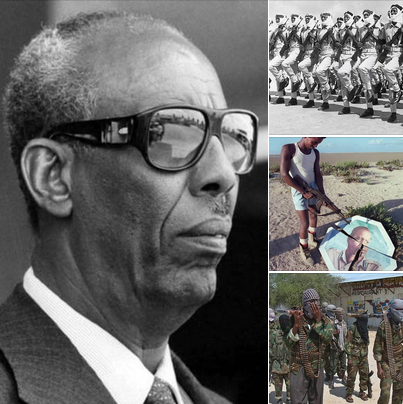

“How the Overthrow of Somalia’s Dictator Siad Barre Turned the Country Into a Failed State”
Somalia was once a vibrant, peaceful parliamentary democracy, often praised as a model for post-colonial Africa, until 1991, when dictator Mohamed Siad Barre was overthrown. Mohamed Siad Barre was Somalia’s second president, ruling from 1969 to 1991. He took power in a bloodless coup following the assassination of Abdirashid Ali Shermarke on October 15, 1969, by one of his own bodyguards.
He abolished parliament, banned political parties, and declared “Scientific Socialism.” In 1972, Barre’s government achieved a historic cultural triumph by adopting an official Latin-based script for the Somali language, which had previously been largely oral. Between 1974 and 1975, the government closed secondary schools and sent over 25,000 students and teachers into rural areas to teach nomads how to read and write.
Barre officially outlawed clanism, replacing traditional clan elders with state-appointed local administrators (“peace-seekers”) and staging public ceremonies where effigies representing “tribalism, corruption, and nepotism” were symbolically buried.
Somalia also had one of the strongest African armies. Backed heavily by the Soviet Union, which gained strategic access to the port of Berbera on the Gulf of Aden, Somalia built one of the largest and best-equipped militaries in sub-Saharan Africa relative to its population.
Under “Scientific Socialism,” Barre nationalised banks, insurance companies, electricity, and major industries while organising farmers and fishermen into state cooperatives. In January 1975, Barre passed a landmark Family Law granting women equal rights in marriage, divorce, and inheritance, sparking mass support from women’s organisations.
Mogadishu was a vibrant cultural hub filled with theatres and state-sponsored musical bands like Waaberi, with women participating openly in sports, education, and civil service.
Sadly, all this changed in July 1977, when Barre invaded Ethiopia to reclaim the Ogaden region. Initially, Somali troops captured most of the territory until the Soviet Union, Somalia’s closest Cold War ally, abruptly switched sides, airlifting weapons and 15,000 Cuban troops to help Ethiopia crush the Somali army in 1978.
Weakened by defeat, Barre survived a 1978 coup attempt and turned towards brutal clan favouritism and repression. When the northern Somali National Movement (SNM) rebelled in 1988, Barre ordered the military to bomb northern cities. Over 50,000 civilians were killed in Hargeisa and Burao, reducing Hargeisa to rubble and displacing hundreds of thousands.
In January 1991, united rebel militias drove Siad Barre out of Mogadishu, ending his 21-year rule, but they didn’t have a plan to govern the country. The victors immediately turned on each other, plunging Somalia into civil war. A catastrophic famine in 1991–1992 killed an estimated 300,000 people.
Amid the chaos in the south, northwestern leaders declared the restoration of independent Somaliland in May 1991, building a peaceful, self-governing democracy that remains internationally unrecognised. In 1998, northeastern leaders formed the autonomous state of Puntland.
In 2006, the Islamic Courts Union restored rare peace to Mogadishu until an Ethiopian military invasion toppled it in December 2006. Out of the insurgency against Ethiopian troops emerged Al-Shabaab, an extremist group that seized much of southern Somalia and banned music, sports, and humanitarian aid.
In August 2012, Somalia established its first permanent central government since 1991, electing academic and civic activist Hassan Sheikh Mohamud as president. In 2017, Mohamed Abdullahi “Farmajo” succeeded him in a peaceful vote, though his 2021 attempt to extend his term by two years triggered street clashes in Mogadishu before he backed down, and Hassan Sheikh Mohamud returned to office in May 2022, as Somalia continued to struggle with insecurity and political instability.
-Victor Adundo