
In Kenya Caleb Orr Signed the $2.5billion but in Zambia he Deferred and Gave a Mere Pledge
America Just Said the Quiet Part Out Loud in Zambia
By Savior Mwambwa.
Three days ago, I wrote in these pages that the scramble for Africa’s critical minerals continues in ernerst and that African governments faced a historic choice about whether to write their own rules or accept terms dictated by others. I did not expect the United States to prove my point quite so rapidly, or quite so brazenly.
On December 11th, the US government was scheduled to sign a Memorandum of Understanding with Zambia releasing $1.5 billion in health funding, including money that keeps HIV treatment programmes running, clinics staffed, and people alive.
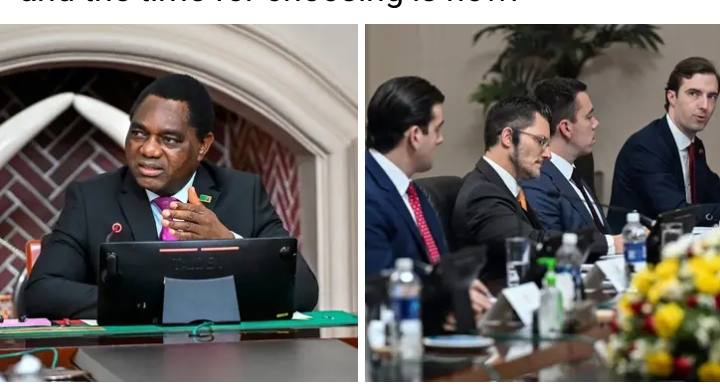
That signing did not happen. Instead, Caleb Orr, the State Department’s Assistant Secretary for Economic, Energy, and Business Affairs, flew to Lusaka to meet President Hakainde Hichilema. The message he delivered was blunt: health funding is now contingent on “collaboration in the mining sector and clear business sector reforms.”
Let that sink in. A US official responsible for energy and business development, not health, now controls the timeline for humanitarian assistance. The signing has been postponed indefinitely while America waits for “clear progress in the coming months” on mining concessions.
Veterans of American global health diplomacy describe this as unprecedented. One called it “uncharted territory.” Another said it was “first of its kind in the world for the Department of State.” The public linkage of humanitarian aid to mineral extraction rights has never been stated so nakedly.
This is not, of course, how American officials would frame it. They would say they are pursuing integrated partnerships that advance mutual interests. They would note that America has always sought collateral benefits from its foreign assistance. They would point out that soft power has always served national interests.
All of this is true, and all of it misses the point. What happened in Lusaka this week is qualitatively different. The curtain has risen on a new era in which access to African resources is not merely a consideration in American foreign policy but the organising principle that supersedes all others, including saving lives.
Let us consider the timing. Zambia, like other countries negotiating these health agreements, received six months of “bridge funding” that expires on March 31st. The Memoranda of Understanding were supposed to be signed in time to plan implementation and ensure continuity of services. That timeline was already compressed. Now it has been blown up entirely, with no clear end date.
What happens to the nurses, the clinics, the supply chains for antiretroviral medicines if April arrives without an agreement? The State Department’s announcement offers no reassurance. It offers only the observation that terms remain to be finalised.
I noted in my previous piece that Zambia had preserved more flexibility than the DRC by not signing a comprehensive strategic partnership with Washington. That observation now requires updating.

Zambia’s flexibility appears to have triggered American displeasure. The abrupt cancellation of the December 11th signing suggests that Lusaka may have pushed back on terms it found unacceptable. If so, the health funding delay is punishment, a warning to Zambia and every other African government about the consequences of resistance.
The juxtaposition with the DRC agreement signed last week is instructive. Kinshasa accepted extraordinary terms: a Strategic Asset Reserve granting US companies first right of offer on mineral concessions, ownership restrictions that will reduce non-aligned (Chinese) participation from 40 percent to 10 percent over twenty years, commitments to route half of copper exports through the US-backed Lobito Corridor. In exchange, DRC received promises of infrastructure financing and security cooperation.
Zambia, apparently, has not yet agreed to comparable terms. And so Zambia waits, while health programmes that keep people alive hang in the balance.
African policymakers must understand what this means for the broader negotiations now unfolding across the continent.
First, the compartmentalisation of American engagement is over. Health, security, trade, and mineral access are now explicitly bundled. Countries cannot negotiate on one track while protecting others. Everything is on the table, and everything is connected to everything else.
Second, the asymmetry of leverage has been made explicit. America controls funding streams that African governments cannot easily replace. Health programmes built over two decades with PEPFAR support have created dependencies that Washington is now prepared to weaponise. The threat is not subtle: cooperate on minerals or watch your health systems deteriorate.
Third, the timeline pressure is deliberate. Bridge funding that expires in March creates urgency that benefits the party making demands. African negotiators are being squeezed between the need to maintain services and the desire to secure acceptable terms. This is not partnership; it is coercion with a deadline.
What should African governments do?
The instinct to capitulate is understandable. Lives are at stake. Programmes that took years to build could collapse in months. The path of least resistance is to sign whatever Washington demands and hope for the best. But capitulation carries its own risks. Terms accepted under duress tend to be unfavourable. Concessions made to one party invite demands from others. And agreements that sacrifice long-term interests for short-term relief rarely serve nations well.
A better approach would recognise that Africa has leverage too, and that collective action multiplies it.
The minerals America seeks are not available elsewhere at the scale required. The green transition depends on African cobalt, copper, lithium, and rare earths. Supply chains cannot be restructured overnight. Washington needs African cooperation as much as African governments need American funding.
Regional coordination is essential. If Zambia stands alone, it can be isolated and pressured. If Zambia coordinates with the DRC, Angola, and other mineral-producing nations, the dynamics shift.
The African Union should convene an emergency discussion on the terms being demanded across the continent. Common positions on ownership restrictions, fiscal terms, and conditionality would strengthen every country’s hand.
Alternative funding sources must be mobilised. The European Union, China, and multilateral institutions all have interests in maintaining African health systems and development partnerships. Diversifying funding reduces American leverage. This is not about choosing sides; it is about preserving options.
Transparency is a weapon. The State Department’s announcement was public because Washington wanted it to be. African governments should be equally transparent about the terms being demanded and the tradeoffs involved. Domestic publics, civil society organisations, and international observers can all influence negotiations when they understand what is at stake.
Finally, African governments must be prepared to accept short-term costs for long-term benefits. This is the hardest calculation. Programmes may suffer. Services may be disrupted. But agreements that mortgage national resources for a generation are not worth signing merely to avoid temporary difficulties.
Emily Bass, the author and global health advocate who first reported the Zambia developments, framed December 11th as “the moment the curtain fully rose on the Trump Administration’s 21st century scramble for Africa.” She is right. But the scramble’s outcome is not predetermined.
Previous scrambles for African resources occurred when African states were weak, divided, and unable to resist external demands. The current moment is different. African nations control resources the world desperately needs. African institutions, while imperfect, are stronger than they were a generation ago. African publics are watching, and African civil society is vocal.
The question is whether African leaders will recognise the moment and rise to it.
What happened in Zambia this week should concentrate minds across the continent. The rules have changed. Health aid is now hostage to mining deals. Humanitarian concern has been subordinated to resource extraction. The quiet part has been said out loud.
African governments can accept these terms, or they can organise to change them. There is no third option. The scramble is on, and the time for choosing is now.