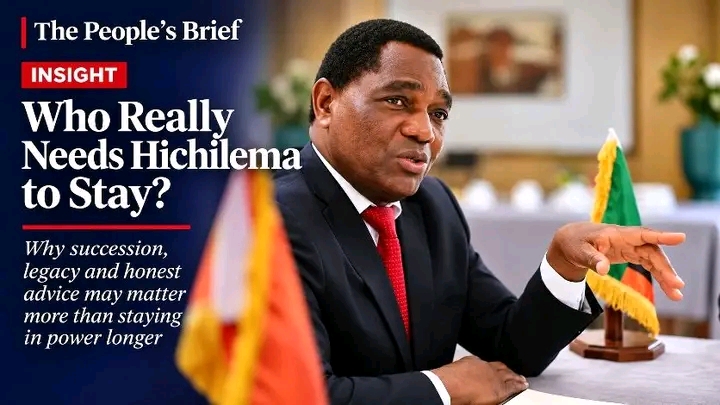

INSIGHT | Who Really Needs Hichilema to Stay?
Every president eventually reaches a point when some of the people around him begin to fear what will happen when he leaves office. For some, the concern is about the future of the country and the political party. For others, it may be about their appointments, influence and access to power. A new president often arrives with new priorities and people. Consequently, the prospect of succession can become uncomfortable for those whose political fortunes depend on the incumbent. The danger begins when these personal concerns are presented as evidence that an entire nation cannot survive without one individual.
Zambia’s ongoing debate about presidential term limits deserves to be examined against this political reality. Strictly speaking, the proposal being advanced is not simply about giving President Hakainde Hichilema a third term. It concerns removing the constitutional restriction that prevents anyone who has twice held presidential office from contesting again. If enacted without alternative limits, such a change would allow future presidents, including Hichilema, to seek election repeatedly. Government maintains that it has not initiated the proposal, while supporters argue that citizens should have the freedom to decide how long an effective leader remains in office.
Hichilema is no newcomer to Zambian politics. He spent nearly two decades in opposition, contested several presidential elections and witnessed the political fortunes of successive governments before finally defeating Edgar Lungu in 2021. Few politicians currently occupying public office have experienced political defeat, opposition pressure and the struggle for State House as extensively as he has. He also understands what happened when Frederick Chiluba attempted to secure a third term in 2001 and when Lungu pursued another presidential term in 2021. His experience gives him considerable knowledge of the political risks associated with prolonged presidential tenure.
What deserves closer attention, therefore, is the advice reaching the President. In an editorial published on 24 November, News Diggers reported divisions within Government and State House over the term-limits debate. According to the newspaper, some influential figures are encouraging Hichilema to remain beyond his second term, while others believe such a course could damage his legacy. The newspaper further alleged that those cautioning against the proposal are increasingly being sidelined. These accounts have not been independently established by The People’s Brief, but they raise an important question about how competing interests influence decisions around political leadership.
Succession has consequences for those who hold positions within a governing party. A new UPND president would bring different relationships, political priorities and possibly a new leadership team. Ministers, party officials and other influential figures cannot automatically assume that their positions would survive such a transition. It is therefore reasonable to examine whether some enthusiasm for removing presidential term limits reflects a genuine constitutional conviction or concern about what might happen when the current President leaves office. Neither possibility should be accepted without evidence, but both deserve consideration.
Political leaders are particularly vulnerable when loyalty becomes confused with agreement. An adviser who believes the President should remain in office indefinitely may be sincere. Another who questions that proposition may be equally committed to the President’s success. If disagreement is interpreted as disloyalty, the leader risks hearing only what those closest to him believe he wants to hear. The resulting political environment can make unpopular but necessary advice increasingly difficult to deliver.
Hichilema’s first term provides a more useful foundation for discussing his legacy than speculation about extending his presidency. His Government introduced free education, expanded the Constituency Development Fund and pursued debt restructuring, among other reforms. Some of these policies have produced visible changes, although unemployment, living costs, electricity supply and household economic pressures remain substantial concerns. Having secured another five-year mandate, Hichilema has an opportunity to demonstrate whether the economic reforms and public investments of his first term can translate into sustained improvements in people’s lives.

His second-term Grow Zambia Agenda places considerable emphasis on investment, productivity, energy generation, industrial expansion and employment. Delivering these commitments will require political attention, effective institutions and sustained execution. A prolonged debate about presidential tenure could compete with that agenda, particularly if political actors increasingly devote their efforts to securing another opportunity for the President to contest rather than implementing the mandate already received.
Zambia has been down this road before. In 2020, Lungu’s Patriotic Front pushed Constitution Amendment Bill No. 10 amid fierce opposition from constitutional lawyers, the Catholic Church, civil society and opposition political parties. Critics warned that the proposed changes would weaken constitutional safeguards and consolidate political power. The controversy was never merely about the individual provisions written into the Bill. It concerned the wider political direction of a Government already facing accusations of concentrating power and weakening democratic institutions.
UPND understood what was at stake and organised its resistance in Parliament. When Bill 10 came before the National Assembly in October 2020, PF secured 105 votes, six short of the required 111. The proposed amendments collapsed. UPND had successfully used parliamentary strategy to frustrate a constitutional project that the governing party had invested considerable political capital in promoting.
Lungu nevertheless proceeded with his controversial presidential eligibility bid. The Constitutional Court cleared him to contest the 2021 election despite widespread objections that he had already held presidential office twice. For many Zambians, the decision reinforced concerns about the independence of institutions under a Government already criticised for its handling of democratic freedoms. In December 2024, the same Court departed from its earlier interpretation and ruled that Lungu had twice held office and was constitutionally ineligible for another presidential election.
But Lungu’s greatest political judgment came from the electorate in August 2021. By then, public resentment had been building for years. Independent media had faced closures and restrictions, PF cadres had become notorious for intimidation and political violence, and critics increasingly described Lungu’s style of governing as authoritarian. His insistence on contesting again, despite the controversy surrounding his eligibility, became another source of public frustration.
When Zambians finally voted, they delivered a crushing defeat to the sitting President. Hichilema won by nearly one million votes, ending Lungu’s presidency despite the considerable advantages of incumbency. The result was more than an ordinary change of Government. It reflected accumulated public anger over the direction in which many voters believed the country had been taken. Lungu had secured the legal clearance he needed to appear on the ballot, but he could not secure the public support needed to remain in State House.
That experience offers a lesson for every president. Constitutional procedures, political influence and control of public institutions cannot manufacture public affection. A leader may have significant achievements, but when citizens begin to believe that political power has become an end in itself, those achievements can be overshadowed by resentment. Zambian voters have demonstrated that they can decisively reject an incumbent, regardless of the confidence displayed by those surrounding him.
On 24 November, the Jesuit Centre for Theological Reflection added another dimension to the present controversy. JCTR called for retaining presidential term limits and proposed amending Article 79(3) to require a national referendum before Article 106 can be changed. Its argument is that presidential tenure should be protected by enduring constitutional safeguards rather than the preferences of whichever political party commands sufficient parliamentary influence. Other religious organisations may disagree, but the recommendation raises a question that extends beyond Hichilema’s presidency.
There is also an important lesson in how political parties survive their founders and influential leaders. Tanzania’s Chama Cha Mapinduzi has remained in power through successive presidents, from Julius Nyerere and Ali Hassan Mwinyi to Benjamin Mkapa, Jakaya Kikwete, John Magufuli and Samia Suluhu Hassan. Tanzania’s record is not without serious democratic controversies, particularly concerning electoral competition and opposition freedoms. Nevertheless, CCM’s continued existence across successive presidencies demonstrates that a governing party can preserve its political identity without depending permanently on one leader.
This is particularly relevant because Hichilema has repeatedly expressed his desire for UPND to outlive him. At the opening of the party’s Southern Province secretariat in Choma, he spoke about building a political organisation that future generations would continue to appreciate. Giving practical meaning to that ambition would involve developing capable leaders, strengthening internal democracy and establishing a credible succession process. Such a transition would also test whether UPND’s political programme has become sufficiently institutionalised to survive beyond the individual who led it into Government.
A successor would not necessarily abandon everything Hichilema has achieved. Political parties can maintain programmes across successive leaders, particularly where their policies enjoy public support and are supported by effective institutions. Succession also creates opportunities for renewal, accountability and new approaches to unresolved national challenges. The assumption that development must stop when a particular president leaves office deserves scrutiny because it places the future of an entire country on the continued availability of one individual.
Ultimately, the question is not whether Hichilema is capable of governing beyond his second term. It is whether Zambia’s long-term interests, UPND’s future and the President’s own legacy are best served by making his continued presidency the centre of national political discussion. His experience in opposition, knowledge of Zambia’s political history and expressed commitment to building an enduring party provide substantial grounds for examining the alternative of an orderly succession.
Hichilema spent many years fighting for the opportunity to govern Zambia. His second term offers an opportunity to demonstrate what that struggle was ultimately about. A lasting legacy would be measured not only by what he delivers while occupying State House, but also by the institutions, policies and leadership capable of continuing after his departure. The political question is whether those advising him are thinking about that future, or primarily about their own place within it.
The People’s Brief | Ollus R. Ndomu
25 November 2026