
GUEST ARTICLE: MY REFLECTIONS ON THE LACK OF UNITY IN THE ZAMBIAN MEDIA TODAY
By Sipo Kapumba, Journalist
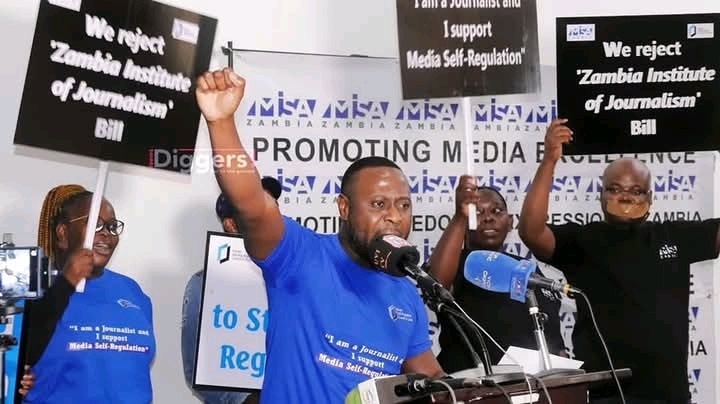
I have just learnt that today, 3rd May 2025, there are two World Press Freedom Day marches, the one by Media Liaison Committee (MLC) and the other by media owners, heading in different directions.
In my time as an active journalist and media freedom advocate at MISA Zambia, we managed to unite the entire media fraternity. PAZA, MISA Zambia, ZAMWA, ZUJ and ZUBID, retained their uniqueness, but we were united in the fight for an amended ZNBC Act, lobbying for an IBA Act and lobbying for the Freedom of Information Act, which was later called an Access to Information Act.
We marched together, journalists’ associations and media owners. Media owners like Fred M’membe and Erol Hickey, would join the marches and be with us.
Bosses, even from the public media, would be present, or would send their representatives. It was beautiful.
May 3, usually a lovely, bright, but not hot day, was ideal for marches. I always looked forward to that day.
Today, I am saddened that that unity has been lost. The media owners have gone it alone with MISA Zambia. The workers have taken a different direction under MLC.
MLC was never meant to be a registered entity. It was a coalition. A gathering of like-minded individuals and institutions, meant to fight for specific causes. It was never meant to be a registered association. Its strength came from the unity of its registered, individual, coalition members.
I could be wrong, but it seems to me as though MLC is now a registered entity. That is a departure from the original spirit and intention of the coalition.
MLC was born out of a protest, maybe in 1997, against the statutory Media Council of Zambia Bill, which was published by the Chiluba, MMD government. They wanted it to be law.
The media were opposed to it, and we united under a coalition called Media Liaison Committee (MLC), led by veteran journalist Robinson Makayi, who ran an entity called Media Resource Centre. We united to protest against the bill. The protest worked. Government withdrew it.
Intensified, self-regulation efforts ensued after that. MISA Zambia and PAZA brought their separate, self-regulatory mechanisms under one umbrella. The effort failed, but an attempt was made.
The script has changed now. MLC, which was against statutory regulation, wants it. I also want it. I don’t think non-statutory, self-regulation can work. We tried it and failed. It has failed in the UK, the spiritual home of non-statutory, self-regulation.
The media owners are now big and powerful. Their interests and those of the majority of their workers, are at variance.
MISA Zambia is the only, remaining, serious media NGO. The others have died, or they are comatose.
MISA Zambia has lost it somewhere. It was a movement of activists. Now, it is siding with media owners, neglecting the individuals who gave it vibrancy in the past.
MISA Zambia is not a militant organisation anymore. It has become fat and lazy.
MISA Zambia’s spirit came from its activist members, including media owners like Fred M’membe and Erol Hickey.
Perhaps the split in the media started when The Post left MISA Zambia in the later parts of the 1990s, maybe early 2000s, to formalise The Press Freedom Committee (PFC) of The Post newspaper. It was a breakaway group.
The Post left MISA Zambia when journalists, who were freelance, or working for smaller members of MISA Zambia, seized power in MISA Zambia. The balance of power had shifted from the “mighty” Post, to smaller and individual members of MISA Zambia.
This was at a MISA Zambia AGM at the Oasis Restaurant, where Arcades Shopping Mall sits today. Maybe that was 1998?
Whatever the case, political interests began to permiate into media activism with the establishment of the PFC of The Post. The Post sought to influence media advocacy with the PFC as an independent member of MLC.
With the demise of The Post and further changes in the governance arena, media interests have changed.
PAZA is dead. ZUJ is mute. ZUBID is moribund. ZAMWA exists only in the memories of people like me.
MISA Zambia is the only remaining entity from the golden era, from 1996 to 2011, when a lot was achieved in media law reforms, through a unity of purpose.
I was there. I was instrumental in building that unity. That is how I came to know Amos Chanda, who was with ZUJ as General Secretary, then with PAZA, rising to the position of President.
It saddens me that the media is deeply divided. Differences over salaries, between the media owners and the workers, are largely responsible for the split.
Times have changed. Interests have changed, but we should not lose focus on common interests. The Zambian media is in a mess. There is need to address issues of professionalism and ethics. Who is a journalist. How do we balance freedom of expression with the need to report truthfully in an era of social media and now, Artificial Intelligence?
I believe that journalism is a manifestation of the constitutional right to freedom of expression, within agreed and time-honoured traditions, or practices. That is what distinguishes the journalism profession from citizen journalism, like the one practiced by Simon Mwelwa Lane (Chitambala Mwelwa), which is technology driven.
We need to advance the journaliam profession. We need to have minimum professional standards which can be enforced. The media fraternity needs to agree on the why and how of effective self-regulation.
Non-statutory, self-regulation is a joke. A bad one for that matter. It is dishonest. It is a bunch of lies promoted by media owners to escape responsibility in reporting.
I have spoken from my heart.
Happy World Press Freedom Day.
Sipo Kapumba
Journalist