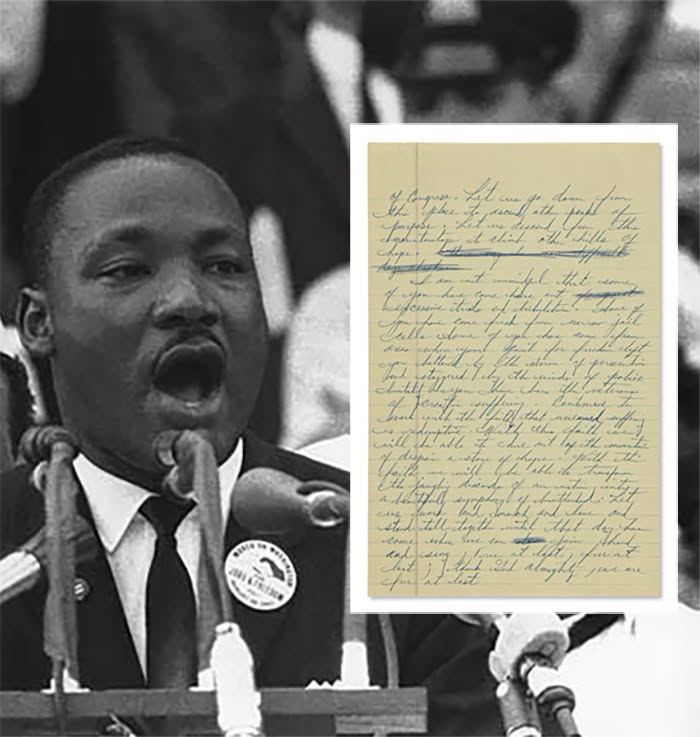

Dr. Martin Luther King Jr.’s handwritten final draft of his historic “I Have a Dream” speech has resurfaced decades after someone placed it in a desk drawer. The seven-page document, believed to be the only surviving handwritten final draft, will go up for auction in New York in January and could sell for more than $10 million.
The auction house Christie’s announced that the rare document will be offered as a single lot, with proceeds supporting several charities, including the King Center in Atlanta. According to The Guardian, the auction house will also display the document to the public from Jan. 15 through Jan. 21, giving visitors a chance to see the original handwritten pages before the sale.
The draft once belonged to Edward T. Clayton, a former aide and trusted speechwriter who worked with King. His widow, Xernona Clayton, first came across the pages in a desk drawer in the late 1990s. She did not know they were the only known handwritten final draft of the speech, so she returned them to the drawer. She found them again in 2024, when experts examined the document and confirmed its rarity.
King wrote the final version in the early hours of Aug. 28, 1963, while staying at the Willard Hotel in Washington, D.C. He used blue ink to write across seven yellow legal pad pages after spending several days discussing his remarks with advisers. He also focused on keeping the speech to around five minutes, carefully considering his word choices and how each section flowed. Later that day, he delivered the speech during the March on Washington for Jobs and Freedom, where hundreds of thousands of people gathered to demand racial equality and an end to discrimination. The handwritten pages contain edits and crossed-out passages that offer a closer look at how he prepared his remarks.

One detail that makes the original draft particularly interesting is the absence of the phrase “I have a dream.” Christie’s explained that King added those famous words spontaneously while delivering the speech before the crowd. The phrase later became the most recognizable part of his address, which is widely regarded as one of the most important speeches in American history.
Peter Klarnet, a manuscripts specialist at Christie’s, said the document allows people to see how King developed and revised his message before delivering it. “It gives you chills to look at it. Reading along, you’re there in the moment with Dr King, watching him compose it and making edits in real time,” he said. Martin Luther King III also addressed the discovery, describing the decision to direct auction proceeds toward charitable organizations as “poetic that the past will protect the future.”