
NO CHILD MUST STAY OUT OF SCHOOL BECAUSE OF HUNGER – PRESIDENT HICHILEMA
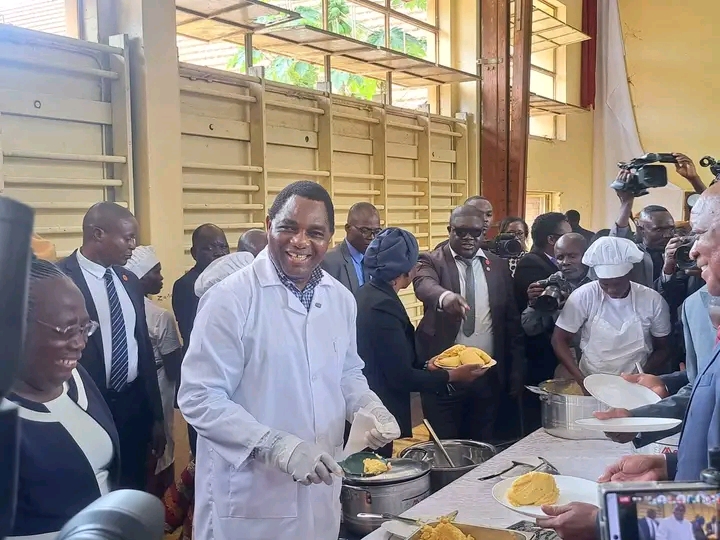
TODAY, President Hakainde Hichilema graced the implementation of the School Feeding programme at Kabulonga Boys Secondary School.
Below are the highlights:
✅️ Described education as the most fundamental sector in Zambia’s transformation agenda noting that his administration’s reform agenda is being executed methodically across key sectors of the economy.
✅️ Indicated that Government has deliberately reclassified education from being viewed merely as a ‘social sector’ to being treated as an economic investment.
✅️ Described education as the greatest inheritance any society can give its children, warning that wealth without knowledge often dissipates within a generation, while education sustains families and nations across decades.
✅️ Stated that upon taking office in 2021, President Hichilema immediately exercised constitutional authority to abolish examination fees to prevent pupils from being blocked from graduating.
✅️ Disclosed that by the end of this year, Government will have recruited nearly 48,000 teachers within five years, a figure the President contrasted with cumulative recruitment under previous administrations.
✅️ Indicated that the School Feeding programme has been rolled out countrywide to avoid to discrimination by geography.
✅️ Noted that the programme is being positioned as an economic catalyst noting that no child must stay out of school because of hunger
✅️ Called for stronger coordination between the Ministries of Education, Agriculture and Livestock to ensure food supplied to schools is sourced locally.
✅️ Meanwhile, President Hichilema pledged, in his personal capacity, to donate durable food plates to pupils at Kabulonga Boys after observing disparities in the quality of utensils learners brought from home.
✅️He said no pupil should feel less than the one next door, reinforcing his administration’s commitment to equal treatment regardless of background.
✅️ Warned that excluding young people from school risks long-term social instability, citing early pregnancies, child marriages and delinquency as consequences of systemic neglect.
MIM