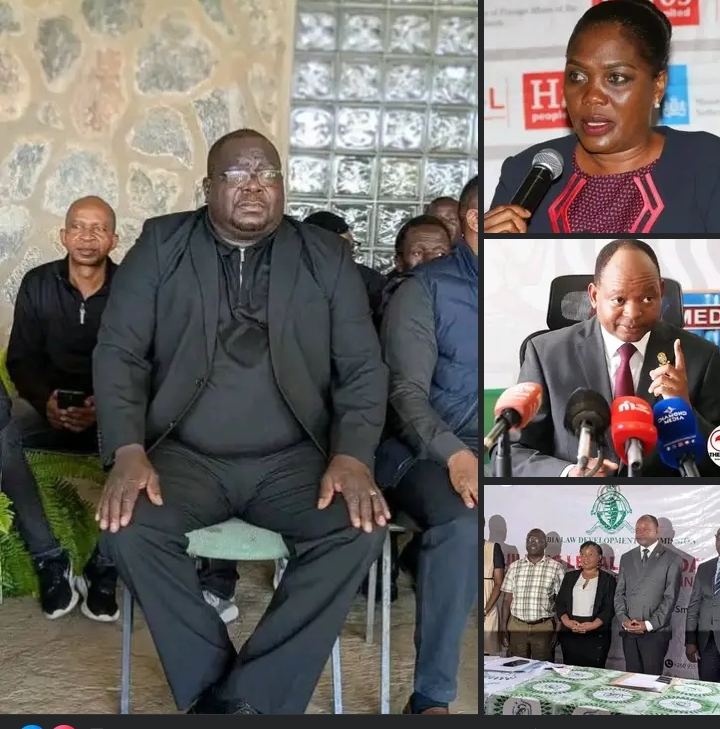

MATTERS ARISING | Political Heat Rises as Bill 7 Fractures Institutions & Alliances
The constitutional debate moved into an even sharper phase on Friday following a new round of statements from key actors on opposite sides of Bill 7. What began as a legal and procedural contest has evolved into a multi-front political confrontation involving civil society, the executive, the legislature, opposition blocs and professional bodies such as the Law Association of Zambia.
This week closes with deeper polarisation, hardening rhetoric and open questions about the path forward.
The strongest signal came from Oasis Forum Chairperson Beauty Katebe, who on Thursday hosted a consortium of opposition presidents at her offices. In remarks that were blunt and unusually political for a civil society platform, she told the opposition to resolve their leadership confusion before the 2026 election cycle is lost.
“We are looking at you, we are watching you, we are seeing the confusion that is there and we are worried as Zambians,” she said, adding that the ruling party is taking advantage of what she described as a fragmented opposition field.
She went further, urging them to settle on one presidential candidate:
“For as long as you all remain presidents and appear on that ballot paper, I can assure you, votes will be split.”
Her statement drew immediate political interpretation. State House Political Advisor Levy Ngoma privately characterised her remarks as “broadly political”, arguing that the Oasis Forum is drifting into overt political space.
This is consistent with the UPND’s emerging narrative that the Forum is no longer a neutral actor in the constitutional debate.
The same Thursday, Chief Government Spokesperson Cornelius Mweetwa responded sharply to remarks by PF presidential hopeful Chishimba Kambwili, who warned that MPs who vote for Bill 7 could face arrest in a future regime.
Mweetwa dismissed the threat as reckless, stating:
“Legislative processes fall within the law. They cannot be criminalised. We are governed by constitutional provisions, not emotional reasoning.”
This was a direct counter to Kambwili’s claim that Bill 7 is unconstitutional and a political trap for MPs.
In parallel, the Law Association of Zambia (LAZ) entered the field with one of its most forceful statements since the Bill 10 era. LAZ President Lungisani Zulu warned of a possible constitutional crisis, stating that both the Government and the National Assembly must “immediately withdraw” Bill 7 because its reintroduction violates a standing Constitutional Court ruling.

He added: “Disregarding the Constitutional Court’s directives poses grave risks to our constitutional democracy. When leaders tasked with upholding the Constitution ignore it, public trust erodes.”
LAZ’s intervention places renewed pressure on Parliament, which resumed consideration of Bill 7 on Tuesday.
The atmosphere was further complicated by remarks from PF Acting President Given Lubinda, who resurrected the Bill 10 history while standing beside Katebe. He argued that the UPND, which rejected Bill 10 on grounds of inadequate consultation, cannot now defend Bill 7 whose process he described as “highly shambolic”.
Lubinda challenged the ruling party’s consistency, stating: “If you were sincere then, you must be sincere now.”
Other opposition leaders echoed warnings that passage of Bill 7 would require future governments to “undo” the amendments, signalling a long political fight even if the Bill secures the required two-thirds majority.
Meanwhile, the litigation front escalated as Munir Zulu and Celestine Mukandila filed a sweeping petition in the Constitutional Court, seeking to summon the Speaker, her deputies, the Clerk and all MPs for alleged contempt linked to the Bill’s reintroduction.
This marks one of the broadest legal challenges to Parliament in recent memory.
Through all this, the arithmetic inside the House remains the decisive battlefield. With UPND holding ninety-seven MPs without including allied independents, and small-party MPs while visible fractures in the PF Lubinda bloc continue to mount within the PF base with some of its MPs expected to cross the aisle when the final vote is taken.
This fear explains the sharp internal attacks seen on social media, where PF supporters have begun naming members of the Select Committee as potential “sellouts”.
State House, sensing momentum, has demanded that the consortium of opposition leaders submit clause-by-clause objections by Sunday, 7 December.
Clayson Hamasaka said: “The opposition letter condemns Bill 7 but does not point to a single clause. We now invite them to demonstrate the same clarity Hichilema showed during Bill 10, if they can.”
The line is a deliberate rhetorical contrast between President Hichilema’s targeted objections to Bill 10 and what State House portrays as vague political theatre from current opposition parties.
By Friday evening, Zambia stands at a junction where law, politics, procedure and public perception are colliding. Bill 7 has become more than a legislative item. It is now a test of political organisation in the opposition, a test of institutional coherence for civil society and a test of constitutional stewardship for the Government.
The coming days will determine whether the debate sharpens into confrontation or matures into structured negotiation. What is clear is that the national mood has shifted.
© The People’s Brief | Gathering —Mwape Nthegwa; Drafting —Ollus R. Ndomu; Verifying —Tracy Shumba
Bill 7 must Pass…
Chapwa…
The Opposition are not stating What is wrong with it, they are just hallucinating…
I see why crossing of legs is encouraged