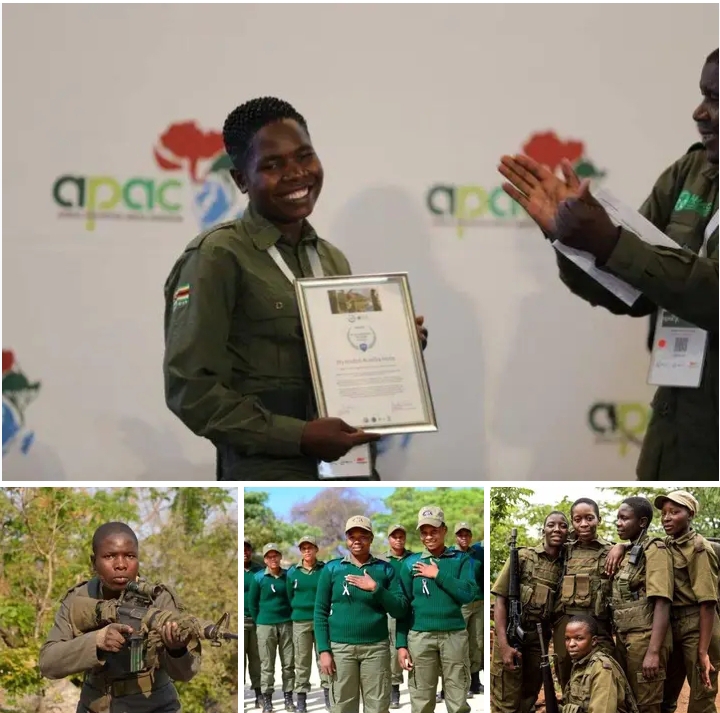

She Faced A Lion At 10 Metres And Didn’t Run – Meet Zimbabwe’s Fearless Female Ranger
Nyaradzo Hoto Makes History
Growing up in a ‘poor’ family in Zimbabwe’s Zambezi Valley, Nyaradzo Auxilia Hoto struggled to pursue her education. After leaving a marriage she describes as violent, she returned to her parents’ home with her daughter, uncertain about what would come next.
In 2017, she became one of the first 16 women recruited by Akashinga, an all-female anti-poaching initiative. She went on to command rangers, earn a university degree and become a biodiversity officer responsible for analyzing wildlife data.
As governments prepare to assess progress toward global biodiversity goals at COP17 in Armenia, Hoto’s journey offers a glimpse into the opportunities conservation can create for rural African women.
For Hoto, one of the most memorable moments of becoming a ranger was a trip to town in her new uniform to open a bank account. “We were very proud,” she recalled.
Hoto, 34, grew up in Huyo village in the Lower Zambezi Valley, where her family survived by gardening and selling vegetables. Money was scarce. Although she was bright at school, she only completed secondary education. Marriage, she hoped, might offer a better life.
“I thought I had found a good man,” she said. “But little did I know I was getting myself into fire.” She endured nearly four years of violence before leaving with her daughter and returning to her parents’ home.
For almost four years she hid what was happening. “Whenever they asked, I would say everything is fine. But deep down I was wounded.” An uncle finally helped her find the courage to divorce.
“I had no job, and I had to look after myself and my daughter,” she said. “I didn’t imagine my life would change.”
Her fortunes changed in 2017, when the International Anti-Poaching Foundation began recruiting local women through traditional leaders. Nearly 100 women applied for 16 places. Many men in her community mocked the idea. “You can’t do this job. How can you arrest a man when you are a woman?”
She went anyway. “If I fail, I fail. If I win, I win.”
That sisterhood helped them survive tough training. “We were women from different villages. But we treated each other like sisters. If someone wanted to quit, we would encourage her.” No one quit.
Her first patrols were frightening. In one encounter, she came face to face with a lion at just 10 meters.
“That was one of my scariest experiences. We thought our lives were gone,” she said. But training kicked in. “We were taught not to run. You cannot outrun a lion. We had to face it and remain firm, while slowly moving backward.”
The lion eventually walked away. In another early deployment without instructors, her team emerged from thick vegetation to find elephants.
Her happiest memory was rarer: seeing a pangolin on patrol. “When I was growing up, if someone found a pangolin, they would take it to the chief. For me, seeing that pangolin reminded me why our work was important.”
The first poachers she arrested were subsistence poachers hunting for food. They resisted women at first. “But during our training, we were taught that arresting poachers should not be about fighting the community. We should use those encounters to educate people.”
In 2019 she was promoted to sergeant. “I didn’t know what my superiors had seen in me,” she said. Leadership taught her to listen. “If you’re sitting in an office, you don’t know everything happening on the ground. And as a leader, you must also help other people become leaders.”
Akashinga supported her to return to school. She enrolled part-time at Chinhoyi University of Technology. For four years she juggled ranger duties by day and schoolwork by night, often sleeping four hours. She graduated in 2023 with a degree in wildlife, ecology and conservation, and was promoted to biodiversity officer.
“When rangers go on patrol, they record animals they see, signs of animals. We analyze the data to understand where animals are found and how they move. That helps with patrol planning,” she explained.
The change in wildlife is visible. As a child, she knew animals from books, not real life. Now, elephants come close to camp and stay to feed.
Globally, women account for just 3-11% of the ranger workforce. Hoto’s path offered financial independence and leadership, but challenges remain.
“Not everyone supports what we’re doing. Some still believe animals should be hunted,” she said.
She also says communities need a real say. Recently Akashinga invited village leaders to assess its management.
Looking back, the biggest change is internal. “When I had just divorced, I didn’t have confidence. Now, I can stand in front of a thousand people and speak. I have even given a TED Talk.”
She is mother to two daughters, now 14. She wants women facing hardship to know: “No situation is permanent.”
To women wanting to enter conservation: “Don’t be afraid. Ranger work is tough. But if someone else has been able to do it, you can also try. Animals cannot speak, but we can speak for them.”
In 10 years, she hopes to follow her inspiration, Moreangels Mbizah, who leads Wildlife Conservation Action in Zimbabwe.
“I don’t want to remain a biodiversity officer forever. I want to keep growing.”