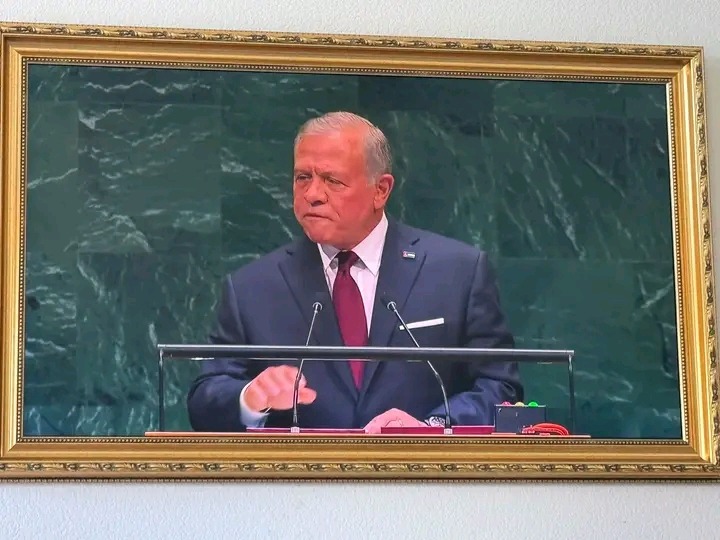

Summary of King Abdullah II of Jordan’s UN General Assembly speech, focusing on global and regional security:
1. “Attention is more than a cognitive resource. It is a geopolitical one.” Abdullah argued that conflicts can worsen when international attention moves elsewhere, allowing diplomacy, humanitarian action and accountability to disappear with the headlines.
2. He directed some of his strongest criticism at the Israeli government. Abdullah accused it of continuing attacks and destruction in Gaza, refusing to withdraw and restricting Palestinians to a shrinking portion of the territory. He characterized this as an attempt to “erase Palestinian life and impose a new territorial reality in Gaza.”
3. He accused Israel of pursuing forced displacement in the West Bank. Abdullah argued that settlement expansion, settler violence and Palestinian displacement should not be understood as isolated incidents. He described them as elements of a policy intended to compel Palestinians to leave their land, which he called “forced displacement” and a “war crime.”
4. He argued that Gaza and the West Bank are parts of the same Israeli strategy. In his formulation, Gaza is being transformed through destruction while the West Bank is being transformed through what he called “de facto annexation.” He said the objective is to make a viable Palestinian state impossible.
5. He accused the Israeli government of acting with impunity. Abdullah argued that the international community possesses tools such as sanctions, asset freezes, embargoes and diplomatic isolation but has not applied comparable pressure to Israel. In his words, with Israel, “resolutions end where they began, on paper.”
6. He rejected the claim that the Arab world has never offered Israel peace. Abdullah cited the 2002 Arab Peace Initiative, which offered normalization in exchange for peace and Palestinian statehood, and argued that the obstacle has been the absence of an Israeli government willing to accept that framework.
7. He accused the Israeli government of trying to portray the conflict as a religious war. Abdullah rejected a framing of Muslims versus Jews and Christians, arguing instead that the fundamental question concerns whether Palestinians, both Muslim and Christian, receive equal rights.
8. He warned that Israeli policy is becoming a regional-security threat. In some of his strongest language, Abdullah said the Israeli government’s “expansionist appetite is now a regional threat.”
9. He specifically warned Israel over southern Syria. Abdullah accused Israel of repeated incursions, territorial expansion and creating new realities on the ground, including around important water resources. He argued that Israel was testing how far it could proceed without an effective international response.
10. He drew a clear Jordanian national-security line. Abdullah declared: “Any threat to our northern border or our water security is a threat to our national security. Jordan will not look away.”
11. Despite those warnings, he reaffirmed Jordan’s commitment to diplomacy and a negotiated peace. Jordan, he said, would continue supporting Palestinian resilience, UNRWA, the two-state framework and the historic status quo at Muslim and Christian holy sites in Jerusalem.
12. His broader global-security argument was that military force cannot create sustainable political solutions. Conflicts ultimately require legitimate institutions, enforceable rules, diplomacy and trust between states.
One line summarize the speech particularly well:
“The future is shaped not only by what we do, but what we choose to ignore.”
– Tapang Ivo Tanku