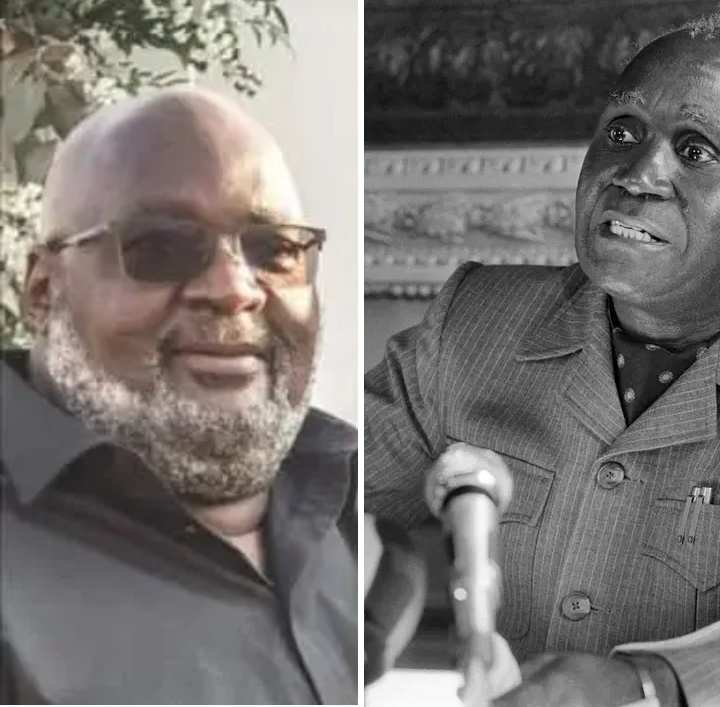

THE DEATH SENTENCE GIVEN TO KKs SON, KAMBARANGE MPUNDU KAUNDA THREE WEEKS BEFORE THE ELECTIONS CONTRIBUTED TO HIS LOSING IN 1991-‘I order that you be hanged by the neck until you are pronounced dead,’ Lusaka high court Judge, Claver Musumali told Kambarange Kaunda, stunning the court.
Kambarange was arrested for the murder of the 19 year old girl on 9th August, 1990 following an inquest into the 1989 shooting. He was later convicted and sentenced to death by hanging.
After the judgement Kambarange’s defense lawyer, Richard Ngenda, immediately told reporters outside the court that he would appeal against the sentence.
‘We will fight on,’ Ngenda said (UPI archives, 1991)..
Kambarange was KK’s last and fourth born son, born in 1964, as a twin with his sister Cheswa. He was a charter pilot and 28 years old when he was facing this murder case.
The story was that while driving in a suburb of Lusaka, a group of people threatened him and blocked the road he was driving on; prompting him to fire at them, resulting in the death of Tabeth Mwanza.
Initially, Kambarange was charged with manslaughter but Judge Musumali changed the charge to murder. Musumali found that Kambarange had fired seven shots at a group of people, killing 19-year-old Tabeth Mwanza.
Regardless, Kambarange pleaded not guilty. He insisted that he had fired in self-defense when a group of people threatened him and blocked the road. Though Judge Musumali rejected Kambarange’s defense in his judgment, saying that Kambarange acted with malice aforethought and unlawfully.
This sentence came barely three weeks before the 1991 general elections. Otherwise, Tabeth’s father was pleased with the sentence.
At the time of Kambarange’s conviction, his father president Kenneth Kaunda said he would not intervene in the process of justice. ‘It is a matter for the courts. It is not for me to say,’ Kaunda senior said ( The New York Times Archives- 15 October, 1991).

Justice delayed is justice denied.
After KK had left office, on 19th March, 1992 Kambarange, who had been sentenced to death by Lusaka’s High Court a year earlier in 1991 for murder: was acquitted in the Supreme Court. The acquittal followed an appeal against the sentence by Kambarange’s defense lawyer, Richard Ngenda. Justice Annel Silungwe told the court that Kambarange Kaunda, acted in self-defense when he shot and killed Tabeth Mwanza in 1989.
‘The appellant acted in self defense, the conviction is quashed, sentence is set aside and the accused is acquitted,’ Silungwe told a packed courtroom ( UPI Archives, 1992).
KK might have had his own leadership weaknesses, but somehow; this case shows that courts operated independently.
Today, we have a number of high profile murder cases and judgement is not passed. It’s adjournment after another. Regardless, the biggest lesson in this article is a question to us all: if Kambarange was found not guilty by Supreme Court, then how many ordinary Zambians have faced injustice because they never took their cases further?
Copyright ©️ Shipungu 2025
If my memory serves me right, a key element in Judge Musumali’s verdict was that Ms. Tabeth Mwanza was shot in the back, which clearly indicated that she was fleeing from Mr. Kambarage Kaunda and therefore posed no threat to the accused.
For context, the author should have given the location where this incident took place.