The Legal and Historical Context Behind Former President Edgar Lungu’s Security Withdrawal
By : Hamunkoyo Tobbius
The ongoing debate surrounding former President Edgar Lungu’s security situation has been clouded by misinformation and political maneuvering. It is essential to understand the legal and historical context to grasp why Lungu’s security has been withdrawn and why this decision is in accordance with Zambian law very important.
Under section 5(1) of the Benefits of Former Presidents Act, Cap 15 of the Laws of Zambia, former presidents are entitled to various benefits, including security. However, these benefits are contingent upon the former president refraining from active politics. This clause is critical in maintaining the neutrality and non-partisanship expected from former heads of state, ensuring they do not exploit their previous positions for political gain.
This is not the first time a former Zambian president has faced the withdrawal of benefits due to political re-engagement. In 2001, after his failed bid for a third term, President Fredrick Chiluba handpicked Levy Mwanawasa to run for president. Mwanawasa’s victory in the disputed election led to a unique political scenario where Chiluba, despite being a former president, continued to engage in active politics as the president of the Movement for Multi-Party Democracy (MMD).
This led to a significant legal challenge. UPND vice presidents Sakwiba Sikota then, Bob Sichinga, and Dipak Patel petitioned the High Court in 2002 to withdraw Chiluba’s retirement benefits. High Court Judge Anthony Nyangulu issued an interim order to suspend Chiluba’s benefits, highlighting the contravention of section 5(1) of Cap 15 due to his active political role. Chiluba eventually resigned from his position in the MMD to have his benefits reinstated, prioritizing his retirement perks over his political ambitions.
A similar situation occurred with Rupiah Banda, who, after being defeated by Michael Sata, contemplated a return to active politics. The Patriotic Front (PF) ministers warned Banda that such a move would jeopardize his retirement benefits, as it would violate the same legal provision. Banda wisely chose to remain in retirement, thus retaining his benefits.
In 2023, Edgar Lungu announced his return to active politics as the president of the Patriotic Front (PF), after initially retiring. This move, influenced by internal party dynamics and leadership challenges, directly contravened the legal stipulations of the Benefits of Former Presidents Act. Consequently, the current government, adhering to the law, withdrew Lungu’s benefits, including his security detail.
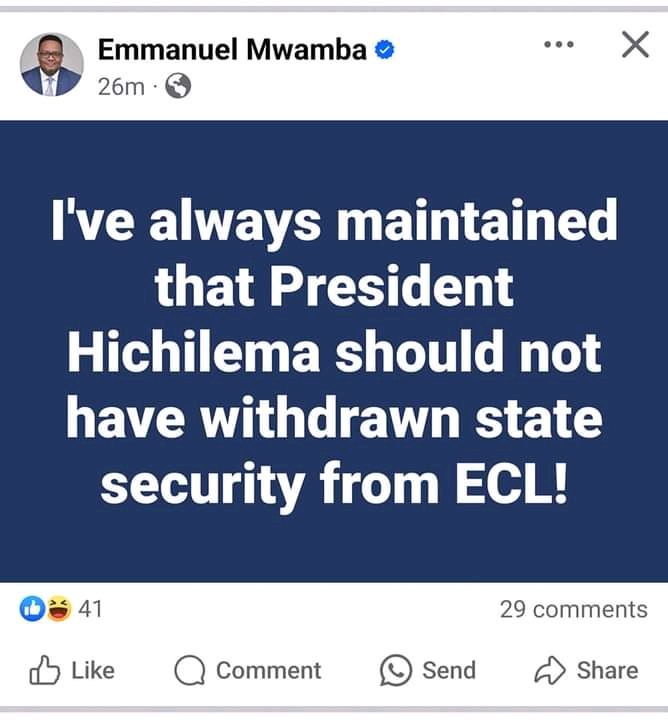
The assertion by some UKA/PF members that President Hakainde Hichilema and his government are personally withholding Edgar Lungu’s security is a not only a misrepresentation but misguiding the general public and Zambia at large. The withdrawal of benefits is a legal matter, not a political vendetta. The law clearly states that former presidents engaging in active politics forfeit their entitled benefits, a principle applied consistently in Zambia’s political history.
The situation with Edgar Lungu is not unique but rather a continuation of Zambia’s legal tradition to ensure that former presidents remain non-partisan. The cases of Fredrick Chiluba and Rupiah Banda set clear precedents. Lungu’s loss of security benefits is a consequence of his choice to re-enter politics, not an arbitrary decision by the current administration. Understanding and respecting the law is crucial in this matter, as it upholds the integrity and neutrality expected from former heads of state in Zambia.
These are benefits that a former President forfeits when back in active politics :
1. An office.
2. One personal secretary.
3. Three security persons.
4. Three cars, with free maintenance, and petrol entitlement to the extent determined by the
Cabinet, but only one car for the surviving spouse.
5. Three drivers, but only one for the surviving spouse.
6. One Administrative Assistant, who shall be at the level of Deputy Permanent Secretary.
7. Three house employees, which number may be increased by Cabinet.
8. A diplomatic passport for the former President and his spouse.
9. A furnished house built or bought in Zambia by the State at a place of the former President’s
choice and ownership of the house shall be transferred to him.
10. Medical insurance for the former President and his spouse.
11. In each year, one return air ticket for the former President and one for his spouse.
12. Funeral Expenses on his death.
Concerned Citizen,
Advocating top-notch Governance
, Legal learner, Lab Scientist , Public Speaker, Author, Rights & Positivity advocate