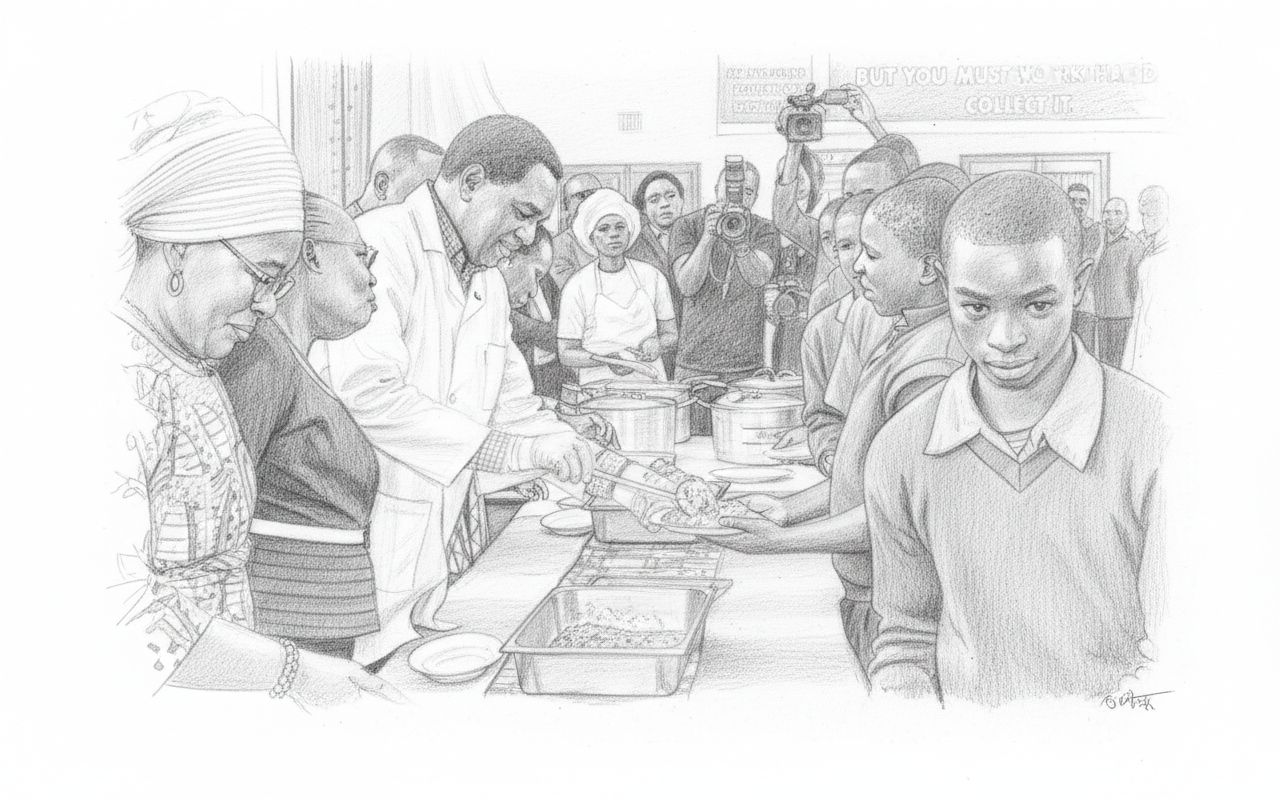

THE SCHOOL FEEDING PROGRAMME IS NOT CHARITY. IT IS STRATEGY.
Some critics have found a clever line.
“Stop giving fish. Teach them how to fish.”
It sounds wise. It sounds disciplined. It sounds like something you would frame and hang in a business seminar.
But here is the problem.
You cannot teach a hungry child how to fish.
A child who has not eaten is not thinking about economic theory. They are thinking about nshima. They are thinking about whether the stomach pains will stop. They are thinking about how to survive the school day.
And when we say government must first “improve the economy so parents can thrive,” we are pretending that national transformation happens in one budget cycle.
It does not.
Let us step back and speak plainly.
The School Feeding Programme is not about handouts. It is about keeping children in class long enough to become the fishermen critics dream about.
You do not build a productive workforce on empty stomachs.
EVEN RICH COUNTRIES FEED THEIR LEARNERS
Some Zambians speak as though feeding children is a sign of poverty. As though it is something done only in struggling economies.
Let us look at countries that have already “learned how to fish.”
UNITED STATES
The United States runs the National School Lunch Program, feeding tens of millions of children every single school day. Not because America is poor. Not because parents cannot work.
But because research shows children learn better when fed.
The richest economy on earth still provides food in public schools.
Are Americans refusing to teach their children how to fish?
UNITED KINGDOM
The United Kingdom provides free school meals for millions of pupils. Even during economic hardship, the programme is expanded rather than cut.
Why?
Because education policy in serious nations understands one fact. Nutrition is part of learning.
You cannot separate them.
FINLAND
Finland, regularly ranked among the best education systems in the world, provides free school meals to all learners.
Not just the poor.
It has done so for decades.
If feeding learners was laziness, Finland would not lead global education rankings.
FEEDING IS NOT THE OPPOSITE OF ECONOMIC REFORM
Critics say, “Fix the economy so parents can thrive.”
That is correct.
But it is not an either-or choice.
You improve the economy while protecting the most vulnerable.
If a country says, “Let us pause feeding children until GDP improves,” it is not discipline. It is negligence.
The School Feeding Programme does three things at once:
- It increases school attendance.
- It improves concentration and performance.
- It reduces dropout rates, especially for girls.
That is not charity. That is human capital investment.
You want a stronger economy?
Feed the future workforce.
THE REAL QUESTION
The real question is not whether children should be fed.
The real question is whether Zambia is willing to invest in long-term productivity instead of arguing in short slogans.
A hungry Grade Five pupil in Mongu is not waiting for macroeconomic stability.
A learner in Chipata cannot eat fiscal discipline.
A child in Mwinilunga does not process structural reform without breakfast.
We must learn to walk and chew sugarcane at the same time.
Economic growth takes years.
Childhood does not.
If we miss these formative years, no amount of later “fishing lessons” will recover the loss.
WHEN ALL IS SAID AND DONE…
A nation that feeds its learners is not weak.
A nation that refuses to feed them in the name of ideology is.
Teaching a child how to fish is noble.
But first, make sure the child can stand.
And sometimes, that begins with a simple plate of food in a schoolyard.
Zambian Angle
Indeed, only fools can criticize such a noble thing. That’s why it is said that wisdom is like money. Not many have it.
Whether it’s charity or a political strategy, it’s serving its intended purpose and is a big kwenyu to Bally and his government. Zonda uzalema.