
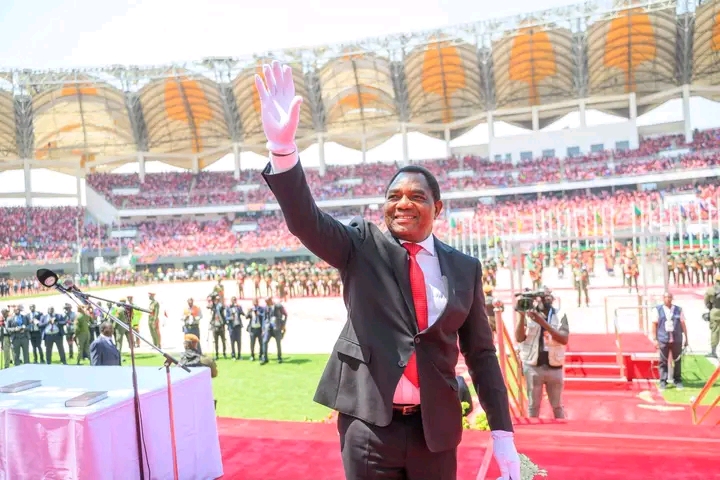
THE SUPER EL NIÑO OF 2026-2027 PRESENTS A THREAT TO PRESIDENT HAKAINDE HICHILEMA’S GROW ZAMBIA PLAN.
By Nchimunya Malambo – Global development and climate change analyst.
Today, September 3, 2026, the World Meteorological Organization warned that El Nino has developed with 100% certainty and is likely to strengthen into a very strong El Nino with “increased impacts on rainfall, temperatures, floods, droughts and heatwaves.”
The UN Secretary-General, António Guterres, said the phenomenon was “being supersized before our eyes” and “the race now is between rising risks and our commitment to take climate action and protect people”.
This follows the 11th June National Oceanic and Atmospheric administration (NOAA) statement on EL NINO Advisory. The Super El Niño, which is growing fast in the Pacific Ocean and is expected to peak in November-December 2026 and continue through early 2027 in Zambia, presents an existential threat to Zambia.
President Hakainde Hichilema’s transformative economic development blueprint, “Grow Zambia Agenda,” whose success he highlighted when he won re-election with a landslide victory in the 2026 presidential elections, is threatened by the super El Niño that is coming soon.
About 90% of his vision and agenda, the 10,000 megawatts of electricity generation capacity, 10 million tonnes of maize production, 3 million tonnes of copper production, 3 million tonnes of soya, 1 million tonnes of wheat, $1 billion beef industry, and the 5 million tourists expected to see the wonder of Victoria Falls and other natural attractions in the country are all at risk.
The rain distribution prognosis in the southern and northern parts of the country is of great concern. Southern Zambia will be dry during November and December, while the northern part will be flooded. The dryness will destroy crops and pasture while the floods will wash away products.
The lesson from the 2023/2024 El Niño, which was the strongest ever in the region, is that over one million farming households and nearly 84 of the 116 districts were severely affected.
The super El Niño of 2026-2027 will have adverse effects on exports and the Growth Agenda. Maize exports will be affected as the 10 million tonnes production goal will be at risk, while the export of soybeans, wheat, and beef will be significantly affected too in the next two years 2027/2028 of President Hakainde Hichilema’s mandate.
Hydropower shortfalls will affect mining and agro-processing activities, reducing the production of goods. It will also reduce the inflow of foreign exchange into the country, increasing the budget deficit and, consequently, the debt burden.
Since about 90% of the Growth Agenda is climate-dependent, the attainment of economic growth targets in the next two years will be difficult to achieve, resulting in fewer jobs, especially in the farming and manufacturing sectors.
Food import bills may not be much or expected especially maize, since government through the Food reserve Agency (FRA) is preparing for mitigation. Power imports due to electricity expected shortages, will also challenge the country’s reserves, requiring massive intervention for Zambia to overcome the disaster
President Hichilema will need to rally everything to ensure national solidarity and international assistance as he did during the prolonged dry season that was caused by the 2023/2024 El Niño.
The impacts of the 2026/2027 super El Niño are expected to cause food shortages because of reduced crops and pasture, reduced hydropower generation, and increased disaster management costs.
This will increase the budget deficit and, consequently, the debt burden. However, this will pass, and Zambia will rebuild its economy through climate-smart technology and investment in early warning systems about such events.
The super El Niño of 2026-2027 will test Zambia’s commitment to protecting its people and it is another immediate challenge that president Hakainde Hichilema’s second term of office will have to face.