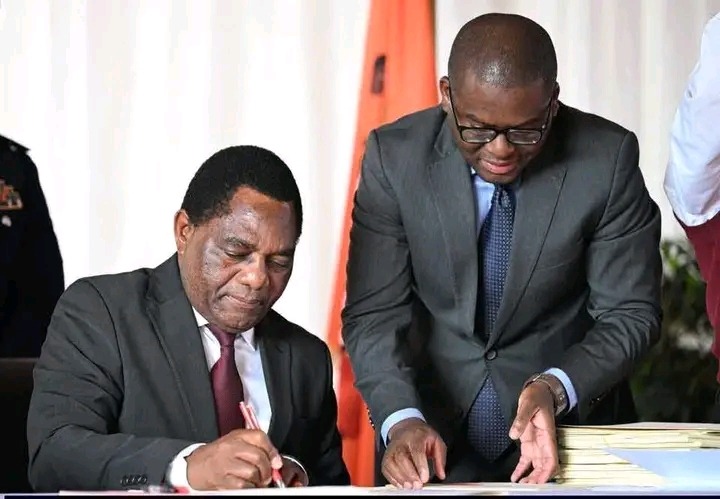

THOSE OF YOU ASKING WHO CHRISTOPHER MUNDIA IS: THE QUIET COUNSEL BEHIND THE PRESIDENCY
By Dr. Larry Mweetwa
Please read till the end you will learn something, don’t be like those keyboard ninja warriors who always rushes to the comments and write hit like if you didn’t read up to the end. .
There is an old African proverb that says, “A tree is known by its fruit, not by the noise of its leaves.” If ever that wisdom found comfortable residence in Zambia’s corridors of power, one might argue that it describes Christopher Mundia rather well.
For those asking, “Who exactly is Christopher Mundia?” — the answer requires more than a job title.
Mr. Christopher Mundia is officially listed by State House as Special Assistant to the President – Legal, serving President Hakainde Hichilema. But titles, impressive though they may be, rarely tell the complete story of the person occupying the office.
In government, there are people whose presence is announced by microphones, motorcades and press conferences. Then there are those whose influence is better measured by the quality of the advice that reaches the decision-maker.
Christopher Mundia appears to belong to the latter school.
THE LAWYER WHO DOES NOT NEED TO SHOUT
Lawyers have occasionally been accused — perhaps with admissible evidence — of believing that every disagreement requires twelve pages of submissions, three authorities and an objection before breakfast.
Mundia presents a rather different image.
Cool-headed, measured and discreet, he represents an important lesson in legal practice: the strongest argument does not necessarily require the loudest advocate.
As Presidential Legal Adviser, he operates close to the centre of executive decision-making, where legal questions are seldom merely academic. Advice rendered at that level potentially carries constitutional, political, institutional and national consequences.
The lawyer advising a President must therefore understand not merely what the law permits, but also what constitutionalism demands, what institutions can sustain and what tomorrow’s precedent may become.
That is a considerably heavier brief than merely winning today’s argument.
In legal language, one might say:
The Presidency may be the principal, but history remains the ultimate appellate court.
And history rarely entertains applications for extension of time.
THE UNSEEN LEGAL ENGINE
Every successful institution has people whose contribution is most visible precisely because their fingerprints are not.
The public sees the President making decisions, signing instruments, announcing policy and navigating difficult questions of State. Behind any functioning Presidency, however, must exist an architecture of professional advice — economists examining numbers, security experts assessing risks, policy specialists considering implementation and lawyers asking that occasionally inconvenient but indispensable question:
“Is it lawful?”
That question can save a government from a thousand headaches.
The presidential lawyer must sometimes say yes.
Sometimes no.
And, perhaps most importantly, sometimes:
“Yes, Your Excellency — but not quite like that.”
That is where legal craftsmanship begins.
A good legal adviser does not merely identify obstacles; he finds constitutionally defensible pathways around them. He must distinguish political convenience from legal sustainability and immediate victory from institutional consequence.
In that sense, Christopher Mundia may fairly be described metaphorically as one of the quiet legal engines behind the Presidency of Hakainde Hichilema — not because government is the work of one adviser, but because sound executive authority necessarily depends upon sound counsel.
EDUCATED, BUT WITHOUT MAKING EDUCATION A PUBLIC ADDRESS SYSTEM
There is something refreshing about educated people who do not carry their qualifications around like exhibits marked “P1, P2 and P3.”
Education is most attractive when it produces judgement rather than arrogance.
The finest lawyers eventually discover that knowing the law is only half the profession. Knowing when to speak, what to say, how much to say and when silence is itself strategic constitutes another education entirely.
Mundia’s professional profile reflects experience extending across legal practice and presidential advisory work. His firm’s professional profile identifies him as Managing Partner (Advisory) and describes experience spanning board directorships, academia and presidential advisory.
Yet perhaps the more compelling quality attributed to him by those who speak warmly of him is temperament.
Intelligent.
Calm.
Level-headed.
Approachable.
Humble.
Generous.
Or, to borrow the wonderfully economical Zambian expression:
Ta samwa.
Power has not apparently persuaded him that gravity operates differently around important people.
That deserves recognition.
POWER WITH HUMILITY
There is an old saying:
“Humility is not thinking less of yourself; it is thinking of yourself less.”
Public office tests this principle severely.
Government offices come with titles, protocol, security, telephone calls that are suddenly returned very quickly, and doors that mysteriously open before one has touched the handle.
The danger is eventually believing that the doors are opening for you rather than for the office you temporarily occupy.
Wisdom therefore requires remembering that public office has tenants, not landlords.
Today somebody occupies the office.
Tomorrow another person will.
The institution remains.
This philosophy is particularly important for advisers operating close to presidential authority. Proximity to power can intoxicate those who mistake borrowed authority for personal sovereignty.
The disciplined adviser understands the distinction.
He advises without attempting to become the principal.
He influences without needing applause.
He carries authority without advertising it.
And when necessary, he allows the President to receive the political credit because that is precisely how advisory government is supposed to function.
DISCRETION: THE CURRENCY OF PRESIDENTIAL COUNSEL
Presidential legal advice is unlike ordinary legal practice.
A lawyer in private practice protects the client’s legal interests. A presidential adviser must additionally appreciate constitutional boundaries, public administration, institutional integrity, national interest and the political consequences surrounding lawful executive action.
Confidentiality therefore becomes more than professional etiquette.
It becomes part of statecraft.
The adviser who tells everyone what he advised will soon discover that nobody important asks for his advice.
Hence another useful principle:
“When entrusted with the King’s confidence, do not become the village radio station.”
That particular proverb may not yet have reached the Oxford Dictionary of Proverbs — but perhaps it deserves admission.
THE VALUE OF TEMPERAMENT
Intelligence alone is insufficient at the highest levels of government.
A brilliant lawyer without temperament can become a constitutional fire extinguisher who somehow arrives carrying petrol.
What leadership requires is intelligence accompanied by restraint.
Confidence accompanied by humility.
Loyalty accompanied by professional independence.
Speed accompanied by reflection.
And legal knowledge accompanied by wisdom.
That is why temperament matters.
President Hakainde Hichilema himself has cultivated a public image centred on analytical decision-making, economic reasoning and methodical administration. An adviser operating effectively within such an environment must consequently possess the patience to interrogate detail rather than merely react to political noise.
Government produces enough noise already.
The lawyer’s contribution should often be clarity.
THE MAN BEHIND THE FILES
Much of serious government happens away from television cameras.
Before the announcement comes the memorandum.
Before the signature comes the legal opinion.
Before the statutory instrument comes the drafting.
Before the policy comes the interrogation of authority.
And before the President places his signature upon certain consequential instruments, someone somewhere must have asked:
“What does the Constitution say?”
That is why some of the most consequential people in government may remain among the least publicly visible.
Their victories are frequently invisible.
When good legal advice prevents an unlawful decision, there may be no headline.
When careful drafting prevents litigation, nobody celebrates the lawsuit that never happened.
When sound counsel prevents institutional embarrassment, the public may never know what was avoided.
Such is the peculiar occupational hazard of excellent advisory work:
When you do your job exceptionally well, sometimes nothing happens.
And that “nothing” may have saved the State considerable trouble.
A LESSON FOR YOUNG LAWYERS
There is therefore a lesson here for Zambia’s emerging generation of lawyers.
Do not confuse visibility with relevance.
Do not confuse aggression with intelligence.
Do not confuse proximity to power with possession of power.
And never confuse speaking last with winning the argument.
The law rewards preparation.
Leadership rewards judgement.
History rewards character.
As the proverb reminds us:
“Wisdom is like a baobab tree; no one individual can embrace it.”
The accomplished lawyer therefore continues learning, continues listening and remains sufficiently humble to recognise that even brilliant counsel benefits from another considered opinion.
CHRISTOPHER MUNDIA: COUNSEL WITHOUT THE DRAMA
So, to those still asking:
WHO IS CHRISTOPHER MUNDIA?
He is the Special Assistant to the President – Legal.
He is a lawyer operating in one of the most sensitive advisory environments in the Republic.
He is among those professionals whose contribution to government is often made behind closed doors rather than behind microphones.
And to those who know him personally and describe him as intelligent, humble, generous, morally grounded and remarkably level-headed, perhaps the simplest description remains the most powerful:
A legal mind that does not need noise to demonstrate its weight.
In politics, everybody wants to be seen near the steering wheel.
But every functioning vehicle also needs an engine.
And sometimes the most important component is the one passengers never see.
Christopher Mundia may not always be the face in the photograph, but in the legal architecture surrounding the Presidency, his is certainly a mind worth recognising.
Because ultimately, great advisers do not compete with the leaders they advise; they make leadership safer, wiser and more defensible.
And perhaps that is the highest compliment one can pay a lawyer entrusted with counsel at the highest office of the land:
He understands that power speaks loudly — but the law, properly understood, does not have to.
Fiat justitia — let justice be done.
And, where possible, let good counsel ensure that we do not first create an unnecessary case file. ⚖️
Cut from mafiaso. Loyalty
Thought Larry Mweetwa said he would take a social media break.