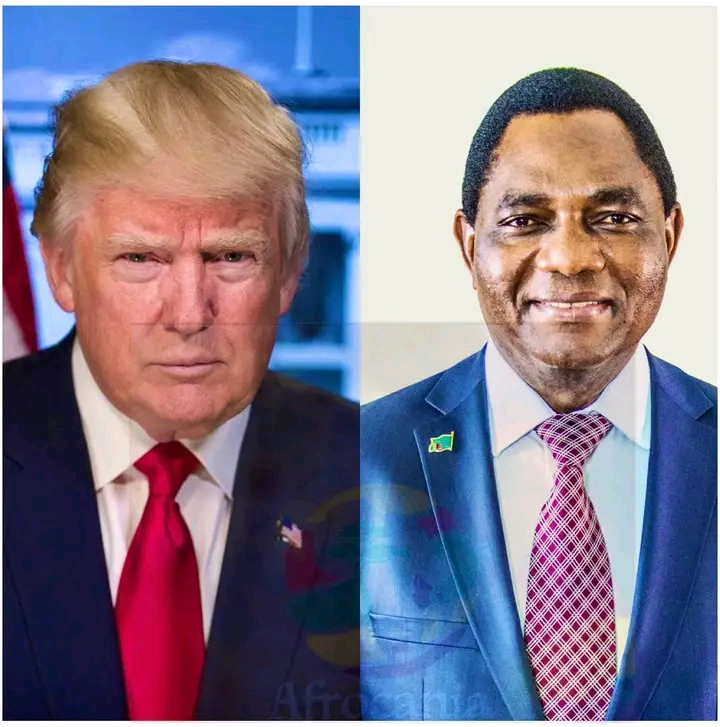

The United States has paused a major health funding agreement with Zambia. The release of $1.5 billion will depend on progress in negotiations on mining cooperation.
According to Trump:
The United States is tired of playing Father Christmas to nations that have shown no reciprocal interest, so it’s strictly business from now on.
Emily Bass writes:
U.S. Delays Zambia Health Agreement as Signing Becomes Contingent on Mining Deal
The US Government has announced that USD$1.5 billion in aid for health will not be released until terms are set for “collaboration in the mining sector” and business sector reforms.1 Up until very recently, the US government planned to sign its Memorandum of Understanding on health funding on December 11th. In a move that surprised many close to the process, that date was abruptly scrapped. Instead, Caleb Orr, a Department of State official in charge of energy and business development traveled to Zambia, met with Zambian President Hakainde Hichilema, and announced that economic cooperation supersedes, and is a pre-requisite, for health funding.
On one level, this development is unsurprising. As this Stack is rather stuck on, all of the Memoranda of Understanding between the US and foreign countries for future health aid are transactional. All tie health funding to access to markets, data and specimens. In the post prior to this one, I covered how the Rwandan signing followed the signing of an economic accord that the Department of State lauded for unlocking economic potential for America.
But what’s just happened in Zambia is also unprecedented, according to veterans of America global health foreign aid who describe the naked, public bartering of mining concessions for humanitarian aid as “uncharted” and “first of its kind in the world for the Department of State.”
On Monday, the State Department announced that Caleb Orr2, current U.S. Assistant Secretary of State for Economic, Energy, and Business Affairs and President Hichilema had “committed to a plan that aims to unlock a substantial grant package of U.S. support in exchange for collaboration in the mining sector and clear business sector reforms that will drive economic growth and commercial investment that benefit both the United States and Zambia.”
Orr, a lawyer who served as Senior Policy Advisor to Secretary of State Marco Rubio during his time in the US Senate, was following up on the matters that Rubio and President Hichilema discussed during a November 17 phone call3 that took place at almost the same time as the US Bureau of Global Health Security and Diplomacy visit to the country by Brad Smith and Permanent Deputy Assistant Secretary Becky Bunnell. Clearly, that call didn’t finalize terms. Nor did Orr, who said, on Monday, “We look forward to finalizing terms based on clear progress in the coming months.”
That timeline is a red flag for Zambian health programs reliant on continued US support. Like all other countries involved in these negotiations, Zambia has received six months of “Bridge Funding,” covering a period that ends on March 31; the MoUs are a pre-requisite for launching a implementation planning phase that would ensure continuity of services supported by the new funds from April 1 onward. That was a compressed timeframe to begin with; now that the signing date is postponed, it’s going to be even more abbreviated.
It may seem excessive to devote a stack to this one development in a week that’s seen a flurry of signings and developments.4 After all, America has always sought concessions and collateral benefits from its foreign aid investments. US deployment of soft power has always been a means of pursuing national interests. The fact that Trump and his people have big plans for extraction, perhaps even plunder, in the region has been clear for the last few months as the State Department fanned out across countries to pursue these ostensibly-health focused agreements.
It’s also been fairly clear that America was getting more than is even captured in the text of the health-related MoUs, including mineral and ore rights and access. I know of at least one other instance in which signing happened on the basis of agreements related to natural resource sharing that are not included in the public text.
Still, Zambia surfaces the stakes in ways that warrant special recognition.
December 11th 2025—the day the Zambia-US health agreement was not signed as scheduled—marks the moment the curtain fully rose on the Trump Administration’s 21st century scramble for Africa.
Access to the region’s natural resources and markets is central to America’s geopolitical ambitions and strategy, and supercedes every other consideration that has historically motivated health foreign aid including winning hearts and minds, saving lives and shoring up global health security.
The State Department wants everyone to know this. Having clearly established that it feels no obligation to keep the public apprised of its plans, the Department’s public statement about the Zambia terms is a warning and an object lesson to anyone who thinks the way things were is the way they are going to be.
There are officials and policy makers in sub-Saharan African countries who remember when the US President’s Emergency Plan for AIDS Relief funds in Uganda were ring fenced as essential humanitarian aid—even as the US pursued economic and travel-related sanctions related to the passage of the first Anti-Homosexuality Act. There are officials and policy makers who have lived through decades of continuous US funding that was primarily contingent on performance against stringent metrics and acceptance of the bilateral program structure and approach.
There are people who remember when American aid for global health was not a reward for compliance with a particular capitalist agenda, and when America had a significantly less aggressive and ambitious posture in relation to Africa’s natural resources and economic markets.
Goodbye to all that.
A US official in charge of energy and business interests now controls the timeline for the health agreement, and has let it be known that this timeline could extend past the end of available health funds. There is no way of knowing what triggered the cancellation, but given that came as a surprise, it could be that the Government of Zambia dug in its heels on some terms. Now, everyone knows what the consequences are, if that is indeed what happened.
Holding hands while the walls come tumbling down.
Sell the copper as a country to fund health and not the other way round.
Easy!! let us Just produce enough gold and this small amount can be funded in no time. Besides which is more valuable, the actual mineral or money which it self has loss up to 90% of it value of the years.
This mind game should not cause us to loss sleep. Just swap partners while we take care of properly amassing real wealth. Serious Minerals.
So Trump wants to use false kindness to get at the minerals, government must use the minerals to generate their own funds and forget about the mad man Trump, why put conditions of mineral extraction when pretending to help. Forget about Trump and his aid packages because they come with unfair strings, we can still survive without allowing ourselves to be manipulated
Yes,its business and not aid anylonger.Zambians must not doubt this.Its loud and clear
Zambians must now not shy away from openimg up even more to other countries for buisness partnerships the BRICS countries without fear or favour in our own national interest
But more importantly,successive governmemts must embark on an aggresive and deliberate policy and program to transfer,as much as possible,the natural resources into the hands of local Zambians.Foreign capitalists must come and find a substantial amount of our resources already in the hands of the locals.Copper prices are projected be very high for the next decade.There is therefore,no reason why this program cannot be done