
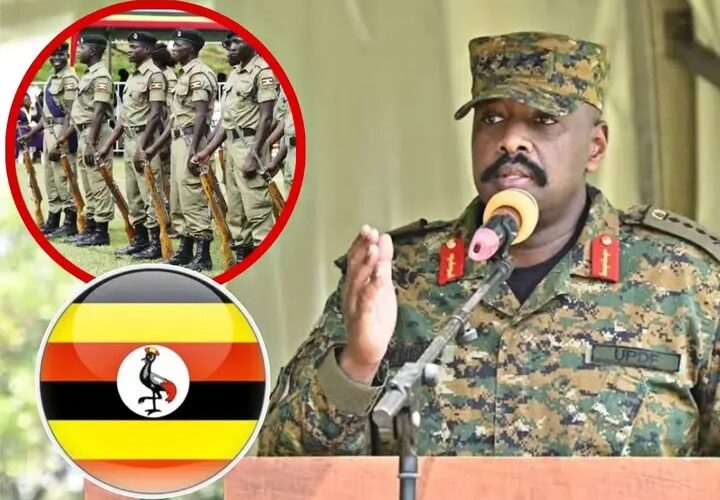
Uganda’s army chief tells police to show name and number and tells citizens they may resist if the officer stays silent
Gen. Muhoozi Kainerugaba, Chief of Defence Forces, posted the order at midday Friday. Twenty minutes later he added: police will start implementing it today.
The instruction is three sentences.
Name tag on the right chest pocket. Badge and force number on the left. Any Ugandan being arrested may demand both. If the officer will not give them, Muhoozi said, “you have the right to resist arrest.”
That last line is the story.
identifiability is not new. After hooded operatives beat journalists and voters in the Kawempe North by-election, MPs demanded visible IDs. The Uganda Police Force was already stitching surname, force number and rank onto new uniforms before the 2026 election, precisely so officers could not peel the tags off during operations.
The Judicial Service Commission already tells citizens they may ask an officer for an identity document before answering questions. If the officer refuses, you need not give your name. That is not the same as a licence to fight the arrest.
Uganda’s Criminal Procedure Code still says the opposite of Muhoozi’s last sentence. If a person resists or tries to evade arrest, the officer “may use all means necessary” to complete it, short of unreasonable force. Resist a lawful arrest and you can be charged for that too. A tweet from the army commander does not repeal that statute.
And this is an army commander talking to the police.
Muhoozi does not run the Uganda Police Force. That sits with the Inspector General and the Ministry of Internal Affairs. He runs the UPDF. He has spent 2026 issuing arrest threats on X, posting photos of detainees, and treating the security services as a single machine that answers to him. Local Government Minister Balaam Barugahara immediately seconded the post. The police force itself had not, as of early afternoon, put out its own circular.
The irony is sitting in the archive. In March 2025 the same general publicly contradicted Internal Affairs minister David Muhoozi and wrote: “There is no requirement for security personnel to be identified! None at all!” Hoods were the issue then.
Today he wants names on the chest and a citizen’s right to push back if they are missing. Both posts came from the same account. Only one of them can be the standing rule.
What Ugandans actually live with is the gap between those two versions. People have been taken by men who would not give a name. Some of those operations were later celebrated online by the same general now promising name tags.
A stitched pocket is accountability only if the people doing the grabbing are police in uniform, not an unnamed squad in a van.
So the useful part of the order is small and overdue: show who you are. The dangerous part is the invitation to resist. In a country where officers are still trained to treat resistance as a reason to use force, that sentence can get someone hurt faster than it gets them justice.
Until the Inspector General, the Attorney General or a gazetted police standing order says the same thing, treat Friday’s post as what it is: the first son, in uniform, rewriting arrest rules on X. Not yet the law.