
By CIC International Affairs.
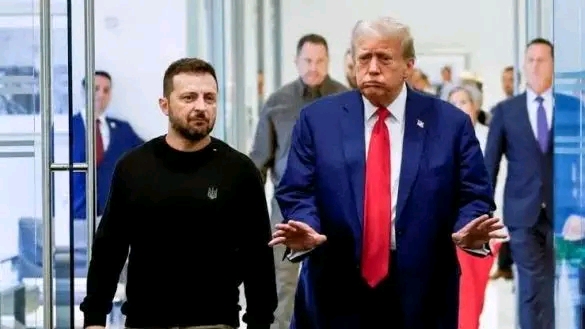
ZELENSKY BEGS TRUMP TO CAPTURE PUTIN AND END THE WAR QUICKLY JUST LIKE HE HAS DONE TO MADURO.
As the world reels from the U.S. military strikes on Venezuela and the reported capture of President Nicolás Maduro on January 3, 2026, Ukrainian President Volodymyr Zelensky has seized the moment to call for similar action against Russian President Vladimir Putin.
In a statement that has sparked global debate, Zelensky suggested that the U.S. should capture Putin next, saying, “If it is possible to deal with dictators like that, then the United States of America knows what to do next.”
For ordinary Ukrainians enduring daily blackouts, high prices, and the grind of a war now in its fourth year, Zelensky’s words bring a mix of hope and frustration, reminding them how far-off events can influence their own fight for freedom.
This bold remark comes amid U.S. President Donald Trump’s announcement of Maduro’s detention, a move Zelensky sees as a model for handling authoritarian leaders like Putin.
In a conflict that has claimed over 50,000 Ukrainian lives and displaced millions, Zelensky’s call highlights the desperation for decisive action against Russia, which has occupied 18 percent of Ukraine’s territory since 2022.

As South Africans reflect on our own history of international solidarity during apartheid, Zelensky’s suggestion resonates as a plea for global powers to step up against aggression.
With Putin facing an ICC arrest warrant for war crimes since 2023 and a bounty on his head, Zelensky’s words fuel speculation about potential U.S. moves, but they also raise risks of escalation in an already tense Europe.
In 2026, this could shift dynamics in the Ukraine-Russia war, where stalled fronts and economic strains have left people weary but resolute.
Eyewitness accounts from Venezuela’s strikes describe chaos, drawing parallels to Ukraine’s own experiences with Russian bombardments.
Zelensky’s statement, made during a press conference, positions the U.S. as a key player in dealing with dictators, but it also draws criticism for potentially provoking Putin.
As global reactions pour in, let’s explore the context, implications, and what this means for international relations.
President Volodymyr Zelensky made his remarks in response to the U.S. capture of Maduro, seeing it as a blueprint for action against other authoritarian leaders.
“If it is possible to deal with dictators like that, then the United States of America knows what to do next,” he said, directly suggesting the U.S. target Putin.
This comes as Zelensky pushes for stronger Western support in Ukraine’s war against Russia, where recent Russian advances in Donbas have raised alarms.
Zelensky’s words echo his frustration with stalled peace talks and what he sees as insufficient action against Putin, who faces an ICC arrest warrant for war crimes since March 2023.
The warrant accuses him of deporting Ukrainian children, a charge Russia denies. Zelensky has long called for Putin’s isolation, and this statement amplifies that in light of Maduro’s fate.
For Ukrainians, this brings hope a quick resolution like Maduro’s could end the war that’s displaced 6 million and caused economic losses of $500 billion. But it also risks escalation, as Putin could see it as a direct threat.
The U.S. operation began in the early hours of January 3, 2026, with airstrikes hitting military sites in Caracas, La Guaira, Miranda, and Aragua states.
Residents reported explosions, low-flying aircraft, and blackouts, leaving hospitals struggling and families in fear.
Trump announced Maduro’s capture on social media, sharing a photo aboard the USS Iwo Jima as proof.
He claimed it targeted a “narco-state,” but boasted about tapping Venezuela’s oil reserves. Maduro denied the capture in an address, declaring emergency and mobilising forces.
This hybrid assault avoided full invasion but risked wider war. Venezuela’s defiance, with street fighting reported, shows resistance. Global outcry from Brazil, Colombia, Russia, and China condemns it as imperialism.
Leaders worldwide slammed the U.S. actions. Brazil’s Lula condemned it as crossing “an unacceptable line,” urging a summit. Colombia called it “bombing Caracas,” Mexico urged calm.
Russia vowed aid, China labelled it aggression. The UN warned of humanitarian woes. Oil jumped 5 percent, hitting importers like SA.
South Africa called for emergency UNSC meeting, viewing it as a peace threat.
This backlash isolates U.S., straining Latin ties.
Zelensky’s call could boost morale in Ukraine, where war fatigue sets in after 1,000 days.
But it risks provoking Putin, who might escalate attacks on Kyiv. In 2025, Russia advanced in Donbas, displacing 100,000.
The ICC warrant on Putin since 2023 for child deportations adds weight, but enforcement is hard. Zelensky’s words draw parallels to Maduro, seeing both as dictators, but ignore differences Venezuela’s internal crisis vs Russia’s invasion.
Venezuela’s reserves 17 percent global make it key. Strikes disrupt production, with oil up 5 percent.
Globally, shortages could worsen if fighting grows. Venezuela’s 800,000 barrels daily in 2025 were vital for allies like China.
For Trump, this tests policy, risking war. Maduro’s defiance suggests resistance, drawing allies.
For 2026, this could define relations, with hopes for dialogue. Venezuelans pray for peace, uncertainty looms. In a connected world, this affects all calling for wisdom over force.
CIC PRESS TEAM