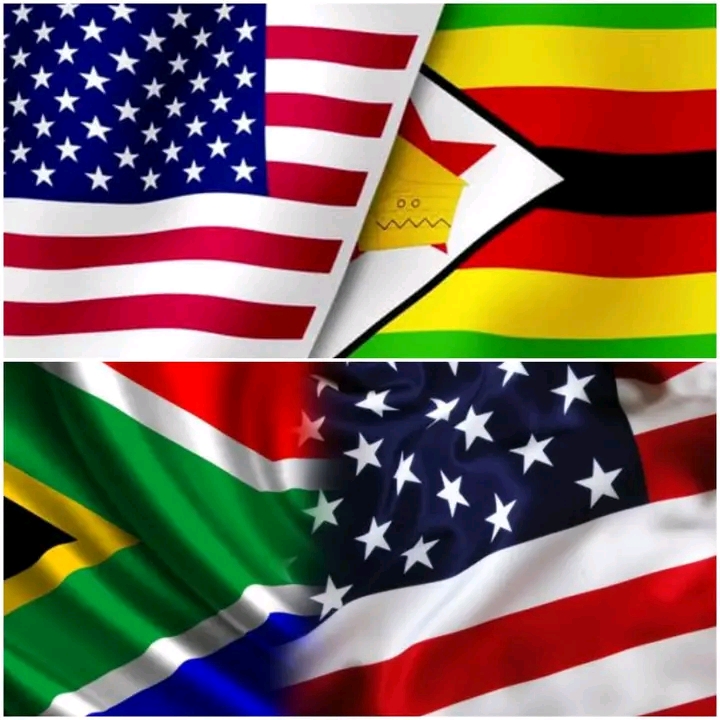

USA Distances Itself From South Africa and the ANC, Now Turning to Zimbabwe, Zambia and Botswana to Build New Strategic Alliances – As US Air Force Plane Is Spotted in Harare
There is a noticeable shift taking place in Southern Africa’s political and economic landscape. The United States appears to be slowly cooling its relationship with South Africa and the ANC-led government, while at the same time strengthening ties with countries further north such as Zimbabwe, Zambia and Botswana.
This change is not only visible in diplomatic language, but also in action. Recently, a United States Air Force aircraft was seen landing in Zimbabwe, a powerful signal that Washington is re-engaging with Harare at a strategic level. Such visits are rarely random. They often point to growing military, intelligence, economic or diplomatic cooperation behind the scenes.
For years, Zimbabwe was largely isolated due to sanctions, political tensions and economic challenges. However, the tone from Washington is changing. The US Embassy in Harare has been issuing more positive statements, and international interest in Zimbabwe’s economy – especially its mining and energy sectors – is rising.
Zimbabwe is believed to possess vast reserves of lithium, platinum, gold, rare earth minerals and possibly oil and gas. These resources are critical for electric vehicles, renewable energy, defence technology and advanced manufacturing. In a world where global powers are competing for secure supply chains, countries with such minerals become strategically important.
At the same time, relations between the United States and South Africa have become strained. Differences over foreign policy, global alliances, positions on major world conflicts, and South Africa’s closeness to countries like Russia and China have created tension. As a result, Washington appears to be quietly diversifying its partnerships in the region.
Zimbabwe, Zambia and Botswana are now increasingly seen as alternative strategic partners. These countries offer:
• Rich and underdeveloped mineral resources
• Political willingness to engage with Western investors
• Strategic geographic positioning in Southern and Central Africa
• Growing energy potential
• A chance for the US to counter Chinese and Russian influence
The sighting of a US Air Force plane in Zimbabwe strengthens the view that relations are warming not only economically, but also diplomatically and strategically. It sends a message that Harare is no longer being treated as a pariah state, but as a country of renewed interest.
What is unfolding suggests a slow but significant realignment. While South Africa has long been Washington’s main partner in the region, the centre of attention now appears to be shifting north. Capital, influence and strategic engagement are beginning to follow minerals, political alignment and future economic potential.
In the coming years, Southern Africa’s power map may look very different, with Zimbabwe, Zambia and Botswana emerging as key players in Washington’s regional strategy, while relations with South Africa and the ANC continue to cool.