
EXPLAINER | What Really Happened in Chingola and Why the Reactions Matter
A violent disturbance in Chingola on Saturday escalated into one of the most serious security incidents President Hakainde Hichilema has faced since taking office. The police report and the UPND statement present sharply different versions of the same event. Social media reactions have moved even further, with sections of the opposition base celebrating the violence and framing it as a symbolic revolt. This explainer sets out what happened, who is driving the narrative, and why the reactions require close monitoring by the state.
What Police Say Happened
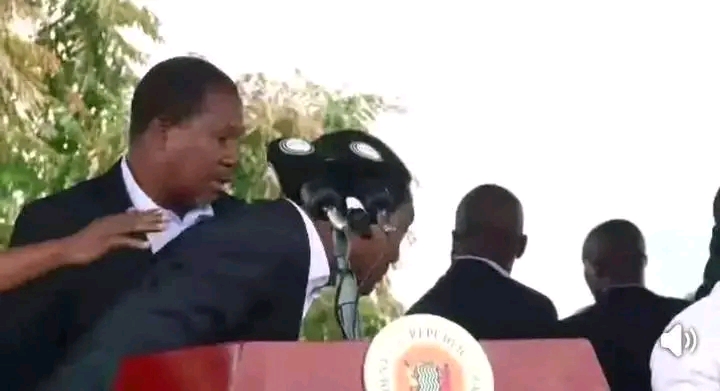
Police spokesperson Rae Hamoonga reported a direct escalation of violence while the President was still addressing the public. “Some unruly people began breaking into and looting shops,” he said. When police moved to stop the looting, the crowd “became violent and started charging towards the venue where the President was speaking.” The President was withdrawn for security reasons and escorted to the landing pad. A police Toyota Land Cruiser was attacked, overturned, and set ablaze. Superintendent Lloyd Kanondo fired ten warning shots into the air without success.
The police listed several burnt items, including a presidential holding tent, floor carpet, carpet runners, a presidential portrait, and a portable toilet. Two suspects are in custody.

What the UPND Says Happened
The UPND issued a contrasting statement. The party described the incident as “a minor and isolated disturbance” triggered by boys who climbed rooftops for a better view. According to the statement, the youths resisted police instructions to come down and threw stones, creating “momentary panic.” The party added that “no one was injured, and no property damage of significance occurred,” and that the President proceeded to Ndola for a football match as planned. Frank Bwalya defended the engagement as peaceful and productive.
What Opposition Pages Are Amplifying
Opposition pages and influencers are shaping the event into a triumph. One PF-aligned page posted a graphic reading “Stoning is Biblical” which attracted hundreds of positive reactions. Another post circulated the caption “From BallyBelt to Bally Stoned.” Meme activity has spiked, with users referencing Goliath, Stephen, and other biblical scenes to normalise the violence. Comments include “Even Stephen was stoned” and “Very much Biblical, ask Goliath.”
Elsewhere, supporters framed the incident as proof that the Copperbelt has turned. A PF comment read, “These few disgruntled misbehaving youths can be found anywhere as we approach 2026 general elections,” a statement that suggests readiness for more confrontations.
⌛ Calls for Tanzanian-Style Action
A consistent theme across platforms is celebration of violence as a political remedy. Some comments openly encourage youths to replicate the street action seen in Tanzania. Others mock law enforcement responses. One user wrote, “They thought Zambia is still in 2pin. Wala tata,” implying that the state no longer commands fear. Another wrote, “You can’t have such an issue and you seem to be praising the act. What kind of leadership are you exhibiting,” in response to opposition leaders who appeared excited by the incident.
Sentiment mapping shows a split. Hardline groups portray the violence as a moral victory. Moderate voices warn that the online celebration signals a readiness to test the state ahead of 2026.
Why the Reactions Matter
The reactions are not isolated humour. They reflect deep frustration among groups that lost economic and political power after 2021. These include former market tax collectors, bus stop enforcers, and informal mining groups. Their commentary reveals a desire to recreate past influence through engineered instability. The spike in violent rhetoric after the Chingola incident points to a coordinated appetite for confrontation as a political tool. Some voices even frame confrontation as divine sanction.
Political Stakes Ahead of 2026
The Copperbelt remains a strategic battleground. The President’s visit was part of a wider outreach following the Chiwempala market fire. The violent scenes risk becoming a template for future disruption. Opposition influencers are already positioning the event as proof that the region has rejected the ruling party. The governing party will attempt to contain this narrative, but online sentiment is drifting faster than official statements can counter.

⚖️ The Facts Versus the Spin
The police report and the UPND statement diverge. The opposition and sections of the public have added another layer of distortion. What is clear is that the incident was serious, violent, and strategically located. Property was burnt. A police vehicle was destroyed. Warning shots were fired. The President was evacuated. These are not markers of a minor disturbance.
What the State Should Note
Discontented groups are testing boundaries before 2026. The online celebration of violence reveals a readiness to exploit any spark. Intelligence signals point to a network of actors who benefited from past lawlessness and now face reduced influence. Their rhetoric shows intent to regain political space through street pressure. The state must recognise that the Chingola incident is not only a security event but also an information event where narratives can embolden or restrain future actions.
⬆️ Editor’s Note
This explainer reflects our verification process which draws from police statements, party communication, on-the-ground reports, and real-time digital sentiment analytics. The People’s Brief monitors political discourse through technology that tracks content clusters, narrative shifts, and high-risk mobilisation patterns across public platforms. Our work aims to give readers clear facts, contextual understanding, and early warning signals without fear or favour.
© The People’s Brief | Gathering —Caesar Bweupe & McCarthy Lumba; Social Media monitoring —Mwape Nthegwa; Analysis —Ollus R. Ndomu
Besides the stoning and property damage, I’m glad that people were able to express their democratic right to register their displeasure. This is perfectly normal in a democratic society. The police’s restraint in not shooting at citizens is also highly commendable.
I only hope the UPND govt maintains a sober and measured approach to every protest or expression of discontent as we move closer to the elections. The stakes will rise, and more clashes are likely. The true character of this govt will be tested by how it handles dissent.
If there’s one key lesson the UPND should take from the Chingola incident, it’s this: do not escalate situations to the point where the govt’s reaction becomes the bigger story. Zambians strongly dislike state-driven violence. Right now, the police are the heroes, they managed to contain the situation without becoming the headline. May this incident serve as a model for handling similar situations as political tensions rise.
The truth is, not everyone is a fan of HH or the UPND and that’s okay. Don’t demonize those who disagree. The ultimate goal must be to protect the democratic process so that citizens can vote freely and fairly, without anyone being physically harmed in the process.
**My advice to the UPND government:**
1. Maintain a clean record — avoid incidents of public harassment and police-induced violence.
2. Allow the opposition space to freely express themselves. Let their message make the news, not police brutality or political intimidation.
3. Improve intelligence gathering — learn to read the public mood early and respond appropriately.
4. Strengthen media strategy — too often, govt communication is reactive rather than proactive.
5. Lead with positive narratives — bad news spreads fast; always find the silver lining and communicate it effectively.
6. On electricity: Stop making condescending statements like the one recently made by the Minister of Energy. This is a sensitive issue. Own the problem and give Zambians hope that it will be resolved. Communicate frequently and transparently about dam levels and water inflows, this is what people need to hear right now.
Solar and coal expansion projects are long-term solutions, but today, only the refilling of the Kariba Dam can restore power. Stay on message.
At present, government communication on electricity, both from officials and their surrogates appears disorganized and dismissive. It has been embarrassing and has done little to inspire public confidence. On this score, the UPND govt has failed to assure Zambians that it takes their concerns about electricity and livelihood seriously.
I have spoken, those who have ears, let them hear otherwise you UPND will get a surprise after 2026 election trying to find out what went wrong when it will be too late. There are alot of desperate people right now who are willing to vote for anybody & anything that will give them hope rather than the current.
You very much right, let those with ears hear!!!!
I sense a lot of hate. This will not help in anyway. People should not use emotions in such matters of national importance. The president of the republic of Zambia deserves respect as a person and the office that he occupies. We will not allow hooliganism and thuggery to take root in Zambia. Not in our time at least.