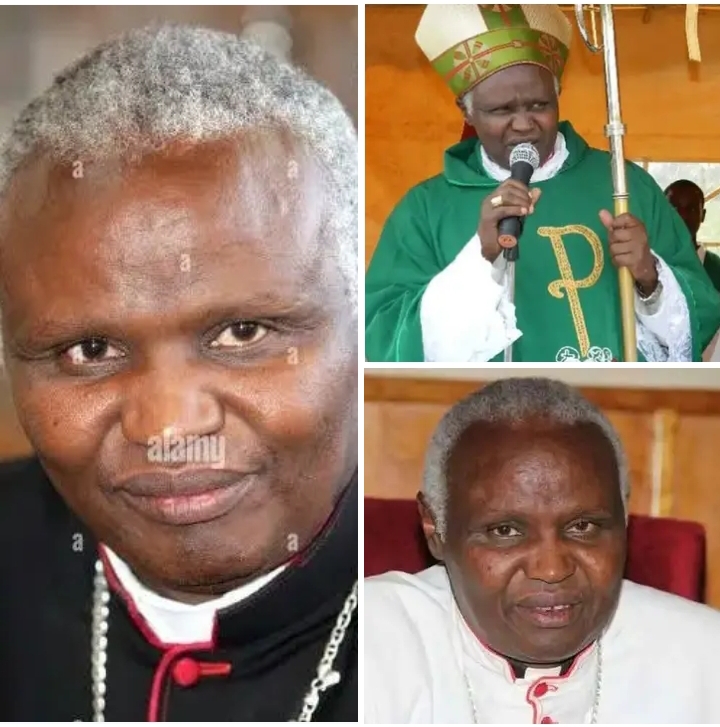

WHEN KENYA BURNED, HE REFUSED TO LOOK AWAY: REMEMBERING BISHOP CORNELIUS KORIR, THE SHEPHERD WHO STOOD BETWEEN HATRED AND HUMANITY
30 October 2017 – 30 October 2026 | Nine Years Without a Remarkable Peacemaker
There are men who occupy powerful offices, and there are men whose lives give meaning to the offices they occupy. Some are remembered for their titles, others for their wealth and influence. But a special few are remembered because, when humanity was at its lowest, they chose to stand on the side of peace, justice and compassion.
Bishop Cornelius Kipng’eno Arap Korir was one such man.
Nine years ago today, on 30 October 2017, the country woke up to the heartbreaking news that the Roman Catholic Bishop of Eldoret had died at the age of 67.
To many, he was a bishop. To others, a spiritual father. But to thousands of ordinary Kenyans who had experienced ethnic violence, displacement, hunger and fear, Bishop Korir was something much greater: a man who refused to abandon them when their world was falling apart.
His story deserves to be told, especially to a generation that may never have known him.
FROM THE VILLAGE OF SEGUTIET TO THE ALTAR
Born on 6 July 1950 in Segutiet Village, in today’s Bomet County, Cornelius was the fourth child of Athanas Arap Tamason and Blandina Chepkoech.
Nothing about his humble beginnings suggested that this village boy would one day become one of Kenya’s most respected religious leaders.
His journey of faith began early, influenced greatly by his devout Catholic mother.
As a young boy, attending church was no small undertaking. The family sometimes had to walk approximately 23 kilometres each way to reach the Catholic mission at Kaplong.
Just imagine a young Cornelius walking those long distances, perhaps never imagining that one day thousands would travel from across Kenya to listen to him preach.
He attended Chesoen and Segutiet primary schools before joining Mother of Apostles Minor Seminary in Eldoret. His calling later took him to St Augustine Major Seminary in Bungoma and St Thomas Aquinas Major Seminary in Nairobi.
In 1989, he furthered his theological education at St Patrick’s College, Maynooth, Ireland, earning an advanced qualification in sacred theology.
But education alone did not define him. What distinguished him was his conviction that faith must be demonstrated through service to humanity.
THE MAKING OF A SHEPHERD
On 6 November 1982, Cornelius Korir was ordained a priest by Bishop Raphael Simon Ndingi Mwana’a Nzeki, serving in the Diocese of Nakuru.
He ministered in parishes including Molo and Kituro, later serving as Vocations Director and Episcopal Vicar.
Then came a defining moment.
On 2 April 1990, Pope John Paul II appointed him Bishop of Eldoret, succeeding Bishop John Joseph Njenga.
On 2 June 1990, he was consecrated and installed at Kipchoge Stadium in Eldoret, in a ceremony presided over by Cardinal Jozef Tomko, assisted by Cardinal Maurice Michael Otunga and Archbishop John Joseph Njenga.
He was only 39 years old.
For the next 27 years, Eldoret would become more than his ecclesiastical assignment. It would become the place where his leadership, faith and courage were tested.
Under his stewardship, the diocese expanded its educational institutions, healthcare services and community outreach programmes.
In 2013, he established Upendo FM, a Catholic radio station whose very name, meaning love, reflected the values he promoted throughout his ministry.
But his greatest test would not come from managing churches or institutions.
It would come from confronting the darkness of tribal hatred.
WHEN NEIGHBOURS BECAME ENEMIES
To appreciate Bishop Korir’s legacy, one must understand the history of Kenya’s North Rift.
For decades, the region experienced recurring ethnic clashes, cattle rustling, disputes over grazing land and politically driven violence.
The Pokot, Marakwet, Turkana and other neighbouring communities sometimes found themselves trapped in cycles of revenge.
And whenever violence erupted, it was often the innocent who suffered most.
Children lost their parents. Families abandoned their homes. Farmers watched their livelihoods disappear. Communities that had shared markets, roads and schools became suspicious of one another.
Bishop Korir refused to accept this as normal.
He travelled into troubled areas, met community elders, listened to grievances and encouraged dialogue between rival groups.
In Kapsait, a church was established as a symbol of reconciliation between Marakwet and Pokot communities.
He understood that preaching about peace from a comfortable pulpit was not enough. Peace had to be pursued where people were hurting.
And then came December 2007.
THE DARKEST HOUR: WHEN KENYA BURNED
The disputed presidential election of December 2007 plunged Kenya into one of the darkest chapters of its post-independence history.
Ethnic violence erupted across several parts of the country, with Eldoret and the wider Rift Valley among the worst affected.
Homes were torched. Businesses destroyed. Families separated. Innocent people were attacked because of their perceived political or ethnic affiliations.
Thousands fled, carrying whatever possessions they could salvage.
In Eldoret, Bishop Korir opened the cathedral compound to displaced families seeking refuge. Accounts of his humanitarian response describe approximately 10,000 displaced people finding shelter there during the crisis.
Think about that for a moment.
A church compound became a sanctuary for frightened families who had nowhere else to go.
There were mothers holding crying babies, elderly people who had lost everything, and children too young to understand why yesterday’s neighbours had suddenly become enemies.
And in the middle of that suffering stood Bishop Korir.
Accounts of the violence also recall his personal intervention when armed youths threatened fleeing women and children.
At a time when many feared for their own safety, he chose to confront danger in defence of others.
He did not first ask victims which tribe they belonged to. He did not demand to know whom they had voted for.
He saw human beings whose lives mattered.
That was the difference between merely holding a religious title and living out the meaning of the Gospel.
AMANI MASHINANI: PEACE MUST BEGIN WITH THE PEOPLE
Following the violence, Bishop Korir understood that the absence of fighting did not necessarily mean that peace had returned.
The deeper wounds remained: mistrust, resentment, painful memories and the desire for revenge.
He therefore championed grassroots reconciliation through an approach popularly associated with Amani Mashinani — peace at the grassroots.
His message was simple but powerful.
Political leaders could shake hands in Nairobi, but if ordinary families in Eldoret, Burnt Forest, the Kerio Valley and surrounding communities continued to hate one another, the country would remain dangerously divided.
He brought together elders, religious leaders, young people and community representatives.
He supported peace meetings, dialogue forums and reconciliation initiatives. He also advocated sustainable livelihoods and greater investment in peacebuilding as alternatives to recurring conflict.
His work crossed religious, ethnic and political boundaries.
In 2006, President Mwai Kibaki honoured him with the Moran of the Burning Spear in recognition of his peacebuilding efforts.
In 2009, he received the Milele Lifetime Award, and in 2012 Moi University awarded him an honorary Doctor of Letters degree.
These honours were significant, but they were not the true measure of his contribution.
His greatest achievement was helping people who had every reason to distrust one another begin talking again.
THE MORNING KENYA LOST A PEACEMAKER
On Monday, 30 October 2017, tragedy struck.
Bishop Korir died following a short illness at his residence in Elgon View, Eldoret. He had been due to seek further medical treatment in Nairobi.
He was 67.
News of his death spread quickly across Kenya.
From the Catholic Church to political leaders, ordinary citizens and the communities he had served, tributes poured in.

President Uhuru Kenyatta, Deputy President William Ruto, former President Daniel arap Moi and opposition leader Raila Odinga were among the prominent figures who recognised his contribution to the nation.
On 11 November 2017, thousands gathered in Eldoret to bid farewell to the man who had spent much of his life encouraging Kenyans to live together in peace.
He was laid to rest in a special tomb inside the Sacred Heart of Jesus Cathedral in Eldoret.
A man who had opened the doors of his cathedral to people fleeing violence was finally laid to rest within its walls.
There is something deeply moving about that.
NINE YEARS LATER, HIS MESSAGE STILL SPEAKS TO KENYA
As we remember Bishop Cornelius Korir today, I cannot help reflecting on the kind of country we are building.
Kenya remains a nation of extraordinary people, rich cultures, remarkable resilience and tremendous potential.
Yet ethnicity and political rivalry continue to shape too many of our conversations.
We sometimes defend political leaders more passionately than we defend our neighbours. We allow differences of opinion to become personal hostility. We forget that long after elections are over, we must still live together as Kenyans.
Bishop Korir’s life offers a challenge to all of us, particularly those entrusted with religious, political and community leadership.
What good is a title if it cannot be used to defend the vulnerable? What good is influence if it cannot bring divided people together? And what good is preaching about love if we cannot demonstrate it when humanity needs it most?
He taught us through his actions that courage is not always found in confronting an enemy with a weapon. Sometimes, real courage is walking unarmed into a hostile community and asking people to put down their weapons.
He demonstrated that leadership is not about how many people stand to applaud you, but how many lives are made better because you chose to serve.
And he reminded us that faith should never become an excuse for tribal division, political hostility or indifference to human suffering.
Today, nine years after his passing, we remember not merely a Catholic bishop, but a Kenyan patriot, a reconciler, a defender of human dignity and a servant of God.
The village boy from Segutiet rose to become a bishop, but his enduring greatness was found in his humanity.
Some people leave behind monuments. Others leave behind movements. Bishop Cornelius Korir left behind a message that Kenya must never forget: we belong to one another before we belong to our tribes or political parties.
May the generation coming after us learn from the courage of this remarkable shepherd.
Rest in eternal peace, Bishop Cornelius Kipng’eno Arap Korir.
6 July 1950 – 30 October 2017.
“Blessed are the peacemakers: for they shall be called the children of God.” — Matthew 5:9 (KJV)
A life of service. A voice for peace. A legacy worth remembering.