
🇿🇲 INSIGHT | Why Abu Dhabi? Zambia’s Foreign Policy in Hichilema’s Second Term
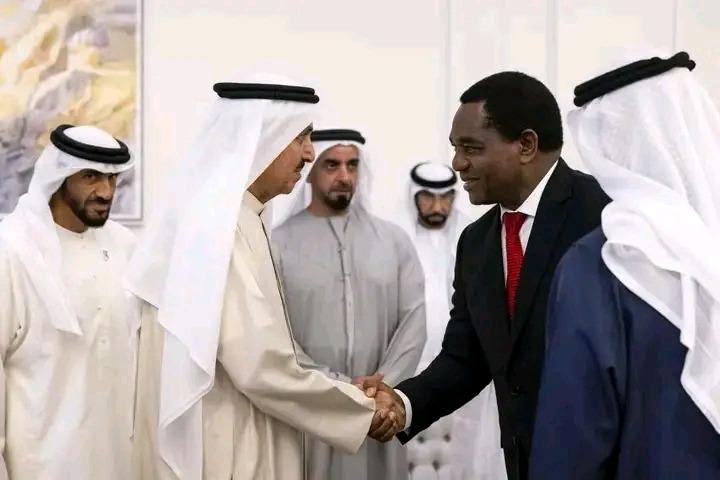
White kanduras, dark business suits and Zambia’s green, red, black and orange flag shared the rooms of Abu Dhabi this week as President Hakainde Hichilema made his first foreign trip since beginning his second term on September 1. Away from the photographs and ceremonial handshakes, something more consequential was taking place.
Hichilema met UAE President Sheikh Mohamed bin Zayed Al Nahyan, addressed the Zambia-UAE Business Forum and witnessed the signing of six investment agreements. The two presidents discussed trade, renewable energy, infrastructure and negotiations towards a Comprehensive Economic Partnership Agreement.
For anyone trying to understand Zambia’s foreign policy over the next five years, Abu Dhabi is a useful place to begin.
Foreign policy can sometimes sound remote to an ordinary citizen in Lusaka, Chipata or Mansa, but it eventually reaches the household. It determines where Zambia sells copper, who finances power stations, which companies build factories, where farmers find export markets and how easily Zambian businesses access foreign capital. Hichilema has explicitly placed “economic diplomacy” at the centre of his second-term foreign policy and instructed Zambia’s diplomatic missions to pursue trade and investment. This explains why his first journey abroad was not simply diplomatic theatre. Zambia went to Abu Dhabi looking for capital, markets and commercial partnerships.
The numbers explain why the UAE matters. According to figures cited by UAE Foreign Trade Minister Thani bin Ahmed Al Zeyoudi, non-oil trade between Zambia and the Emirates reached approximately US$3.4 billion in 2025, an extraordinary 64.5 percent increase from 2024. That implies trade of roughly US$2.07 billion a year earlier under the same UAE measure. The relationship has therefore moved well beyond diplomatic courtesy.
The UAE is a major global trading and financial hub positioned between Africa, Asia and Europe, while Zambia possesses copper and other minerals, agricultural potential and growing energy requirements. Abu Dhabi has capital. Lusaka needs capital. Zambia has resources. The Emirates needs international commercial opportunities. Foreign policy often begins with precisely such complementary interests.
Tuesday’s business forum put numbers behind the diplomacy. Six MoUs worth a reported US$2.14 billion were announced across healthcare, renewable energy, logistics, technology and biotechnology. But the headline figure requires careful reading. About US$2 billion is attached to one proposed Medical City, meaning roughly 93 percent of the announced value sits in a single project. An MoU is also not money already deposited into Zambia’s economy. In the Medical City case, project partners and investors still have to be assembled, and reporting indicates the agreement itself places no financial obligation on the Zambian Treasury.
The serious measure of Abu Dhabi will therefore come later: financing secured, projects reaching financial close, construction beginning, businesses operating and Zambians employed.
There is a larger geopolitical story here. Zambia sits in a world where Washington and Beijing are competing for critical minerals, infrastructure routes and commercial influence across Africa. China remains deeply embedded in Zambia’s mining and infrastructure economy, while the United States has increased its strategic interest through critical-minerals diplomacy and the Lobito Corridor.
Hichilema’s approach has generally been to avoid treating these relationships as mutually exclusive. His government has maintained engagement with Washington while continuing major economic cooperation with Beijing. The UAE now adds another pool of capital and another diplomatic axis. For a landlocked African country seeking rapid growth, diversification of partnerships can reduce dependence on any single external power.
The next development to watch is the proposed Comprehensive Economic Partnership Agreement. CEPA negotiations predate this week’s visit and are intended to expand market access for goods and services, encourage investment and create a more structured commercial relationship. If concluded, the agreement could take Zambia-UAE relations beyond presidential visits and individual MoUs into a rules-based trading framework.
But there is another issue requiring scrutiny. Zambia and UAE trade statistics have previously produced substantial discrepancies, particularly around gold. Such differences do not automatically prove wrongdoing because mirror-trade data can diverge for several technical reasons, but minerals worth billions of dollars require transparent reconciliation. Economic diplomacy works best when increased trade is accompanied by traceability, taxation, regulatory oversight and clear benefits for the producing country.
So perhaps the most important story from Abu Dhabi is not who shook whose hand. It is the direction Zambia appears to be taking. Elections ended in August and the new administration must now be judged on governing outcomes. Economic diplomacy can bring investors into Zambia, but diplomacy cannot substitute for domestic execution. Agreements must become factories, power generation, technology transfer, export earnings and jobs.
As a publication increasingly interested in governance, elections and diplomacy analysis, this is the space we intend to follow closely: not the daily partisan noise, but how political decisions, international relationships and flows of capital eventually affect Zambia’s development.
Abu Dhabi has given us an early glimpse of Hichilema’s second-term foreign policy. The next question is whether the billions discussed in those gilded halls eventually acquire foundations, machinery and payrolls back home. This is the INSIGHT, good morning Zambia!
INSIGHT | Beyond the headline. We examine the forces, choices and consequences shaping the story.
-The People’s Brief | Ollus R. Ndomu