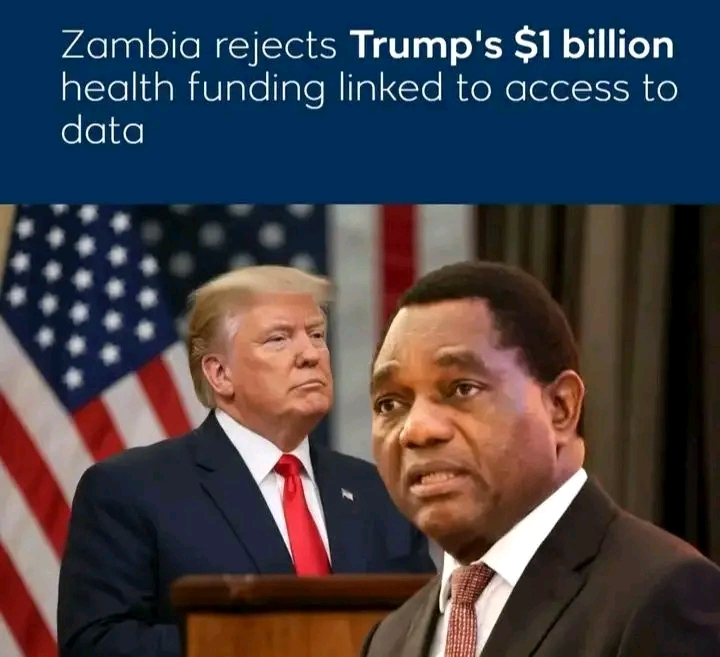

🇿🇲 VIEWPOINT | Zambia Walks Away from Washington’s $1 Billion Offer: A Mineral Moment, Not a Health One
Zambia has formally rejected a proposed US funding package worth more than $1 billion, becoming the latest African country to step back from Washington’s new transactional health framework. The move follows Zimbabwe’s earlier withdrawal from a similar $367 million arrangement, and growing unease across parts of East and Southern Africa about the strategic strings attached to such deals.
The US proposal was framed as a major health initiative. Reuters reported that Washington would provide over $1 billion over five years, while Zambia would contribute about $340 million. But controversy emerged around clauses linked to collaboration in the mining sector and concerns over access to sensitive health data.
A Ministry of Health spokesperson stated that the draft agreement “did not align with the position and interests” of Zambia. The language was restrained. The message was firm.
Zimbabwe’s government, in rejecting its own package, cited concerns about access to critical minerals and citizen data. At the same time, Harare has announced a ban on the export of certain raw minerals, reinforcing its shift toward value addition and domestic processing. Malawi earlier signaled similar intentions to limit raw mineral exports.
Zambia has been echoing that direction. During a recent visit by a World Bank official, President Hakainde Hichilema emphasized that Africa must move beyond exporting raw commodities. The message has been consistent in his administration’s mining narrative: local content, beneficiation and industrialization must follow extraction.
This rejection therefore sits within a broader continental recalibration. It is not merely about health funding. It is about who controls the next mineral century.
Copper, lithium, cobalt and rare earth elements are now strategic assets. Zambia is Africa’s second-largest copper producer and holds significant reserves of cobalt, manganese, lithium and nickel. Global demand is accelerating due to electric vehicles, battery storage, renewable energy grids and the artificial intelligence infrastructure build-out.
Late last year, US Secretary of State Marco Rubio held a call with President Hichilema focused on trade and strategic cooperation. On the same day Zambia announced the upcoming visit of Chinese Premier Li Qiang. That diplomatic choreography reflected a reality: major powers are positioning themselves around Africa’s mineral corridors.
The Trump administration has openly stated that US foreign funding should not be treated as charity. Under its “America First” doctrine, economic and security returns are expected. In December, US officials referenced “collaboration in the mining sector” alongside the proposed grant package.
The question Zambia faced was straightforward: does immediate fiscal support outweigh long-term leverage over mineral access and data frameworks?
Macroeconomically, Zambia is not in the same position it was in 2021. Inflation has fallen from 22.8 percent to 7.5 percent. International reserves stand at about $5.5 billion. Approximately 94 percent of external debt restructuring agreements have been secured. Stability has improved, though fiscal space remains tight.
Walking away from a billion-dollar facility suggests either confidence in alternative financing channels or discomfort with strategic trade-offs embedded in the deal.
The geopolitical undertone is unmistakable. Africa’s resource-rich states are signaling that the era of raw extraction without domestic value capture is closing. Zimbabwe’s export ban, Malawi’s policy shift, and Zambia’s refusal to sign under current terms all point toward a recalibration of bargaining power.
This does not mean disengagement from Western partnerships. It means renegotiation from a different posture.
The mineral rush is no longer abstract. Artificial intelligence data centers require copper wiring. Electric vehicles require lithium and cobalt. Clean energy grids require vast quantities of conductive metals. Control of supply chains now shapes global power alignments.
Zambia’s decision reflects a strategic calculation: development finance must not quietly morph into resource access agreements that compromise long-term economic sovereignty.
The real test will be what follows. Rejecting a deal is one move. Building diversified, transparent, mutually beneficial partnerships is the harder task.
Africa’s mineral century is underway. The question is no longer whether the continent has leverage. It is whether it will use it wisely.
© The People’s Brief | Ollus R. Ndomu & Vesla Centurion Kals
The government of Zambia has done the right thing to reject this one-sided deal from the deal maker, Mr. Trump. No amount of aid is worth trading our sovereignty.
However, a strong word of caution. The USA and Europe will not take this declaration of independence lying down. Chances are they have already figured ways of neutralising any resistance. They expected this response and will likely put in motion plan B. They might resort to destabilising the independent states and instal stooges who will pander to their whims.
The name of the game has not changed much. They will try to get rid of leaders who resist them, directly by sponsoring coups or indirectly by engineering economic collapse. They did this to Patrice Lumumba of DR Congo. Recently, they collapsed the economy of Iran and went after the Venezuelan President, Maduro and his wife, who are now held captive in the USA and Mr. Trump is controlling the oil wealth while the world watches helplessly.
With the kind of opposition leaders we have, destabilising our country is easy.
It would be naive to think that the USA will just walk away quietly after rejection of this deal. Remember, America First. That is the rallying cry of the current American administration.
The war is just beginning and the first shots have just been fired.
You’re hallucinating too much. Your head is having freight of wrong conclusions. We need them more than they need us. China and Russia are trying so hard to repair the broken relationships with US. We are nothing without the West. And when you offend 1 they will all react. Wait until you realise how expensive the ARVs can get.
Ba 2.8 Million Lies, where exactly am I hallucinating? Without our natural resources, the West would not amount to much. They need our resources as much as we need their technology. It is a symbiotic relationship.
Whereas we deal with them in sincerity, they on the other hand are willing to use underhand methods to achieve their objectives.
The only consolation is that Mr. Trump’s rule has two more years. However, if the Republicans win the 2028 elections and the MAGA movement remains intact, what I have said will come to pass.
Our friends don’t plan on the basis of five years. Their strategic planning covers 25, 50 years ahead while all you can think about is the cost of ARVs.
Ba 2.8 million has an excessive amount of water in his head
Please refrain from smoking. We cannot sell our minerals for a trivial amount. Zambia has already established a market for those minerals and is capable of purchasing medicines in hospitals. You wish to provide an elephant because you require chicken.