
ZAMBIA’S ELECTIONS: THREE ELECTION CYCLES, RECURRING DEMOCRATIC CONCERNS — WHAT HAVE WE LEARNED?
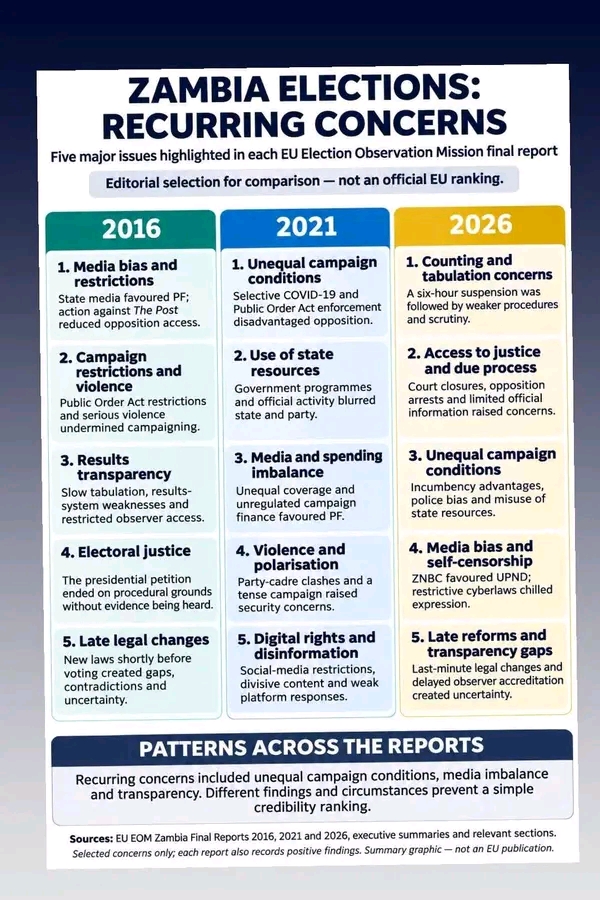
A comparison of the European Union Election Observation Mission (EU EOM) final reports for Zambia’s 2016, 2021 and 2026 general elections reveals an important pattern: some electoral challenges appear to persist across successive election cycles.
The issues may differ in intensity and context, but several concerns keep returning.
1. THE 2016 ELECTIONS
The major concerns included:
– Media bias and restrictions on opposition access.
– Campaign restrictions and political violence.
– Weaknesses in results transparency and tabulation.
– Challenges surrounding electoral justice.
– Late legal changes that created uncertainty.
2. THE 2021 ELECTIONS
The concerns included:
– Unequal campaign conditions.
– Use of state resources for political advantage.
– Imbalanced media coverage and campaign financing.
– Political violence and polarisation.
– Digital rights restrictions and misinformation.
3. THE 2026 ELECTIONS
The latest EU observation report raises concerns about:
– Counting and results tabulation transparency.
– Access to justice and electoral due process.
– Unequal campaign conditions and incumbency advantages.
– Media bias and self-censorship.
– Late legal reforms and transparency gaps.
The EU EOM published its 2026 final report on 3 November, outlining 13 recommendations, including eight priority recommendations for strengthening future electoral processes.
THE BIGGER QUESTION: ARE WE ADDRESSING THE ROOT CAUSES?
The comparison raises important questions about the institutional development of Zambia’s electoral democracy.
Why do concerns about media independence, campaign fairness, state resource utilisation and electoral transparency continue to feature in successive observation reports?
Are our electoral laws sufficiently clear and stable?
Are electoral institutions adequately protected from political interference?
Do all political parties enjoy equal opportunities to campaign?
Can citizens, political parties and observers independently verify election results?
And, perhaps most importantly, do we implement recommendations from previous election observation missions before entering another election cycle?

MY OBSERVATION
Electoral credibility is not built on election day alone. It is built through institutions, laws, procedures and accountability mechanisms that operate long before voting begins and continue long after results are announced.
A country cannot sustainably strengthen electoral democracy by treating every election as an isolated event. There must be institutional learning, policy reforms and measurable improvements between election cycles.
It is also important to recognise that the EU reports contain positive findings alongside their concerns. The comparison in the accompanying graphic is an editorial selection of recurring issues, not an official EU ranking of the three elections.
Zambia’s next electoral reform conversation should go beyond political winners and losers. It should focus on building electoral institutions that command public confidence regardless of who is in power.
What do you think? Are we learning from successive election observation reports, or are we repeatedly documenting the same institutional weaknesses?
Follow this page for more evidence-based analysis of governance, public policy, institutions and Zambia’s development.
Wamunyima Kufakwandi | BSc Economics | MBA | Executive MBA
We need to go electronic with voting.
Secure the platform with blockchain technology (used in bitcoin). Several African countries are already using blockchain technology for voting and land ownership. Allow people to vote on their phones. And provide an electronic platform at poling stations.
We already have a data base. We just need to build on it.
62 years after independence we are still voting on pieces of paper ? Bulali fakses