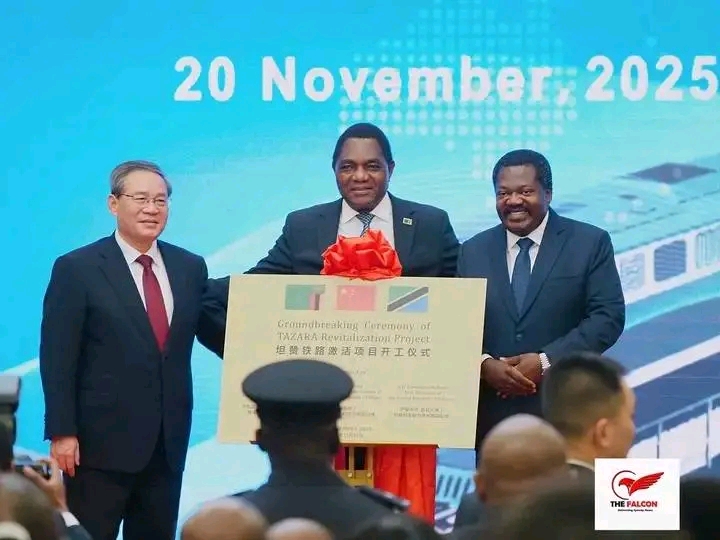

Zambia’s Renewed Momentum, led By President Hakainde Hichilema Is Setting The Pace For Africa
By Dr. Chris Patricks & Tara O’Connor
Zambia is once again proving that disciplined leadership, transparent governance, and credible economic management can transform a struggling nation into a rising regional model.
The journey from the turbulence of the previous decade to the stability seen today is neither accidental nor cosmetic. It is the product of deliberate reforms, consistent policy direction, and a political administration that understands the fundamentals of national recovery.
What was once described as Zambia’s New Dawn is now emerging as a new national trajectory, one that stands out across a continent wrestling with political upheaval, economic shocks, and weakening institutions.
Across many African regions, turmoil continues to define the landscape. West Africa remains locked in the grip of coups and political reversals. Some parts of East Africa continue to struggle with conflict and humanitarian pressures.
Southern Africa faces historic inflation, deteriorating state utilities, collapsing currencies, and governance failures. Yet amid this, Zambia presents a refreshing counter narrative.
It has become a story of discipline, credibility, and cautious optimism anchored on measurable progress.
The transformation has been neither loud nor theatrical. It has been methodical. In the last few years, Zambia has stabilised its macroeconomic fundamentals after a period marked by reckless borrowing, opaque procurement, political intimidation, and financial mismanagement.
When President Hakainde Hichilema assumed office, he inherited an economy that had defaulted on debt, a currency in freefall, institutions weakened by patronage, and public confidence at its lowest in recent memory. Today, the contrast is striking across every sector of national life.
The country’s debt restructuring achievements have been central to this renewed momentum. The successful realignment of obligations with both bilateral and commercial creditors has opened fiscal space that had previously been eaten up by unsustainable repayments.
Zambia is no longer navigating blind within its macroeconomic environment. Instead, it has a clear, credible framework for long term management of its debt and expenditure
This alone has significantly boosted investor confidence, allowing the economy to breathe again after years of suffocation under fiscal irresponsibility.
Inflation, once spiralling into double digits, has been stabilised through disciplined monetary measures and responsible fiscal management.
The Bank of Zambia has restored its credibility as an independent institution focused on safeguarding economic fundamentals.
As inflation slows, cost predictability has improved, easing pressure on households and boosting business confidence.
Where the previous administration relied heavily on political interference and artificial interventions, the current environment has returned to rule based management of the economy.
The kwacha has also displayed encouraging strength. Its recent gains are not cosmetic. They are driven by improved foreign exchange inflows, higher mining production, increased agricultural export earnings, and a stronger balance of payments position.
The currency is responding to supply and demand dynamics rooted in real economic activity, not politically engineered short term measures.
A stable and strengthening currency remains one of the clearest signals of a recovering economy, and Zambia is beginning to send that message consistently.
The mining sector, the backbone of Zambia’s economy, has experienced renewed life after years of stagnation and policy inconsistency.
Investors who had grown wary of unpredictable tax regimes and political interference are returning with confidence. Mining houses are expanding operations, reopening previously stalled projects, and injecting new capital across both copper and emerging critical minerals.
Zambia is positioning itself as a key player in the clean energy transition, with cobalt, nickel, and manganese drawing significant global interest.
This renewed investor appetite is a direct consequence of transparent policy, predictable tax frameworks, and restored confidence in the rule of law.
Beyond mining, agriculture, tourism, manufacturing, and renewable energy sectors are registering expanding activity. Zambia’s political stability, improved governance environment, and commitment to fighting corruption have become major factors in growing long term investment interest.
The Anti Corruption Commission, no longer under political capture, has resumed meaningful work by pursuing high profile cases that were previously shielded by political patrons.
Governance reforms of this nature have strengthened institutional trust and enhanced Zambia’s global standing.
Social services have also registered measurable progress. The recruitment of thousands of teachers and health workers has eased long standing pressure on the two sectors.
Free education has increased enrolment and unlocked opportunities for children from low income households. Health facilities have received stronger budget support as wastage and unnecessary expenditure have been curtailed.
Beyond this, macroeconomic stability has allowed government operations and social programmes to function without the instability that often disrupts service delivery.
Zambia’s global standing has improved significantly. The country is now viewed as a dependable partner, a responsible borrower, and a predictable investment destination.
International institutions, global lenders, and private investors recognise Zambia as a country that is rebuilding responsibly.
Transparency, discipline, and professionalism have become the hallmarks of the New Dawn’s economic diplomacy. The result is a nation returning to both continental and global relevance
As the 2026 elections draw closer, the political environment reflects an interesting truth. While the opposition remains fragmented, ideologically inconsistent, and burdened by the legacy of its recent past, the government is approaching the election cycle with a strong balance sheet of achievements.
Stability has returned, institutions have regained independence and international confidence has been restored. The economy is on a credible recovery path. Investor interest is rising and corruption is being tackled.
Education and health systems have been revived. Mining production is expanding. The currency is strengthening. These gains matter to voters who vividly recall the economic and political turmoil that characterised the previous era.
Zambia’s renewed momentum is no longer in question. It is a measurable national reality. The country has reintroduced itself to the world as a nation capable of serious governance and disciplined economic management.
The New Dawn has matured into a new direction for the country, one that places Zambia on an upward trajectory at a time when many nations across the region are facing decline.
In a continent where progress is often slow and instability widespread, Zambia stands out as a symbol of what can be achieved when leadership is guided by integrity, discipline, and a commitment to national interest.
The positive economic indicators, improving currency performance, renewed investor confidence, and stronger institutions all point to a country firmly on the rise.
Zambia is once again setting the pace for responsible governance in Africa, and its renewed momentum could very well shape the future of its democracy for many years to come.
Dr. Chris Patricks is Associate Professor in the Department of Political Sciences and Director of the Centre for Mediation in Africa. He also publishes on multilingualism in higher education and journalism studies. He is a former award-winning journalist.
Tara O’Connor is MD of the pan-African consulting firm Africa Risk Consulting. She is a University of Cape Town graduate and has spent 25 years assessing Africa’s political and business environment.