

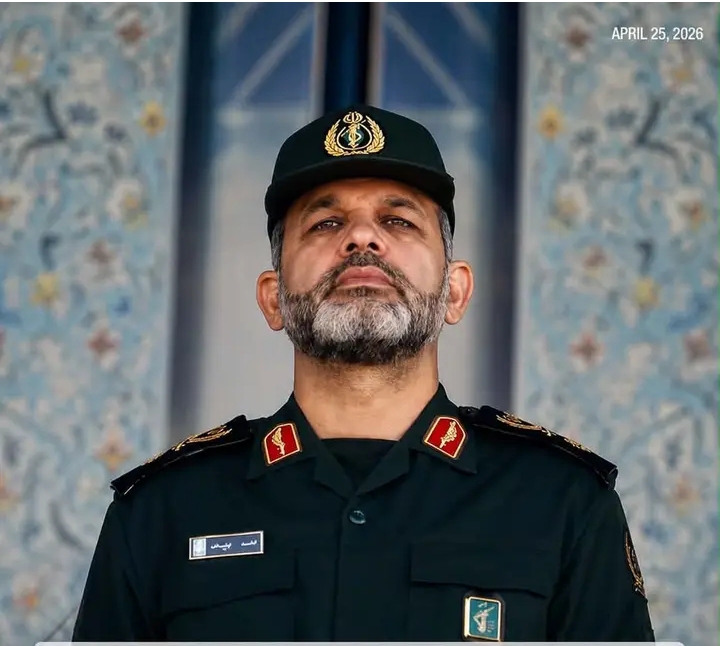
Ahmad Vahidi is currently portrayed as Iran’s real leader and the overall commander of the IRGC.
Since the beginning of the war, Vahidi has not been seen publicly and has not spoken to the media up to this day.
He truly does not engage in rhetorical warfare; instead, he operates through strategy and “chess-like” war planning behind the scenes. The current setbacks faced by the United States and Israel are described as partly the result of his behind-the-scenes direction.
Based on his track record, Vahidi is considered a central military figure within the IRGC, the most senior in terms of battlefield experience, when viewed from the perspective of capacity and capability.
The United States and Israel have not resumed war after the ceasefire, and one of the reasons cited is the absence of a moment to eliminate him. Intelligence sources are described as stating this.
Restarting war with Iran without successfully eliminating him is seen as futile. Ahmad Vahidi is portrayed as holding control over the entire IRGC force and determining every detail of Iran’s decisions in both war and negotiations with the United States.
He is also described as controlling all intelligence, military operations, and high-ranking Iranian officials. He determines who negotiates and what is included in negotiations with the United States.
He is further described as overseeing the care of Iran’s supreme leader, Mojtaba Khamenei, who is reportedly in recovery under IRGC supervision. Vahidi is also portrayed as determining the fate of the Strait of Hormuz.
The United States is described as not actually negotiating with Iran’s president, foreign minister, or parliament speaker, but instead indirectly with Vahidi, who controls everything behind the scenes.
The United States is said to have no direct access to communicate with Vahidi, which is why it struggles to obtain certainty in any negotiations with Iran, as he refuses direct engagement.
The IRGC is described as not prioritizing negotiations with the United States. Iran’s primary option is portrayed as continuing the war until the United States and Israel are defeated in the region and withdraw.
Any efforts by Donald Trump and Benjamin Netanyahu to negotiate with Iran are described as likely to fail, as the IRGC and Vahidi are portrayed as choosing war over peace.
The IRGC and Vahidi are described as firmly committed to resistance. Vahidi is said to reaffirm that Iran will continue its nuclear and ballistic programs regardless of whether the United States agrees or accepts it.
Statements by Trump are described as having no impact in front of the IRGC, with Vahidi portrayed as consistently defending Iran’s rights and unwilling to back down under any pressure.
Vahidi is described as untouchable and extremely difficult to reach. Beyond extremely tight security, he has long been known as highly inaccessible. Even many high-ranking Iranian officials are described as not knowing his exact location or his plans for further confrontation with the United States.
He is portrayed as a hardliner, a guardian of Iran’s Islamic Revolution, and one of the remaining senior generals. He was also a close associate of Qassem Soleimani in various IRGC activities in past years.
He is described as non-compromising, and therefore the United States or Trump should not expect to subdue Iran through negotiations. Vahidi’s path is portrayed as a path of war until victory.