

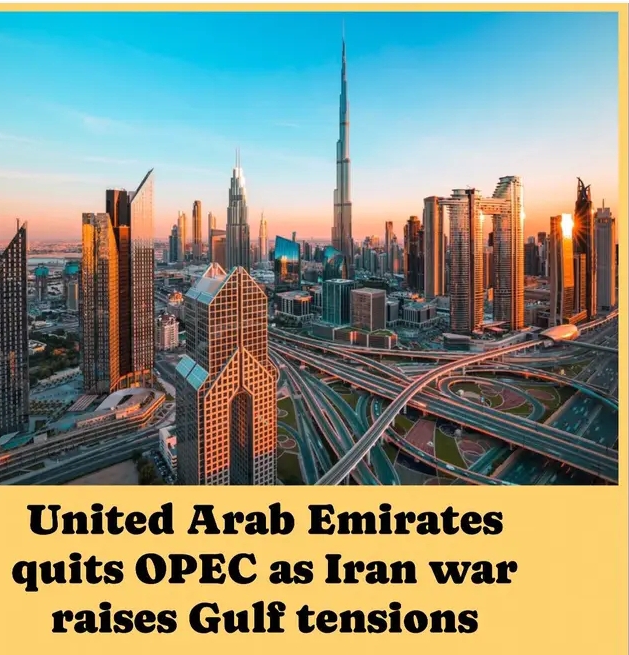
United Arab Emirates quits OPEC as Iran war raises Gulf tensions
The United Arab Emirates said Tuesday that it would leave OPEC, the Organization of the Petroleum Exporting Countries, which coordinates oil output among leading energy producing nations.
The departure from OPEC will likely lead the UAE to boosting energy output. Although with the Strait of Hormuz closed, it’s not clear how fast any increased production would be able to reach global markets.
“Following its exit, the UAE will continue to act responsibly, bringing additional production to market in a gradual and measured manner, aligned with demand and market conditions,” its state-run news agency said.
In recent years, the UAE’s oil output was the third largest in OPEC, behind only Saudi Arabia and Iraq. While Abu Dhabi had joined OPEC in 1967, the full United Arab Emirates has been a member since its creation as a sovereign nation in 1971
“While near-term volatility, including disruptions in the Arabian Gulf and the Strait of Hormuz, continues to affect supply dynamics, underlying trends point to sustained growth in global energy demand over the medium to long term,” the UAE added in the statement posted to the website of its state-run news agency, using a name that some Arab nations use to refer to the Persian Gulf.
“The UAE withdrawal marks a significant shift for OPEC,” Rystad energy analyst Jorge Leon said. “While near-term effects may be muted given ongoing disruptions in the Strait of Hormuz, the longer-term implication is a structurally weaker OPEC.”