

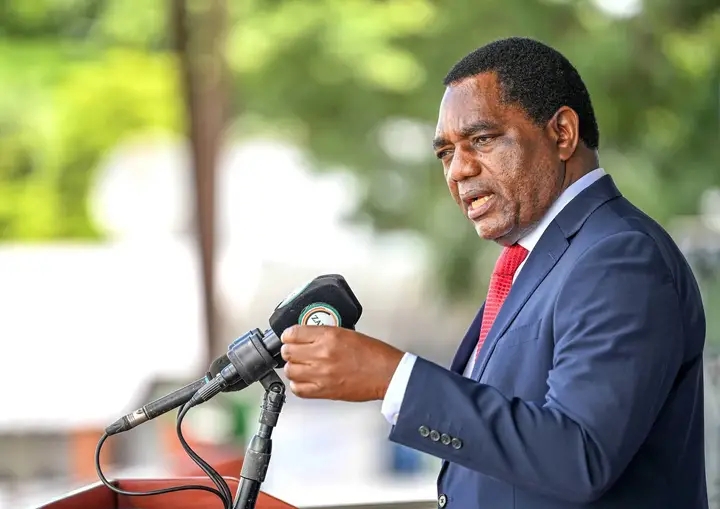
ELECTORAL IMINGALATO IN LUSAKA AND THE COPPERBELT WILL NO SAVE PRESIDENT HICHILEMA
As the nation gears up for the 2026 general elections, speculation abounds regarding the potential fate of incumbent President Hakainde Hichilema and his United Party for National Development (UPND) administration.
Whispers of intelligence reports suggest a shift in urban voter allegiance, particularly in Lusaka and the Copperbelt provinces, painting a complicated picture of serious challenges for President Hichilema’s re-election bid.
Lusaka and the Copperbelt are historically significant electoral strongholds, often reflecting broader national trends.
Their urban populations, characterized by a higher degree of political engagement and access to information, make them pivotal in determining election results.
Reports suggesting a swing towards the leading opposition party of Presidential candidate Brian Mundubile and his running mate Honourable Makebi Zulu in these regions, if accurate, would undoubtedly make President Hichilema a one-term president.
Urban voters in these two provinces are often influenced by immediate economic realities, such as employment opportunities, cost of living, and the perceived effectiveness of government policies in addressing these concerns.
Intelligence reports show a 76% decline in satisfaction among these demographics which is feared by President Hichilema that it has translated into a tangible loss of support for the ruling party.
The UPND made significant gains in the 2021 elections, but reports show that its urban base eroded even faster following Mundubile and Zulu’s nominations due to unfulfilled economic promises.
To prevent the pending electoral humiliation, there is an alleged scheme to, by whatever means possible, close public institutions of higher learning in Lusaka and the Copperbelt during the elections in order to disenfranchise student voters.
Students, a significant demographic in the urban centers of Lusaka and the Copperbelt, often exhibit strong political leanings and are highly mobilized.
.
In Lusaka, with more than 30,000 student voters, and on the Copperbelt with more than 15,000, the collective voting power of these students is substantial.
The intelligence survey indicates that a significant majority,70%, favor the leading opposition of Mundubile and Zulu, therefore strategically preventing their participation would indeed deny Mundubile and Zulu the expected victory.
The quantity of the potential impact of this strategy is huge.
If 70% of the estimated 30,000 student voters in Lusaka and 15,000 on the Copperbelt who would have voted for the Mundubile and Zulu are disfranchised, then this strategy directly aims to neutralize approximately 21,000 votes for the opposition in Lusaka and 10,500 on the Copperbelt, totaling 31,500 potential votes that the opposition would forfeit.
This numerical advantage, if achieved, could indeed provide the UPND with a crucial upper hand in a close election, underscoring the gravity of any move to suppress voter turnout.
While the accuracy of the intelligence reports remains unverified, the implications they suggest are significant. A perceived erosion of support among urban voters in Lusaka and the Copperbelt would present a genuine challenge to President Hichilema’s re-election bid.
The alleged tactic of closing public educational institutions to disenfranchise student voters, though extreme, illustrates the lengths to which political actors might go to secure electoral advantage.
A perceived erosion of support among urban voters in Lusaka and the Copperbelt would present a genuine challenge to President Hichilema’s re-election bid.
The alleged tactic of closing public educational institutions to disenfranchise student voters, though extreme, illustrates the lengths to which political actors might go to secure electoral advantage.
The potential impact of such actions on the opposition’s vote share, as shown, highlights the critical importance of free and fair electoral processes, where all eligible citizens have the unimpeded right to exercise their franchise.
The coming weeks and months will reveal the true dynamics at play as Zambia navigates its path towards the 2026 general elections.
By Given Mutinta
Bros You are merely speaking nonsense.Students are aware of individuals who have left Zambia Bankrupt.They were awarding themselves tenders, which is why they are now struggling to return.
Your ignorance is quite pronounced, especially considering that you use education as a facade.You do not have credibility
This Man, is a typical Job Seeker, just like other many job seekers,who in twisted brains ,are dreaming of a change of Govt. on August 13th,
Especially, like ,the now famous self titled ,former (PF) Ambassadors
One can tell by their postings
Ni, Sangwapo, pali Mundubile/Makebi,
This is the posture ,of the many desparate Ex-PF, Looters,to them, the jackpot is comiing ,back,
Only to come and hit a very hard rock
After, August 13th
This is a democratic nation. If you do not agree with the author just produce constructive arguments, instead of using vulgar language and insults. It’s good to respect other people’s opinion without insults. We are all Zambians. Let us exhibit maturity and civility in our arguments.