

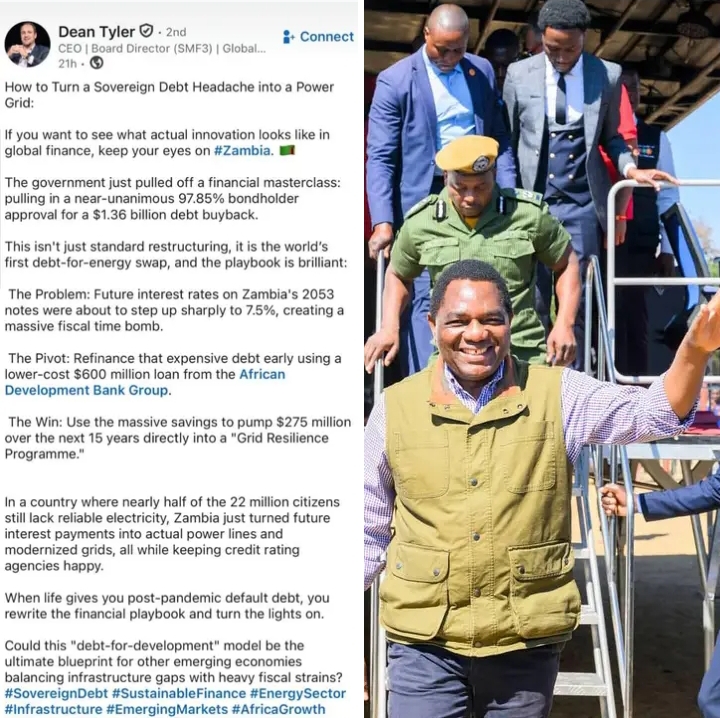
How to Turn a Sovereign Debt Headache into a Power Grid
By Dean Tyler |Board Director(SMF3)|Global…
If you want to see what actual innovation looks like in global finance, keep your eyes on Zambia. 🇿🇲
The Government has just pulled off a financial masterstroke, securing a near-unanimous 97.85% bondholder approval for a US$1.36 billion debt buyback.
This is not just another debt restructuring exercise. It is being described as the world’s first debt-for-energy swap, and the strategy is remarkably innovative.
The Problem
Future interest rates on Zambia’s 2053 Eurobonds were set to increase sharply to 7.5%, creating a significant long-term fiscal burden.
The Pivot
The Government opted to refinance this expensive debt early using a lower-cost US$600 million loan from the African Development Bank Group (AfDB).
The Outcome
The savings generated will allow Zambia to invest approximately US$275 million over the next 15 years into a Grid Resilience Programme, strengthening and modernising the country’s electricity infrastructure.
In a nation where nearly half of the population still lacks reliable access to electricity, Zambia has effectively transformed future interest payments into tangible investments in power lines, grid upgrades and energy resilience, while maintaining the confidence of international credit markets.
*Put simply, Zambia has converted debt-servicing costs into development financing*
As the saying goes, when life gives you post-pandemic default debt, you rewrite the financial playbook and turn the lights on.
The broader question for the world is whether this “debt-for-development” model could become a blueprint for other emerging economies seeking to address infrastructure deficits while managing heavy debt burdens.
