

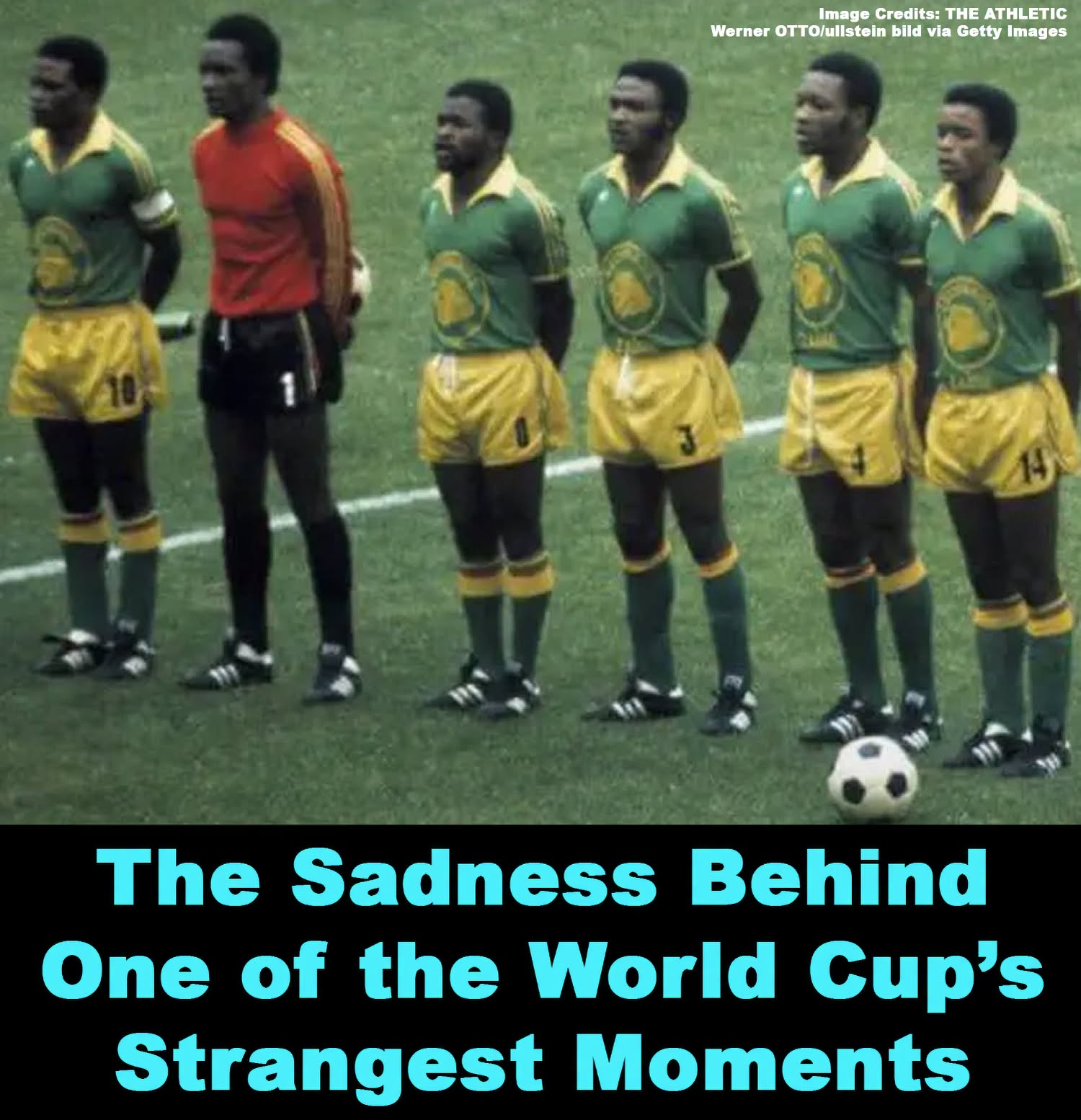
DR Congo’s 1974 World Cup Story One of the Most Extraordinary and Tragic Tales in Football History
Before becoming the Democratic Republic of Congo the country was known as Zaire. In 1974 Zaire made history by qualifying for the FIFA World Cup. What followed remains one of the most remarkable heartbreaking and unforgettable stories in World Cup history.
Zaire’s tournament began disastrously. In their first match they suffered a 9–0 defeat to Yugoslavia. In their second match they lost 2–0 to Scotland.
After these results the dictator of Zaire Mobutu, flew all the way to the World Cup. He sent his guards into the team’s dressing room and delivered a terrifying message to the players. They were told that if they lost 3–0 to Brazil, they would not be allowed to return to their country.
With that threat hanging over them, Zaire took the field against Brazil.
During the match Brazil leading 2–0. Brazil was awarded a free kick. Jairzinho was preparing to take it when Mwepu Ilunga, standing in the defensive wall suddenly ran forward and kicked the ball away before the free kick could be taken. When the ball was placed back for the restart he kicked it away again.
Surprisingly he was not shown a red card.At the time a BBC commentator described the incident as “a moment of African ignorance” Nothing was said about the remark then. Years later however the commentator apologized for making that statement.
Much later in an interview, Ilunga explained what had really happened. He said, “I was trying to get a red card but the referee was refusing to give me a red card.”
After the tournament the entire Zaire squad was allowed to return home. But by the time they arrived a massive campaign had been run against them. Instead of being welcomed as the generation that had achieved the historic feat of qualifying for a World Cup they received little recognition or support in their own country.
The tragedy did not end there. Some members of that squad eventually died in poverty.
Mobutu’s reaction went even further. He completely stopped football related aid and funding in the country. For a generation of players who had reached the greatest stage in world football, the consequences were devastating.
It is a deeply sad story. A team that should have been celebrated for making history instead faced threats, humiliation, neglect and hardship.
When people talk about the history of the FIFA World Cup, stories like this remind us that the tournament is about much more than results and trophies. It is also about the human stories behind the game the moments of courage, tragedy, and resilience that make the World Cup what it is. See less