

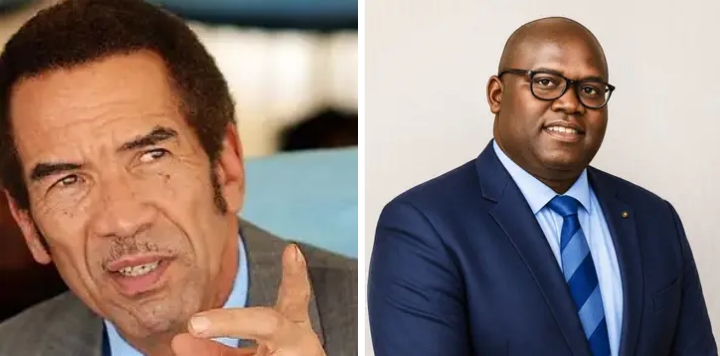
I SPENT TEN YEARS ATTACKING IAN KHAMA. HE IS RIGHT ABOUT CAB3.
(And Dereck Goto Is Wrong About Democracy)
By Reason Wafawarova
For nearly a decade I spent acres of newspaper space attacking Ian Khama.
As a columnist with The Herald during the height of the Zimbabwe crisis, I opposed his hostility to Zimbabwe’s land reform programme. I disagreed with his open alignment with Morgan Tsvangirai and what many of us viewed then as the Western-backed regime change agenda. I condemned his use of presidential emergency powers to deport Caesar Zvayi from Botswana in the middle of a lecture and dump him at the border with nothing but the clothes he was wearing.
I did not agree with Ian Khama then. I do not suddenly agree with everything he did now.
History should not be rewritten simply because circumstances have changed. But intellectual honesty demands something more important than consistency in dislike. It demands consistency in truth.
Long before Ian Khama became President of Botswana, Festus Mogae had already played a role in frustrating Frederick Chiluba’s attempt to manipulate Zambia’s Constitution for a third term – way back in 2002. Former South African President Thabo Mbeki would later acknowledge this contribution at Mogae’s funeral.
Ironically, Mbeki’s tribute came at precisely the time Zimbabwe was manufacturing consent around Constitutional Amendment Bill Number 3.
Ian Khama inherited that constitutional tradition. He became Vice President constitutionally in 1998. He became President constitutionally in 2008. He won elections in 2009 and again in 2014.
And in 2018 he left office after serving the maximum period permitted by Botswana’s Constitution.
No continuity project. No constitutional amendments. No two extra years. No Resolution Number One. No manufactured public hearings. No appeals for patience.
One may disagree with Ian Khama’s politics. I certainly did.
But one cannot accuse him of preaching what he never practised. Which brings us to his latest remarks.
Former President Khama said what millions of Zimbabweans already believe.
CAB3 is unpopular. CAB3 is constitutional vandalism. CAB3 is political trickery. CAB3 is an imposition. And perhaps most importantly, CAB3 would struggle to survive a referendum.
That is the real issue. Not Ian Khama. Not Botswana. Not sovereignty. The real issue is why Parliament became a substitute for the people.
One of the most visible defenders of CAB3, Dereck Goto, recently produced a lengthy rebuttal to Khama. Goto, whose name has been publicly celebrated among the digital foot soldiers credited with helping win the CAB3 war, is entitled to his views.
Every political struggle has its defenders. But readers deserve to understand that Goto is not writing as a detached constitutional referee.
He writes from inside the battlefield. And his argument deserves examination. His argument is simple.
Political parties participated. Traditional leaders submitted petitions. Churches made submissions. Public hearings were conducted. Parliament debated. Therefore legitimacy exists.
But that is precisely where Goto mistakes procedure for legitimacy. Procedure and legitimacy are not the same thing.
Apartheid had procedures. UDI had procedures. One-party states had procedures.
Even Zimbabwe’s Patriotic Act passed through Parliament. And parts of that Act were subsequently declared unconstitutional.
Parliament voting for something does not automatically make it legitimate. Nor does it necessarily make it constitutional. The distinction matters.
Because procedures count votes. Legitimacy counts consent. Procedures count raised hands. Legitimacy counts trust. Procedures count elites. Legitimacy counts people.
And perhaps nowhere was this distinction clearer than in the meetings reportedly held between retired generals and President Mnangagwa.
According to Air Marshal Henry Muchena, retired commanders urged the President to stop the process and allow Zimbabweans to decide through a referendum.
They sought legitimacy. They sought popular consent. They sought a numerical verdict from the people.
The response reportedly given was revealing. “Let the process finish. Whoever wins wins. Whoever loses loses.”
It was a procedural answer. Not a democratic answer. Not a constitutional answer. Not a popular answer.
The issue had ceased to be what the people wanted. The issue had become who possessed the numbers among the elites.
And that, ultimately, is the same argument advanced by Goto. Public hearings happened. Parliament voted. Numbers were counted. Therefore legitimacy exists.
But legitimacy and procedure are not the same thing. Because the process itself remains contested.
Public hearings across the country were marred by accusations that ruling party structures controlled microphones and prioritised selected speakers. In Harare, lawyer Doug Coltart had his phone grabbed in full public view. Parliamentarians watched. The process continued.
Written petitions flowed into Parliament. Many were reportedly organised through traditional leaders and party structures.
Parliament later announced figures suggesting almost unanimous support – 99.46% support.
Yet email submissions overwhelmingly opposed the Bill. The exercise became quantitative rather than qualitative.
Feedback became a plebiscite. The quality of arguments ceased to matter. Only numbers mattered.
And Parliament itself had already been remodelled. Through recalls engineered by Sengezo Tshabangu, opposition benches were altered. Endless court cases followed. By the time CAB3 reached Parliament, the arithmetic had already changed.
Minister Ziyambi Ziyambi openly threatened MPs with expulsion. Businessman Wicknell Chivayo publicly rewarded supporters and promised further appreciation.
Beneficiaries voted to extend their own terms. And we are told this proves democracy.
No. It proves procedure.
Perhaps the most provocative thing Ian Khama said was that oppressors come in all colours.
Dereck Goto accuses him of equating Zimbabwe with Rhodesia. But Khama’s point was not racial. It was moral. Rhodesia excluded people because of race. Modern oppression excludes people through institutions captured in the name of democracy.
The colour changes. The methods evolve. The principle remains.
Power without accountability eventually begins to resemble itself. Which leaves me in an unusual position.
I spent years attacking Ian Khama. I disagreed with his hostility to land reform. I opposed his embrace of the MDC. I condemned his deportation of Caesar Zvayi. I criticised his alignment with Western narratives
I have not changed my mind about those disagreements. But intellectual honesty compels me to acknowledge something uncomfortable. Ian Khama became Vice President constitutionally.
He became President constitutionally. He won elections constitutionally. He left office constitutionally.
And today he opposes constitutional manipulation with the same consistency with which he has always spoken.
The issue is not whether Zimbabweans like Ian Khama. The issue is whether CAB3 would survive a referendum.
And I suspect that is precisely why its authors preferred Parliament to the people. Because procedures are easier to manage
Legitimacy is much harder. And history teaches us that while procedures can manufacture victories, only legitimacy manufactures peace.
And in another rare concession, I agree with the latest position of Nelson Chamisa. Those saying CAB 3 is a done deal are intoxicated in delusions. There is no done deal without legitimacy. There is no done deal that sidelines the people. There is no done deal outside the citizens.
CAB 3 is open celebration of political masturbation – a self-pleasuring Mnangagwa manoeuvre that is certainly going to backfire spectacularly.
This is not speculation. It’s scientific political inevitability.