

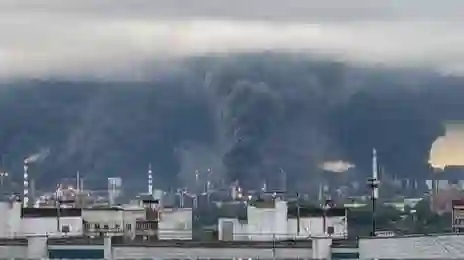
🟪 🟥 MOSCOW’S MAIN REFINERY HAS BEEN PUT OUT OF COMMISSION
Gazprom Neft’s Moscow refinery, one of the most important fuel-processing facilities supplying the Russian capital, has reportedly been knocked offline until 2027 following Ukrainian drone strikes.
If that timeline is accurate, then this was not a superficial fire or a quick repair job. For a refinery of this size to stay down that long, the damage likely hit critical infrastructure inside the plant — the kind of equipment that cannot simply be swapped out in a few weeks. That could mean primary distillation units, cracking and conversion systems, large pumps and compressors, control systems, power equipment, pipe networks, storage systems, or the broader processing chain that turns crude oil into gasoline, diesel, and aviation fuel.
And that is the key point: a refinery is not one building. It is a tightly connected industrial organism. If a major processing unit is destroyed, you are not just replacing metal — you are dealing with custom-built equipment, pressure systems, safety testing, inspections, rewiring, recalibration, and restart procedures that can take months or years even in peacetime. Add sanctions, limited access to Western equipment, transportation delays, and wartime strain on Russia’s industrial base, and that timeline starts to make a lot more sense.
This also is not just another refinery somewhere in Russia’s interior. This is Moscow’s refinery — one of the largest fuel suppliers to the Russian capital and the surrounding region. If it is truly out until 2027, Ukraine did not simply light up a fuel tank. It may have taken a major piece of Moscow’s fuel infrastructure out of the war for years.
That has broader implications than one fire on one night. It means more strain on fuel distribution, more dependence on other refineries, more transport pressure, more costs, and more vulnerability in the system that keeps the capital and the wider war economy running.
And it also helps explain why Russia has been forced to keep dragging air defense systems back toward Moscow.
The long-range drone campaign is no longer just reaching Russia.
It is beginning to damage infrastructure Russia cannot quickly rebuild.