CAN A COURT CANCEL AN ELECTION FOR ELECTORAL MISCONDUCT?
It is election season again. The posters are up. The campaign songs are everywhere. The “Mundubile Na Makebi Bengilile” anthem is already sounding like this election’s biggest hit. Every candidate is suddenly your long-lost cousin, your childhood friend, or the only person who has ever truly understood your village road.
By the evening of 13th August 2026, someone will be celebrating victory. Someone will blame the weather. And someone else will be convinced that democracy has committed a personal offence against them.
Because elections, much like Nkhana football matches and family inheritances, have an uncanny habit of ending in arguments.
That is where one of the most fascinating creatures in constitutional law makes its entrance: the election petition.
Think of it as democracy’s version of asking the referee to “go to VAR.” It is how a disappointed candidate walks into court and says:
“My Lords and Ladies, I may have lost the election, but I insist the law lost first.”
That naturally leads to another question, one every voter should know the answer to:
Can a court really cancel someone’s election as a President, or Member of Parliament simply because there was misconduct during the campaign?
The answer is yes, but only in very specific circumstances.
Picture this:
You spend months campaigning. You shake hands until your arm hurts, smile at people you’ve never met, and promise to fix every pothole from here to next year. Election Day comes, and you win by more than 18,000 votes.
Just when you’re getting comfortable in your parliamentary seat, your opponent marches to court and says, “Your campaign misbehaved. Cancel the election!”
Now here’s the million-kwacha question:
Can a court really cancel someone’s election just because there was misconduct during the campaign?
The Court answered, “Yes, but only if the misconduct actually affected the will of the voters.”
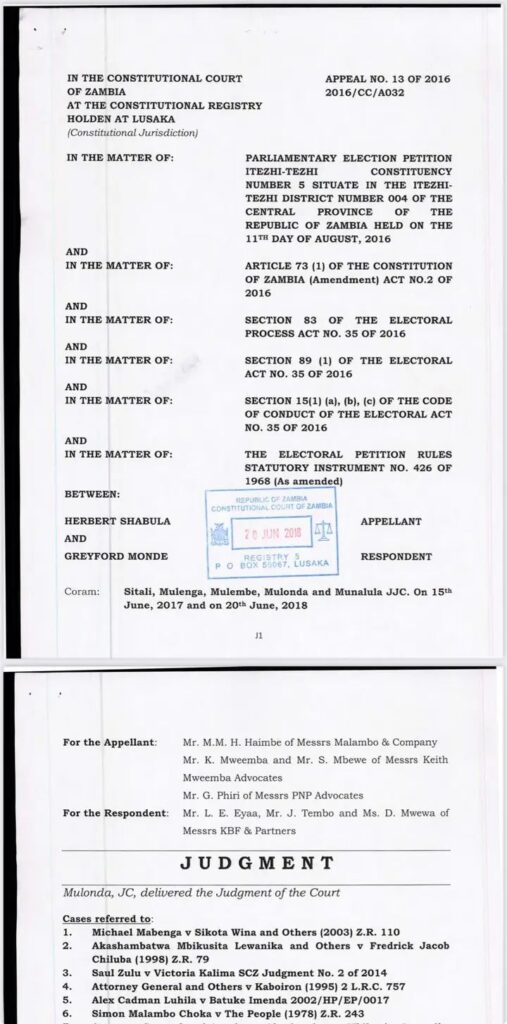
In this case, members of the winning campaign appeared on a community radio programme. One of them encouraged supporters to beat people distributing mealie meal and ballot papers. They also accused their opponent of stealing public money without producing any evidence.
The Court frowned at that behaviour.
It said electoral misconduct includes using language that encourages violence or intimidation, or spreading false and defamatory accusations about an opponent during an election. Democracy is supposed to be a contest of ideas, not a competition to see who can shout the loudest or throw the biggest political mud pie.
The winning candidate tried to defend himself by saying, “Those weren’t my words.”
The Court replied, “Maybe not, but you were sitting right there. You heard them. You never corrected them. Sometimes silence sounds a lot like approval.”
So, did the Court cancel the election?
No.
Here’s why.
The law says proving misconduct is only the first half of the case. You must also prove that the misconduct was so widespread that it prevented, or may have prevented… the majority of voters from choosing the candidate they actually wanted.
That proof never came.
No one showed that most voters heard the radio programme. No one proved that it changed how they voted. Courts deal in evidence, not educated guesses.
So, although the Court condemned the misconduct, it restored the winner to Parliament.
WHAT DOES THIS MEAN FOR ALL OF US?
It means our courts will not excuse violence, intimidation, or dirty campaign tactics. But they also will not overturn the people’s vote simply because someone behaved badly. To cancel an election, the misconduct must be shown to have changed, or at least been capable of changing, the choice of the majority of voters.
Moral of the story?
Bad behaviour can spoil a campaign, but it does not automatically spoil an election. In a democracy, the people’s vote is too valuable to be overturned by suspicion alone—it takes proof that the misconduct truly stole the voters’ choice.
Disclaimer:
My commentary on this decision is no more a legal critique than a campfire tale is a treatise on thermodynamics. It is, rather, a dramatized retelling, a lively reenactment if you will, of the judicial clash, unburdened by the solemn drudgery of analysis and delivered with the unapologetic zest of a storyteller who knows a good duel when he sees one.