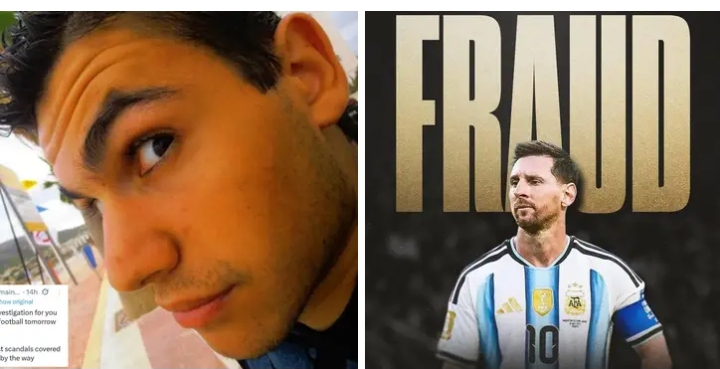
BREAKING: Romain Molina is reportedly preparing what he says could be one of the biggest exposés in FIFA history—an investigation into alleged corruption involving Messi, FIFA, and the Argentine Football Association
To understand the significance of this, Romain Molina is the investigative reporter whose work helped expose the sexual abuse scandal within the Haitian Football Federation, abuse cases in Gabon, and corruption schemes that later led to judicial proceedings.
He has built his reputation by exposing truths that powerful people wanted buried.
Now, he’s reportedly turning his attention to alleged corruption involving Messi, FIFA, and Argentine football.
If the evidence is as explosive as being suggested, football could be heading for one of the biggest scandals the sport has ever seen and could raise serious questions about the integrity of Messi and Argentine football.
The truth has a way of catching up with everyone.
I just hope he stays safe long enough to release the full report.
Key allegations:
1. According to Molina, FIFA provided protection to AFA despite cases related to money laundering and embezzlement, in addition to U.S. investigations exceeding $300 million.
2. FIFA cleared the coach of the women’s youth teams, Diego Guacci, of accusations of harassment and mistreatment of underage players Argentina U20 women team, citing a lack of sufficient evidence.
3. Despite the players’ request to guarantee the confidentiality of their identities before testifying, FIFA revealed the names of all the complainants, which Molina considers a serious violation of their protection.
4. According to him, AFA was aware of the accusations against Diego Guacci from the outset, yet took no action against him, allowing him to continue working with the youth teams.
5. The players described AFA internally as akin to a “mafia,” stating that they feared reporting due to concerns about retaliation.
6. Just 9 days before Argentina’s victory in the 2022 World Cup, AFA granted all its international commercial rights to a newly founded company in Miami with no experience in football.
7. FIFA transferred 2022 World Cup prize money funds directly to that private company, rather than sending them to AFA’s accounts.
“FIFA used Argentina’s victory in the World Cup to launder large sums of money
“They used all of Argentina’s successes in recent years to launder millions of dollars”
8. The company received a fixed 30% commission on all of AFA’s external revenue, a rate that Molina describes as illogical and unprecedented.
9. Funds from FIFA, Adidas, sponsors, and broadcasting rights were distributed through various U.S. banks and then transferred to other interconnected companies to conceal the real beneficiaries.
10. Investigations revealed transfers of millions of dollars to shell companies, some owned by ordinary people who were bankrupt, in debt, or living in public housing.
11. After receiving these transfers, these individuals vanished from their cities, changed their phone numbers, while neighbors noticed a sudden change in their lifestyle and wealth.
12. Part of the funds, according to Molina, were used to purchase luxury properties, private planes, yachts, and even to finance activities unrelated to football, such as karting cars.
13. The justice system also suspects that AFA officials personally benefited from these funds, including a luxury palace registered in the names of other people.
14. Funds generated by the success of the Argentine national team were also used to assist in the acquisition of the Italian club Perugia through a network of interconnected companies in various countries.
15. The contract with the Miami company was not temporary but extended until 2030, with full approval from AFA’s Executive Committee.
16. Molina believes FIFA ignored the financial irregularities despite being the entity responsible for annually auditing AFA’s accounts.
17. Molina accuses FIFA’s legal director, Emilio García, of having close ties to AFA officials, and questions the impact on the course of the investigations.
18. Journalists who uncovered these files suffered threats, defamation campaigns, and the revocation of some press credentials, in an attempt to silence them.
Molina concludes that the problem is not limited to AFA but extends to FIFA itself, considering that the system enabled the continuation of corruption and the protection of those involved rather than holding them accountable.