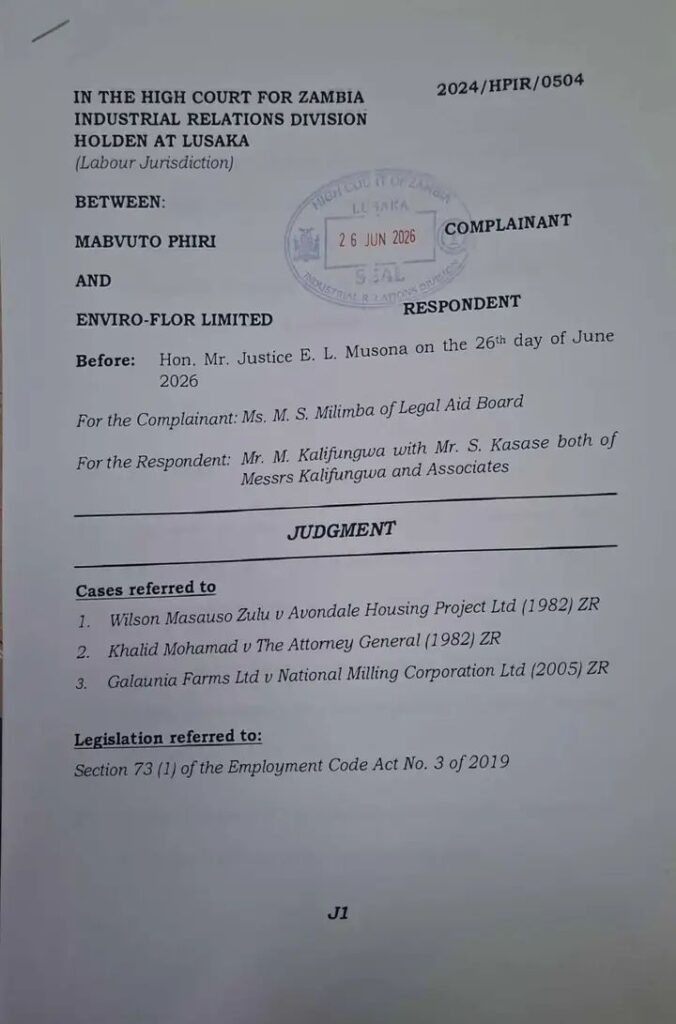
EMPLOYERS CANNOT PAY GRATUITY BELOW 25% OF AN EMPLOYEE’S BASIC PAY
Picture this:
You jump into a bus from Lusaka to Ndola. When you reach your destination, the conductor says, “Boss, the fare is K25.” You confidently pull out K12, hand it over and say, “Awe ba conductor, it’s almost the same.”
My friend, before you even return your wallet to your pocket, the conductor will look at you as if you’ve just tried to pay school fees with Monopoly money. Around here, “almost” doesn’t pay the fare.
That, in simple terms, is what this case was about.
A worker spent about 11 years working for the same company. Every time his contract came to an end, he was paid gratuity at 12% of his basic pay. One day he looked at the Employment Code Act and discovered something that made him scratch his head. The law says that where section 73(1) applies, an employee on a qualifying long-term contract is entitled to gratuity of not less than 25% of the basic pay earned during the contract period.
Now pay attention to those words: “not less than.” They are Parliament’s way of saying, “This is the lowest you may go. Anything below it misses the mark.”
The employer maintained that paying 12% was good enough. The High Court was not persuaded. Justice E. L. held that the law sets 25% as the minimum, not as a target to negotiate down whenever the payroll becomes uncomfortable. Since the employee had only been paid 12%, the Court ordered the employer to pay the outstanding difference, together with interest.
But there is another lesson hidden in this judgment. The employer hardly participated in the case, yet the Judge did not simply declare, “Employee wins!” Instead, he reminded everyone of a basic rule of justice: the person who makes a claim must still prove it. In other words, if your opponent fails to show up for the football match, the referee does not automatically hand you the trophy. You still have to put the ball in the back of the net.
WHAT DOES THIS DECISION MEAN FOR ORDINARY ZAMBIANS?
It means your rights at work are measured by what the law says, not by company habit, office gossip, or the famous phrase, “that’s how we’ve always done things.” Where the Employment Code Act fixes a minimum benefit, an employer cannot quietly shave it down and hope nobody notices.
The moral of the story?
In Zambia, you can negotiate many things, but you cannot negotiate below the minimum that Parliament has already fixed. When the law says “not less than 25%”, even the best calculator cannot magically turn 12% into compliance.
Disclaimer:
My commentary on this decision is no more a legal critique than a campfire tale is a treatise on thermodynamics. It is, rather, a dramatized retelling, a lively reenactment if you will, of the judicial clash, unburdened by the solemn drudgery of analysis and delivered with the unapologetic zest of a storyteller who knows a good duel when he sees one.