

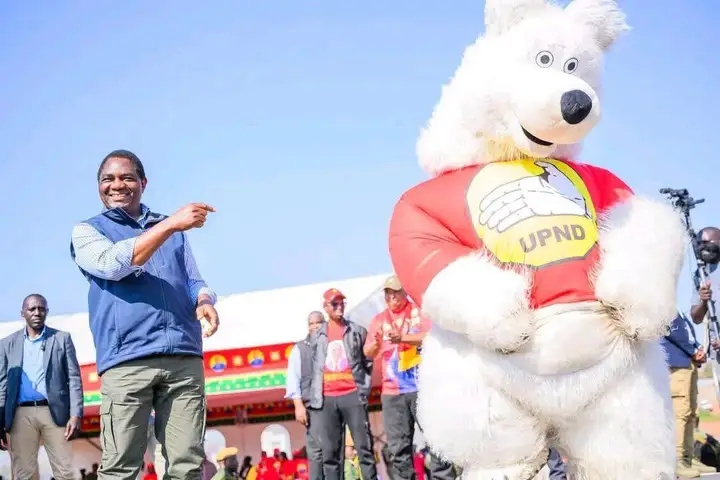
Teddy Bear Politics: UPND’s Desperate Gimmicks Expose a Party Running on Empty
By Professor Namukolo Miyanda, Pan-Africanist and Governance Expert_
14th July 2026
The recent scenes from a UPND campaign rally in Chongwe District left Zambians stunned, not by policy or vision, but by the appearance of a dancing teddy bear. As the nation counts down to the 13 August 2026 general elections, one must ask: when did national politics descend into a circus? The answer is simple. When a ruling party runs out of credibility, it imports gimmicks.
African politics has never lacked innovation in crowd mobilisation. In 2025, 92-year-old President Paul Biya of Cameroon deployed an AI humanoid robot of himself to conduct roadshows while he rested at his residence. The replica attracted curiosity, drew crowds, and allowed his team to project visibility. Biya went on to win. The robot was a double edged sword. On one hand it pulled people in. On the other, it distracted voters from substance and reduced elections to spectacle. Zambia’s UPND has taken note, but instead of robotics, they have unveiled a teddy bear.
The rationale is not difficult to decode. A party that cannot attract crowds on the strength of its record must manufacture attention. The sudden debut of a teddy bear on the campaign stage is an admission of failure. It signals that UPND’s traditional mobilisation machinery has collapsed. If this were the football World Cup, the teddy bear would be called a super substitute. It has been brought on after the first team underperformed.
Consider the line-up that has already failed to stimulate national interest. Social media influencers such as Mutale Mwanza, Kidist, and Ben Lombe have not moved the numbers. Comedians Ken Dumbo, Junior Bally, and Vubwi have not generated the laughs or the crowds. Top musicians Yo Maps, Y Celeb, and Slap Dee have not turned their streams into votes. Even presidential alliance partners Charles Milupi, Felix Mutati, and Miles Sampa have underwhelmed. When all these personalities fall short, what remains? The UPND has gone back to consult the Bill Cosby Show and Tom and Jerry cartoons, and returned with a teddy bear.
The strategy also reveals how the party perceives the electorate. Deploying a teddy bear in a rural constituency implies a belief that rural voters can be entertained into submission. It is unlikely we will see the same bear on Cairo Road. The UPND considers urban voters too literate and too scarred by five years of economic hardship to be pacified by costumes. This is not mobilisation. It is condescension.
.
The UPND teddy bear, labelled “Salt Sana” on its back, is large enough to frighten children and bemuse cadres. To its credit, it has shown resilience on stage. It waves at crowds, dances to DJ sets, and even moves to live performances. Reports suggest that even Chellah Tukuta, the presidential cameraman, watches it with a hint of jealousy. In fairness, the teddy bear may be the most prudent economic decision UPND has made this cycle. It saves the party money that would otherwise be paid to hungry musicians, influencers, and comedians who deliver no votes.
Yet questions persist. Who is inside that teddy bear? Which UPND member has transformed into a mascot because their own face could not draw a crowd? More importantly, what comes next? With three weeks to polling day, the nation waits to see which social media personality with foreign followers will be recruited as the next saviour. A word of caution to the UPND: social media metrics are not votes. Many followers are not Zambian citizens. Many are not registered voters. A million likes cannot cast a single ballot.
There is no need to panic if a party has delivered in five years. Aliko Dangote, Africa’s richest man, once warned leaders that if you resolve the energy deficit through coal and real production, you will talk less during campaigns. What do we see instead? The UPND has embarked on a stressful campaign marathon, hoping to change the minds of people who decided their vote long ago. The teddy bear has no voter’s card. Its influence ends on stage. It may excite children, but it cannot answer for mealie meal prices, fuel costs, or youth unemployment.
So when is the teddy bear’s birthday? Perhaps Zambians should buy it stockings and a cap, because August is cold and the symbolism is freezing. A ruling party that campaigns with cartoons has already conceded the argument. On 13 August 2026, voters will choose between substance and spectacle. The bear can dance, but it cannot govern.
To me Teddy Bear is better than AI generated crowds displayed by the other party. Teddy Bear is entertaining real people while AI generated crowds are displaying fake people. Moreover Mundubile is going nowhere, he has already lost. IMundubile is nothing but PF using a different party name and if PF failed to defeat HH whilst in opposition, do you think you can defeat him whist in power? Impossible, may be in 3031 but certainly not 2026. Mundubile is promising in future while HH is pointing at what he has done at present. So who can go for something he has not seen leaving something he has seen and using? Unless that person is not normal upstairs. Civil Servants; can they vote for employment or unemployment and wage freeze? Can University students vote for meal allowances or meal allowance withdraw? Can parents vote for free education and school feeding programme or vote for none of those things?