

DR. GUY SCOTT: I was related to David Livingstone in a Bemba sense … My brother and I mostly grew up in Lilanda
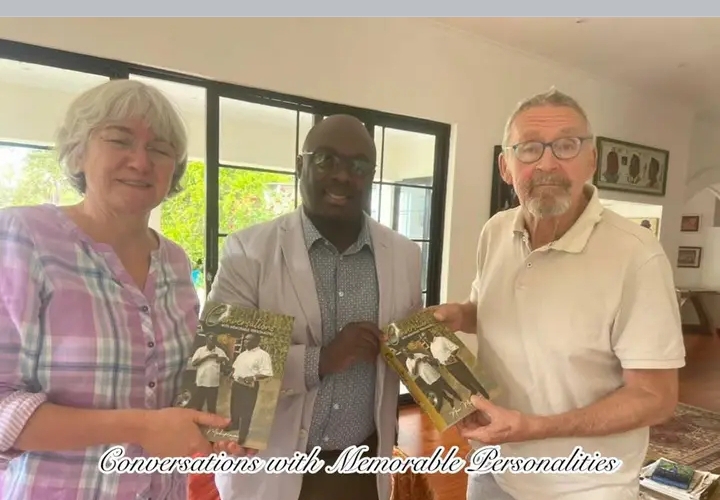
On May 10, 2022, I visited Zambia’s former Vice-President, Dr. Guy Scott, at his farmhouse in Lusaka East, off Leopards Hill Road. My purpose was to invite him to the launch of Conversations with Memorable Personalities, a book in which he is featured. The launch was scheduled for May 13, 2022.
It was a nostalgic moment for Dr. Scott and me as we reminisced about the many interviews I had conducted at his farmhouse—particularly the conversation featured in this book, which took place in his Treehouse. His wife, Dr. Charlotte Scott, fondly described that Treehouse as “a once-upon-a-time PF headquarters.”
Dr. Scott and I also joked about his 90-day stint as Zambia’s transitional President following the passing of President Michael Sata in October 2014. In the pictures below, I am showing Dr. Scott my autograph and posing with him and Dr. Charlotte.
Sadly, Dr. Scott passed away earlier today, July 15, 2026, after a long illness. As a recap of his rich background, here is an excerpt from pages 314–315 of the book, Conversations with Memorable Personalities (2022).
I will always remember Dr. Scott for his witty sense of humor, which some of you have already enjoyed in his full conversation with me.
****
Amos Malupenga: Give me your brief background; Who is Guy Scott?
Dr. Guy Scott: I don’t know how far you want me to go but my father, Alexander Scott, was a doctor of medicine whose sister had married a missionary out here. He came here around 1929. We were part of a large extended family which included the Moffats; my father’s sister had married into the Moffat clan which had again married into the Livingstone family.
Amos Malupenga: Which Livingstone is this?
Dr Guy Scott: David. He married a Moffat, Mary Moffat. In fact, he was brought to Botswana by Mary’s father, Robert Moffat, in the 19th century. That’s how he came to Africa before he set off for his explorations. But let’s be careful. In 1991 the Telegraph newspaper in Britain captioned me as a descendant of Livingstone and I was inundated with letters from real descendants demanding to know how I was related to them. I had to reply: “Only in the Bemba sense”.
My mother, Grace, was a nurse. She died two days before the 2003 Christmas Day, at theage of 89. She met my father here in 1943 and I was born in Livingstone in 1944.
My young brother and I were mostly raised in Lilanda farm here in Lusaka. This used to be a very beautiful farm; it was a paradise on earth but it is now part of George compound, which is okay in parts but not a paradise.
We were educated in Southern Rhodesia [now Zimbabwe] because the Southern
Rhodesians had put up a label that Northern Rhodesia [now Zambia] was too hot for white people to think. So, you had to go to Southern Rhodesia if you were white and wanted to be able to think. That was part of their propaganda against the north. So, all the good boarding schools were built in Southern Rhodesia.
I went to a school called Peterhouse. It was an all-white boys boarding school. There were no mixed schools those days. At one stage, I asked to go to Munali and I was told: ‘Listen, it is not done.’ This was in the 1950s.
I must say I didn’t like the racism of the Rhodesian whites. Up to today, I don’t like it.
They tell us they have changed but many of them haven’t changed. They still use words like picanin and kaffir whenever they feel they can get away with it. They don’t even know how to socially have a drink with a black person.
Northern Rhodesia had always been a much more easy-going place especially around
Lusaka. The Copperbelt was sort of a hotbed of Afrikaner racism because of the expatriate mine workers.
I used to get involved in a lot of fights in Southern Rhodesia. I even joined what was
then called the NDP, National Democratic Party. It was the very first Southern Rhodesian independence movement before ZAPU and later ZANU. Joshua Nkomo was leader of that. This was while I was at school.
It really annoyed my colleagues but I told them, ‘Who are you to stop me from thinking freely?’ My father, meanwhile, founded the Central African Post after which your newspaper [The Post] is named. That was effectively closed down by the white establishment, you know the establishment in those days used to be the BSA company, Anglo American Company and the Federal Party. That was the kind of mafia which was running the federation.
My father then resurrected it under the name of African Times but it didn’t last very long. Then he founded the Central African Mail, as a weekly initially and then turned it into a daily newspaper which was sold to the government. This is now the Zambia Daily Mail.
My father died in 1960. I completed school in 1961 and I went to the United States, then to Cambridge University where I studied mathematics and economics. I took economics as a subject with which I could help my country because I intended to come back here. I had been involved in the independence business even though I was a very small and amateur politician. …”
***