

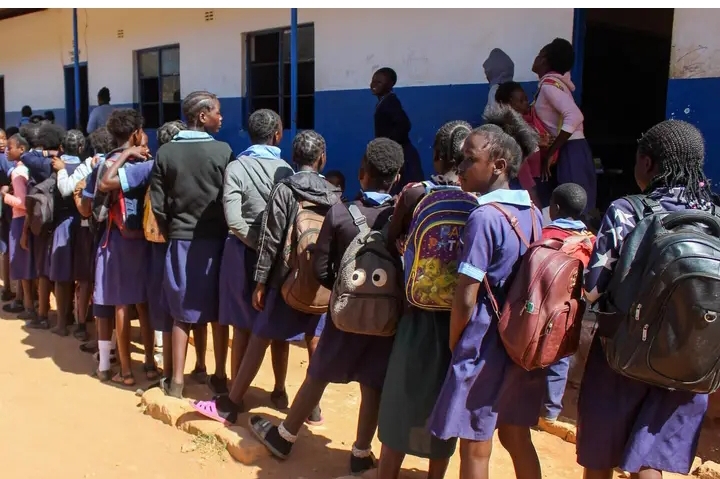
Free education in Zambia: The gap between the UPND’s claims and classroom reality
By Prof. Cephas Lumina
The UPND government deserves credit for removing school fees, expanding enrolment, and turning free education into a statutory right. But as Zambians assess its record ahead of the 13 August 2026 elections, the government’s sweeping claims of transformation must be assessed against history, law and the lived reality of overcrowded classrooms, overstretched teachers, and weak learning outcomes.
Performance, not fresh promises
As it approaches the 13 August 2026 general elections, the country is again awash with political campaign promises. That is normal in a democracy. But the rules are different for a governing party seeking another mandate. An opposition party may be judged on what it proposes to do; an incumbent must first be judged on what it has already done with public power, public money, and public institutions
That distinction matters because free education is one of several achievements the UPND cites in support of its record in office. Its rhetoric often presents the policy as a historic breakthrough that transformed schooling overnight. The reality, however, is more complicated. The policy has removed financial barriers for many families and brought large numbers of learners into school. But some of the UPND’s claims risk outrunning the evidence, obscuring the country’s history of free education, and treating increased enrolment as though it were, by itself, proof of educational success.
The UPND’s free education record should therefore be judged by a more robust standard: what was genuinely new, what was merely expanded, whether schools can cope with the increased numbers and—most importantly—whether children are actually learning.
Free education did not begin in 2021
The first claim requiring correction is the suggestion, explicit or implied, that the UPND invented free education in Zambia. It did not.
The Parliamentary Budget Office records that free education was first introduced in Zambia in 1965. That system later came under pressure from economic crisis and structural adjustment. In 2002, free basic education was reintroduced at primary school level. The national commitment to free education therefore predates the UPND by decades.
This does not diminish what the UPND did. It clarifies it. The government’s genuine achievement was a major expansion of fee-free schooling from 2022 to early childhood, primary and secondary education. Tuition, PTA, and examination fees were removed in government schools; grants were increased; teachers were recruited; and Constituency Development Fund bursaries helped some learners meet boarding costs.
That is noteworthy. But it is an expansion of a long national trajectory, not the discovery of an idea that began in 2021. A government confident in its own record should not need historical amnesia to make its achievements appear bigger than they are.
Big enrolment claims need better evidence
The UPND frequently points to the millions of additional or returning learners said to have entered school after fees were abolished. The direction of change is not seriously disputed: enrolment rose sharply, and many children previously excluded because of cost gained access.
But political slogans are not a substitute for transparent data. In January 2023, the Zambia Institute for Policy Analysis and Research (ZIPAR) recommended improved availability of administrative information on school enrolment and progression so that the policy could be properly monitored. The Auditor General’s findings also exposed discrepancies between official Education Management Information System (EMIS) data and conditions encountered during site visits.
That should make us cautious about treating headline enrolment figures as unquestionable fact. How many learners were genuinely new entrants? How many were returning pupils? How many attend regularly? How many progress from one grade to another, complete school and acquire basic literacy and numeracy? These are not pedantic questions. They go to the heart of what government means when it claims success.
Without reliable school-level data on attendance, progression, completion and learning, large enrolment figures risk becoming political theatre: impressive enough for a campaign billboard, but inadequate for determining whether the education system is working.
Recruitment is not the same as adequate staffing
The UPND also deserves credit for teacher recruitment. ZIPAR records the recruitment of more than 34,000 teachers in 2022 and 2023, a substantial intervention following years of underinvestment in education.
But recruitment figures must be evaluated against actual need.
The Auditor General’s Performance Audit of Zambia’s Free Education Policy on Access and Quality of Education, 2020–2024 found a striking gap between national averages and school-level reality. While EMIS cited a teacher-pupil ratio of 1:35, audit visits found early childhood ratios as high as 1:110 and primary school ratios as high as 1:226.
Those figures puncture the easy triumphalism surrounding recruitment announcements. Hiring thousands of teachers is not enough if they are not equitably deployed, if rural schools remain severely understaffed, if shortages persist in mathematics, science, and ICT, or if enrolment increases faster than staffing.
The real measure of success is not how many appointment letters the government has issued. It is whether the child sitting in an overcrowded classroom has a qualified teacher with enough time, space, materials, and support to teach effectively.
From policy promise to legal right—but law is not delivery
The Education (Amendment) Act, No. 17 of 2026, is an important development. It defines free education at early childhood, primary and secondary levels in public institutions and gives citizen children a statutory right to it. It also prohibits public and community educational institutions from charging admission, tuition, and accommodation fees, subject to limited exceptions for services or programmes outside the scope of free education.
The UPND is entitled to claim credit for strengthening the legal framework. But legal entrenchment should not be oversold as proof that the right is fully realised.
A statute can prohibit fees. It cannot build a classroom, supply a textbook, recruit a science teacher, provide a meal, or shorten the distance a rural child must walk to school. Nor does it eliminate the indirect costs that families still bear for uniforms, transport, stationery, and other necessities.
The law is therefore an important shield, but it is not a substitute for delivery. The danger is that government turns a legal milestone into a political trophy while the material conditions necessary to make the right meaningful remain inadequate.
But access is different from quality
This is the central weakness in the UPND’s narrative. The government too readily equates the removal of fees and rising enrolment with educational success and transformation. Yet access and quality are not the same thing.
International human rights law makes this clear. Article 13 of the International Covenant on Economic, Social and Cultural Rights guarantees the right to education, while the UN Committee on Economic, Social and Cultural Rights, in General Comment No. 13, explains that education must have four essential characteristics: availability, accessibility, acceptability and adaptability.
Availability means that there must be sufficient schools, trained teachers, classrooms, sanitation facilities, and learning materials. Accessibility requires education to be physically and economically accessible to everyone without discrimination. Acceptability concerns the relevance, safety, and quality of curricula, teaching methods and learning environments. Adaptability requires education to respond to learners’ changing circumstances and diverse needs.
These principles demonstrate that free education cannot be reduced to the mere absence of fees. Abolishing tuition and other compulsory charges is important, but it is only one element of the right to education. Quality is not an optional benefit that government may address later; it is part of the right itself. By that standard, getting a child through the school gate is only the beginning.
The government’s own 2025 National Education Policy acknowledges persistent low literacy and numeracy outcomes, poor progression, high dropout rates, inadequate infrastructure, rural-urban disparities, and gender inequalities. These are not allegations invented by opposition politicians. They are the state’s own admissions.
The UPND therefore cannot claim to have transformed education simply because more children are enrolled and fees have been removed. Increased access is important—but access to what? A crowded room without enough desks? A teacher facing more than one hundred learners? A school without adequate textbooks, laboratories, or sanitation?
A child may be officially enrolled and still be educationally abandoned.
Overcrowding exposes the cost of political speed
The Auditor General’s performance audit provides the clearest rebuttal to excessively celebratory claims. It found that early childhood access targets were missed from 2021 to 2024, Grade 12 completion targets were not achieved during the period studied, and targets for training teachers and teacher educators to implement the revised curriculum were also missed.
The Parliamentary Budget Office further noted that increased enrolment had been accompanied by overcrowding, high teacher-pupil ratios, and limited educational materials. It called for infrastructure planning tied to actual enrolment levels, improved teacher deployment, better distribution of learning materials and closer monitoring of school grants.
A 2026 study on the impact of the free education policy in Monze District tells a similar story at secondary school level: classes exceeding 70 learners, shortages of textbooks, pupils sharing desks or sitting on floors, heavier teacher workloads, reduced lesson preparation and diminished instructional quality (Francis Banda, “Balancing Access and Quality: Evaluating the Impact of Zambia’s Free Education Policy on Secondary Schools in Monze District”). These are not minor implementation glitches that can simply be brushed aside as inevitable teething problems. They go to the heart of whether the policy was expanded faster than the system could safely absorb.
The UPND opened the gates quickly. But in too many places, classrooms, teachers, desks, laboratories, sanitation facilities, and learning materials did not expand at the same speed. The uncomfortable truth is that one financial barrier has sometimes been replaced by an educational one: children can enter school, but the environment they enter may be too overstretched to deliver meaningful learning.
That is not transformation. It is unfinished reform being marketed as a completed success.
Free education must not become cheap education
The most dangerous form of political self-congratulation is to treat the abolition of fees as the completion of education reform. It is not.
A policy can be free at the point of entry and still fail a child through overcrowding, weak teaching, inadequate materials, hunger, poor sanitation, or long distances to school. Free education must not become cheap education—a system in which government maximises headcounts while tolerating declining standards.
The UPND deserves credit for expanding access. But credit must not become immunity from scrutiny. Nor should every criticism of the policy be dismissed as an attack on free education itself. That is a false choice. One can strongly support free education while demanding that the government account honestly for its shortcomings.
Indeed, the more loudly a government claims transformation, the more rigorously its results should be assessed. The evidence shows a mixed record: major gains in access and stronger legal protection, but persistent weaknesses in staffing, infrastructure, data reliability, progression, learning materials, and educational outcomes.
The UPND should be judged on the whole record—not simply on the parts that look best on campaign posters.
What the next government must do
With the country heading into a general election, responsibility for the next phase of education reform may remain with the UPND or pass to another government. Either way, the obligation is the same: preserve the gains in access and urgently address the quality deficit.
The next government must publish verifiable school-level data on enrolment, attendance, progression, completion, teacher deployment, and learning outcomes. Infrastructure investment must follow actual enrolment pressures. Teachers should be recruited, equitably deployed, and retained where shortages are most severe, especially in rural areas and critical subjects. School grants must be predictable, timely and sufficient. Classrooms, laboratories, libraries, and sanitation facilities must be expanded and properly equipped. Early childhood education needs greater attention, while teacher professional development and well-being must be treated as essential to educational quality.
Most importantly, free education should be treated as a national commitment, not the property of any political party. The country cannot afford a cycle in which every administration exaggerates its own contribution, erases what came before and renames continuity as invention.
Whether the UPND remains in power or another government takes office, the task will be the same: keep the school gates open, but make what happens inside the classroom worthy of the children who walk through them.
Judge the record fairly—but without illusions
As voters assess the UPND’s record in office, fairness requires two conclusions at once. First, the expansion of fee-free education and its statutory entrenchment are substantial achievements that have relieved household costs and broadened access.
Second, the government’s claims of transformation must be treated with caution. Enrolment is not learning. Recruitment is not necessarily adequate staffing. A law is not a classroom. And a child counted in school statistics is not necessarily a child receiving a quality education.
The decisive question is therefore not how many children entered a school gate after 2022. It is how many can read with understanding, calculate confidently, complete their education, and leave school equipped to live dignified, productive lives. That is the standard by which the UPND should be judged in 2026—and by which any government after the election should be judged thereafter.
Free education is worth defending. But free must also mean available, accessible, acceptable, and adaptable.
Above all, free must mean good.
The UPND has not said the job is done. HH himself keeps saying that more needs to be done. It’s the step in the right direction that is being celebrated.
It is ONLY the UPND government that has codified free education into law.
I keep hearing people complain that free education has caused problems with large classroom sizes. So what? It is better to read a page in a book than not to read at all. It is better to learn Arithmetic on the floor than not to lear at all. Children DESERVE to be in school. In the long run these children will make positive contributions to the society and their sacrifices to sit in overcrowded classrooms will one day pay off. Under UNIP, education was free, but it was not without difficulties. Some of you who grew up in cities and towns have no clue about what kind of schools some of us who were in villages went to. We had no desks, no potable water, no electricity and no toilets to write home about. We studied under candle light and went to the bush for our bathroom actions. Eventually we made it out of that strife, went to university and now some of us are competeing at the highest levels with children who were educated in the finest private schools in the world! Ah, do not despise the day of small beginnings. Do not write diatribes against this modest attempt by the UPND government to redress an injustice.
EXTOL this measure instead of pouring cold water over it.
Whichever you look at it, the REINTRODUCTION of free education by UPND government is a significant step in levelling the ground in as far as life opportunities are concerned.
Yes, alot remains to be done. The fine tuning will continue for a long time to come but it would be folly to wait until all the pieces are in place before offering free education. Such a time will never be.
A bird in hand is better than two in the bush.