DANGOTE, BOKO IN HIGH-STAKES REGIONAL INDUSTRIALISATION TALKS
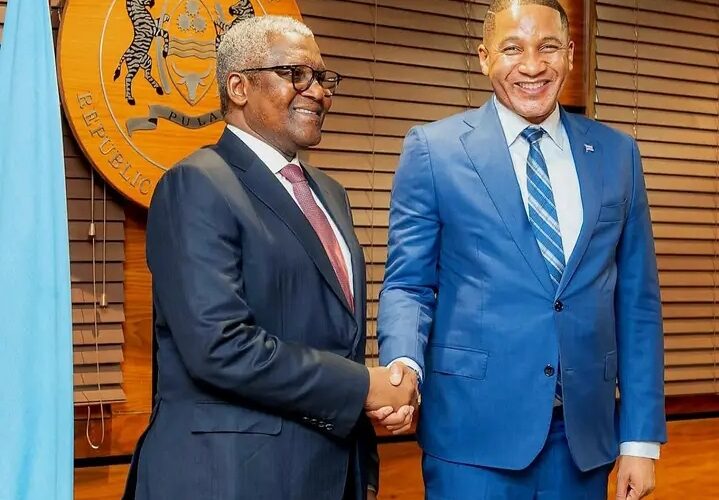
GABORONE — Botswana President Duma Boko has hosted Nigerian billionaire and Dangote Group founder Aliko Dangote for high-level talks centred on industrialisation, economic diversification and major infrastructure projects across the region.
The meeting places Botswana at the centre of Dangote’s expanding Southern African investment ambitions, with discussions focusing on regional transport corridors, including the proposed Trans-Kalahari rail line, which could unlock major opportunities for cement, fuel and other industrial products.
Boko stressed the need for Africa’s development to be driven by Africans, calling for large-scale implementation rather than policies that remain on paper.
Dangote has substantial business interests across Southern Africa, including Botswana, Namibia, South Africa, Zambia and Zimbabwe.
In Zimbabwe, Dangote has signed a US$1 billion investment agreement with President Emmerson Mnangagwa covering energy, cement, fertiliser and infrastructure projects. The package could rise to US$2 billion if a proposed fuel pipeline is included.
The ambitious proposal involves a roughly 2,200km transnational fuel pipeline linking Bulawayo to a 1.6-million-barrel fuel storage facility at Walvis Bay in Namibia, with the route passing through Botswana.
The mega-project has also attracted interest from a Zimbabwean billionaire with interests in the fuel sector and capital markets, who is keen to explore a potential partnership around the pipeline.
The matter is expected to be raised with Mnangagwa as discussions continue on possible collaboration with Dangote in what is being framed as a project of regional and national interest
Dangote is separately investing about US$140 million in Namibia to establish a major petroleum tank farm and regional energy hub at the Port of Walvis Bay, strengthening the strategic importance of the Namibian port to his Southern African expansion.
In Zambia, Dangote Cement Zambia is anchored by a US$500 million integrated cement plant in Ndola.
Botswana has also been courting Dangote over potential capital-market opportunities, including the possibility of listing parts of his business and refinery-related assets regionally.
Meanwhile, South Africa’s Government Employees Pension Fund and the Public Investment Corporation have toured Dangote’s massive refining and fertiliser complexes in Nigeria, amid discussions over a possible secondary listing of the Dangote refinery on the Johannesburg Stock Exchange following its primary Nigerian public offering.
Dangote Cement also has a presence in South Africa through its strategic partnership in Sephaku Cement, trading as Dangote Cement South Africa (Pty) Ltd.
The Botswana meeting is part of a broader engagement between Boko and Dangote that began through exploratory contacts on the sidelines of African Union summits.
Dangote, Africa’s richest man, has built a roughly US$35 billion industrial empire through the Dangote Group, with investments spanning petroleum refining, cement, fertiliser, agriculture, power and infrastructure.
His manufacturing footprint extends across about 10 core African markets, with broader logistics, fertiliser and energy supply chains reaching further across the continent.
The group operates major cement businesses in countries including Tanzania and the Republic of Congo, while pursuing major expansion projects involving ports, power generation and transport corridors.
Beyond Southern Africa, Dangote is also pursuing major investments designed to replicate his Nigerian industrial model in other African markets, including a proposed US$17 billion refinery project in Kenya.
At the heart of Dangote’s strategy is a push to move Africa away from exporting raw materials and importing finished products towards local manufacturing, refining and industrial self-sufficiency.
For Botswana and its neighbours, the emerging question is whether Dangote’s expanding industrial footprint can be connected through the region’s transport, energy and logistics infrastructure to create a genuinely integrated Southern African industrial corridor.