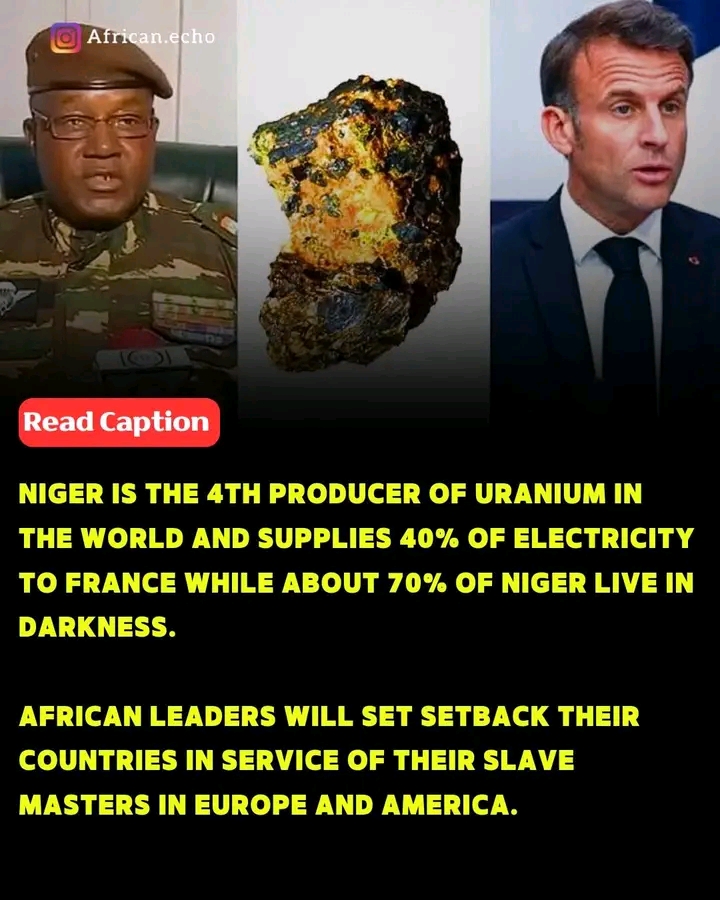

A COUNTRY THAT POWERS FRANCE, YET SITS IN DARKNESS
Niger is one of the world’s major uranium producers.
Its soil feeds the nuclear reactors that keep France’s cities glowing, trains running, and industries alive.
Yet inside Niger itself, the picture is cruelly different.
More than two-thirds of Nigeriens still live without reliable electricity. Hospitals ration power. Schools go dark at sunset. Entire communities exist off-grid—while their resources travel thousands of miles to light up Europe.
This is not a mystery. It’s a system.
For decades, uranium from Niger has been extracted under contracts shaped during colonial rule and preserved by post-independence elites. Deals were signed that prioritized foreign energy security over local development. Profits flowed outward. Infrastructure barely trickled back.
And here’s the uncomfortable truth: this system survives because African leadership often protects it.
Too many leaders negotiate for approval, not sovereignty. They defend exploitative agreements in exchange for political support, personal gain, or international legitimacy. The language may have changed—from colonialism to “partnership”—but the power imbalance remains.
This is not about hating Europe or America.
It’s about asking why resource-rich African nations remain energy-poor.
It’s about questioning who benefits—and who pays the price.

Niger’s story is not unique. It’s a warning.
Until African resources serve African people first, darkness will continue to exist beside abundance.
The question is no longer what is happening.
The question is: how long will it be tolerated?
Follow @african.echo for more powerful African history and untold stories.
Support the movement by buying our debut book: “20 African Wonder Women That Changed History.”
Sources:
World Nuclear Association; EDF Energy reports; International Energy Agency (IEA); World Bank electrification data.