
GUEST ARTICLE: A THEORETICAL CONCEPT OF PUBLIC SERVICE CORRUPTION AND MISAPPROPRIATION
By Manson Mutumba
I have had this theory, when one enters civil service in African countries with high corruption; a cycle of an opportunity to loot presents itself in varying proportions ranging from the value of a few tens of dollars to hundreds of thousands or millions depending on the hierarchy position in the bureaucracy chain; and the person faces two choices;
- Option (A): Take part in the opportunity to loot while telling oneself a story; like,
➡️ “will only do this once and then never do it again,”
➡️ “if I don’t do it, someone else will do it, so, I might as well do it,”
➡️ “if I don’t participate, my colleagues will think I am going to snitch on them,”
➡️ “do it and use the money for a noble cause (help struggling family members, etc),
➡️ “yes, this is exactly what I got into the service for!”
- Option (B): Refuse to take part.
Most of the time, people take option A; you can see the plenty of reasons why that choice happens, but, once it’s done, then it’s an offense that every other participant is aware of. It’s a track record of the deed AKA, the sin, and here is where it gets complicated.
In the next cycle of the opportunity for looting, the key person, it could be a procurement officer or the person that signs for the funds to be released, may demand a higher share, thereby creating a chain reaction where the next guy also demands a higher share merely because the first one asked for it; such that, the guys on the lower hierarchy of the bureaucracy system get completely cut out of the spoils of the loot right in front of their eyes.
Those cut out become aggrieved, but they can’t do anything about it because if they tell on their colleagues who have taken the entire loot, they will also be implicating themselves of past any of the past looting where they got a share, so, to avoid implicating themselves, they determine that the best approach is to keep quiet and cry silently, praying that the key guys on top of them even either get hit by a truck or die a horrible death from food poisoning so that they can inherit the positions and be fair in the looting
However, those on the higher hierarchy never get hit by trucks or die from horrible food poisoning; but after a few cycles of looting on their own, they occasionally pass on some of the spoils to the quiet but furious guys on the lower hierarchy levels of the bureaucracy system. Overall, this creates a very terrible toxic environment where looting is the object of the motivation to work and where those unhappy because they are getting very tiny shares of the spoils feel like not even putting in the work that they are collecting a paycheck for.
This is my theory of how the culture of corruption and misappropriation of public resources operates in countries with high levels of such issues.
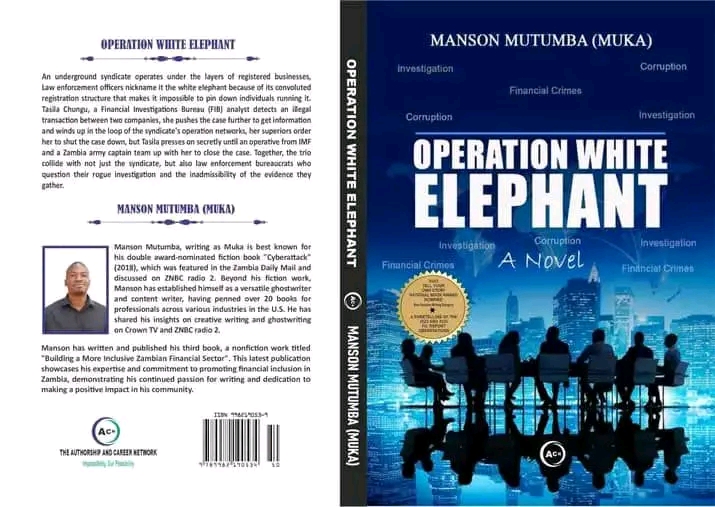
In “Operation White Elephant,” the theoretical concept forming the premise of the fictional entertaining narrative of how public resources and corruption operates in Zambia is on a more sophisticated, complex and convoluted system with players across their entire system.
Manson Mutumba