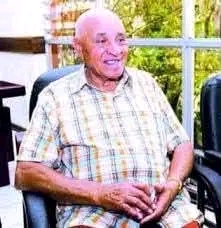

AARON MILNER: THE MAN WHO RAN AWAY FROM A POLITICAL APPOINTMENT!
Aaron Michael Milner (1932–2024) was a man whose life reads like a political thriller, a romantic comedy and a liberation history lesson rolled into one.
Born in Bulawayo, Southern Rhodesia, on 31 May 1932, to a European businessman and an African mother, Milner was destined for an unusual journey. He trained as a tailor, developed a passion for opera and reportedly won a scholarship to study in Italy under the celebrated tenor Beniamino Gigli.
Educated at Embakwe Mission, Plumtree, Rhodesia, but left in 1948 to become an apprentice tailor in Bulawayo because his father had died.
But then came love.
During a visit to Ndola, Milner met Phyllis, the woman who would become his wife. Suddenly, Italy, opera and international musical fame could wait. Romance had intervened, and the liberation struggle was about to acquire an unlikely recruit. One could say that Kenneth Kaunda gained a politician, while the opera world lost a tenor. History, as usual, has a wicked sense of humour.
After acquiring business experience in Bulawayo he moved to Zambia’s Copperbelt in 1954 as manager of the Commercial Trading Company at Chingola. As chairman of the Euro-African Association he came into contact with Kaunda and Mainza Chona and joined the United National Independence Party.
Milner joined UNIP and rose through its ranks, becoming one of Kenneth Kaunda’s trusted lieutenants. In fact, when UNIP elected its leadership at a congress attended by thousands, Milner was looking informed that his name had landed among the top six. His reaction? He jumped into his car, drove to Chingola, collected his wife and child, and fled to his mother in Victoria Falls.
Imagine being elected to leadership and treating the news like a summons from the police! But Kaunda was not about to let his reluctant recruit disappear into the Rhodesian countryside.
Milner was eventually persuaded back and became a key organiser in the independence movement.
From 1961 to 1964 he was the main party organiser in the Copperbelt and presided at meetings. Milner became Parliamentary Secretary to Prime Minister Kaunda and was given responsibility for the civil service. Milner was elected member of parliament for Muchinga constituency in 1962.
After Zambia gained her independence, Kaunda granted Milner Zambian citizenship.
From 1964 to 1967 he was Minister of State for the Cabinet and Public Service. It was in 1964 that he was elected member of parliament for Nchanga constituency on the UNIP ticket. In September 1967 he was appointed Minister of State for Presidential Affairs with special responsibility for Information and Broadcasting. He was elected UNIP member of parliament for Chingola West in 1968. Milner retained the seat in 1973 under Chingola seat.
Among other ministerial positions Milner held after Zambia’s independence was security, home affairs, transport, power and works, as well as defence. He also played a significant role in coordinating support for African liberation movements.
While some politicians were busy organising speeches, rallies and political survival strategies, Milner was involved in the logistical machinery of liberation. He helped coordinate the movement of weapons and supplies for freedom fighters and worked alongside Kaunda’s government in supporting nationalist movements from Zimbabwe, South Africa, Namibia, Angola and Mozambique.
Zambia’s commitment to liberation came at a price. Rhodesian attacks, bombings and assassination attempts threatened the country and those sheltering within its borders. Milner recalled the terrifying realities of that period, including the bombing that killed ZAPU representative JZ Moyo. These were not merely political slogans for the men and women involved; they were matters of life and death.
His wife, Phyllis, also played her part, helping care for nationalist leaders and young liberation fighters hosted in Zambia. Apparently, the struggle for African freedom required more than speeches and revolutionary vocabulary. Somebody had to provide food, shelter and, occasionally, slaughter cattle to feed thousands of young people. Liberation, it turns out, also had a household budget!
Milner’s Zimbabwean roots never disappeared. When Zimbabwe finally attained independence in 1980, he returned to assist in preparing the country’s political machinery for its first elections, drawing on Zambia’s experience. He later spoke proudly of his country of birth and urged Zimbabweans to remain united.
He died in Harare on 22 June 2024, aged 92.
And here is the irony worth remembering: a man born in colonial Rhodesia, who nearly escaped politics to become an opera singer in Italy, ended up helping to shape the political history of an independent Zambia and supporting the liberation of his birthplace.
Some men follow their dreams. Others meet a woman in Ndola, abandon an opera career, run away from a UNIP leadership position, get hunted down by Kaunda and end up in Cabinet.
In African politics, even the man who tries to dodge the job can end up running the department.