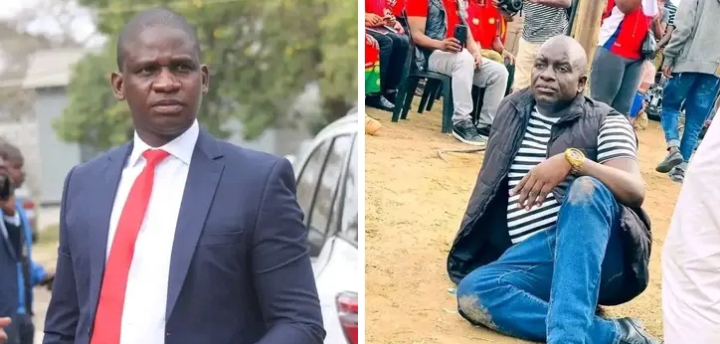

ACCEPT DEFEAT AND MOVE ON — NJOBVU ADVICES UPND’S MORGAN MUUNDA OVER ECZ APPEAL
Democratic Union President Ackim Antony Njobvu has taken a swipe at the losing UPND candidate in the Chawama parliamentary by-election, Morgan Muunda, accusing him of shifting goalposts after defeat and attempting to perform duties that legally belong to the Electoral Commission of Zambia (ECZ).
Reacting to Muunda’s public appeal for ECZ to withdraw the nomination of newly elected MP Hon. Bright Nundwe before his swearing-in on 15th February 2026, Njobvu said it was baffling that a defeated candidate had suddenly turned himself into an investigator, prosecutor and judge.
Njobvu questioned why Muunda was raising “technical issues” after the election, arguing that ECZ had already carried out its due diligence before admitting Nundwe as a duly nominated candidate.
“For ECZ to have admitted him and allowed him to contest, it means a background check was done. Why should a candidate who has lost now start doing investigations that are supposed to be done by ECZ?” Njobvu wondered.
Muunda has alleged that Nundwe did not qualify to stand in the Chawama by-election because the contest was conducted under the 2021 voters’ register and that Nundwe was allegedly not registered in Lusaka Province as prescribed by law. He further cited what he referred to as Section 35 of the ECZ Act, claiming it empowers the Commission to withdraw a nomination.

However, the Consortium for Good Governance and Constitutionalism for Civil Society Organisations (CSOs) Deputy Chairperson Solomon Ngoma charged that under Zambia’s legal framework, the Electoral Process Act does not empower ECZ to invalidate or cancel a parliamentary candidate’s nomination after an election has already taken place. Contrary to Muunda’s claims, the Electoral Commission of Zambia Act contains no Section 35 granting the Commission authority to withdraw a nomination on eligibility grounds after the fact.
The law is clear:
Any person dissatisfied with a nomination or an election outcome must file an election petition within 14 days, in line with Sections 100(3) and 96(1)(a) of the Electoral Process Act.
ECZ’s corrective powers are limited to correcting tabulation errors under Section 76, and even then, only within seven days after results are declared. Those powers do not extend to disqualifying candidates or reopening nominations.
On eligibility, neither the Constitution nor the Electoral Process Act expressly requires a parliamentary candidate to be registered as a voter in the constituency they are contesting. Any constitutional interpretation dispute falls under the jurisdiction of the Constitutional Court, not ECZ.
Njobvu therefore advised Muunda to accept political reality and move on.
“Why don’t candidates just accept that they did not win and focus on the next general election? Continuing to raise confusion over matters that are not within your mandate only exposes desperation,” he said.
The Democratic Union leader concluded by urging Muunda to concentrate on rebuilding political support rather than dragging ECZ into matters already settled by the ballot.
Chawama voted, the people decided, and the law has spoken. Accept defeat, regroup, and campaign for 2026 general elections not from the courtroom of public opinion, but on the ground.