DR CONGO’S FAILED GAMBLE ON ROMANIAN MERCENARIES
It has been a humiliating week for nearly 300 Romanian mercenaries recruited to fight on the side of the army in the Democratic Republic of Congo.

Their surrender following a rebel assault on the eastern city of Goma has also shattered the dreams of those who signed up for the job to earn big money.
The BBC has seen contracts that show that these hired soldiers were being paid around $5,000 (£4,000) a month, while regular military recruits get around $100, or sometimes go unpaid.

The Romanians were contracted to help the army fight the Rwanda-backed M23 rebels, who say they are fighting to protect the rights of DR Congo’s minority ethnic Tutsis.
When the offensive on Goma started on Sunday night, the Romanians were forced to take refuge at a UN peacekeeping base.


“The M23 rebels were supported by troops and state-of-the-art military equipment from Rwanda and managed to reach our positions around the city of Goma,” Constantin Timofti, described as a co-ordinator for the group, told Romanian TVR channel on Monday.
“The national army gave up fighting and we were forced to withdraw.”
Romania’s foreign ministry spokesman Andrei Țărnea told the BBC that “complex” negotiations followed, which saw the M23 hand over the Romanian fighters – whom he described as private employees of the DR Congo government on an army training mission – to Rwanda.
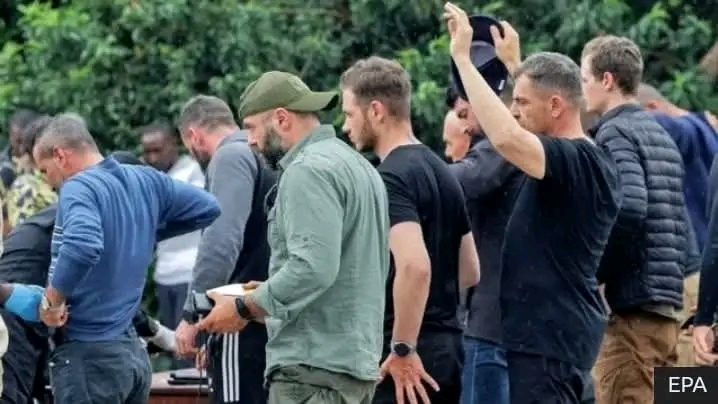
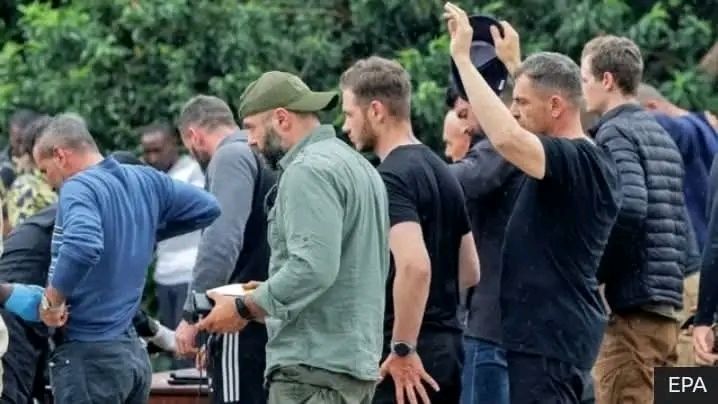
Goma sits right on the border with Rwanda – and the mercenaries were filmed by journalists as they crossed over, surrendering to body searches and other checks.
Before they crossed over, phone footage shows M23 commander Willy Ngoma berating one of the Romanians in French, telling him to sit on the ground, cross his legs and put his hands over his head.
He asked him about his military training – it was with the French Foreign Legion, the Romanian replied.
“They recruited you with a salary of $8,000 a month, you eat well,” Ngoma yelled, pointing out the disparity between that and a Congolese army recruit’s pay.
“We are fighting for our future. Do not come for adventure here,” he warned.
It is not clear where Ngoma got the $8,000 figure, but the contract shown to the BBC by a former Romanian mercenary in October detailed that “strictly confidential remuneration” for senior personnel started at $5,000 per month during active duty and $3,000 during periods of leave.
The agreement outlines an “indefinite period” of service, with contractors scheduled to take a one-month break after every three months of deployment.
I had met the ex-mercenary in Romania’s capital, Bucharest, where I had gone to investigate Asociatia RALF, which a group of UN experts say is a Romanian enterprise with “ex-Romanians from the French Foreign Legion”.
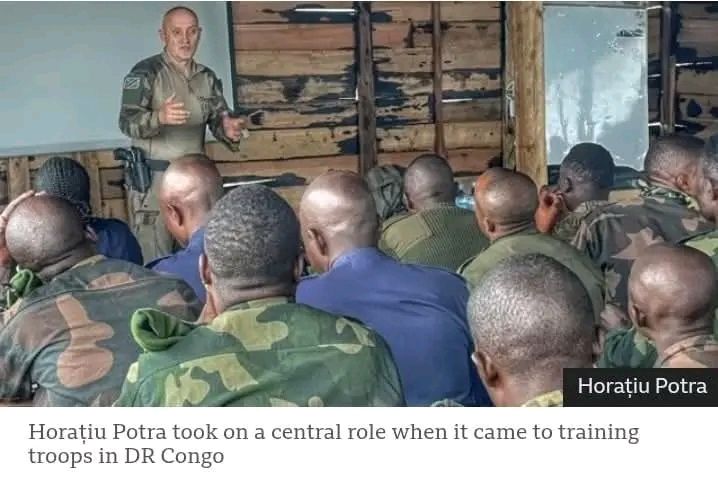
It is headed by Horațiu Potra, a Romanian who describes himself as a military instructor.
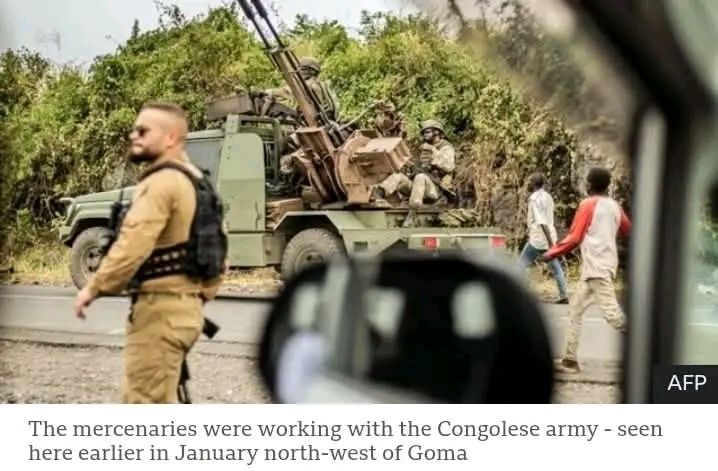
In June while in Goma, I had noticed such mercenaries at checkpoints and deployed around the city, working closely with army.
Over the last three years, others have reported seeing them driving Congolese troops in army vehicles.
“When they arrived, everyone referred to them as Russian,” Fiston Mahamba, co-founder of disinformation group Check Congo, told the BBC.
“I think this was linked to the Russian mercenary group, Wagner with presence in several African countries.”
In fact, Asociatia RALF may also work across Africa – its contract stipulated that it had various “operational locations”, including “Burkina Faso, DR Congo, Ivory Coast, Niger, Senegal, Sierra Leone, Gambia and Guinea”.
The UN experts say that two private military companies were brought on board to bolster its forces in 2022, not long after the M23 had regrouped and begun capturing territory in North Kivu.
The province has been unstable for decades with numerous militias operating there making money from its minerals like gold and coltan – used to make batteries for electric vehicles and mobile phones.
The first firm that was signed up was Agemira RDC, headed by Olivier Bazin, a French-Congolese national. The experts say the company employed Bulgarian, Belarusian, Georgian, Algerian, French and Congolese nationals. [BBC News]