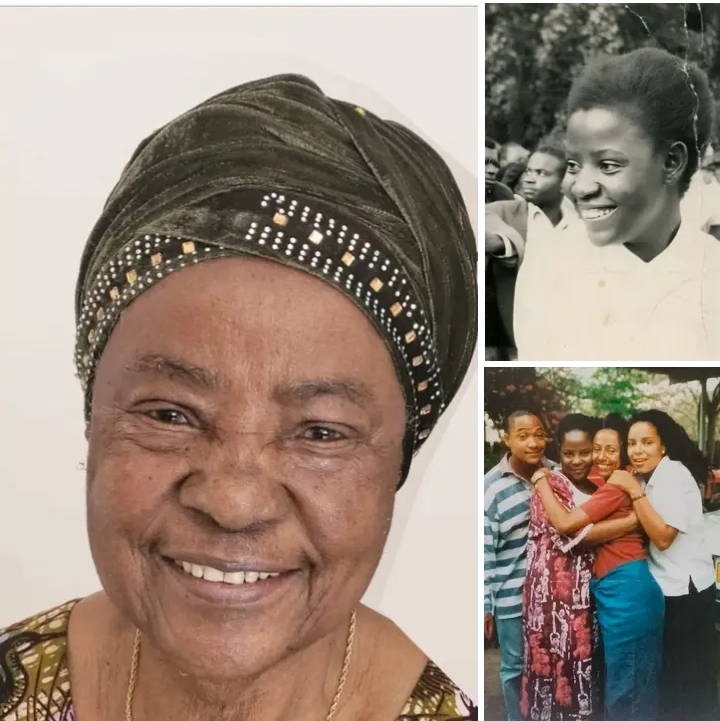

DR. MUTUMBA MAINGA BULL; AN UNDERSTATED WOMAN OF SUBSTANCE – A TRIBUTE
ACADEMIC OR SCHOLAR? [PART ONE]
By Eugene Makai
INTRODUCTION
If one were to say that Mutumba Mainga Bull was an exceptional person, it would be an understatement. Quite to the contrary, she was an EXTRAORDINARY person.
Dr. Bull passed away on the 13th of February, 2026 aged 88 and was put to rest at Leopards Hill Memorial Park in Lusaka on Thursday 19th February, 2026.
For many people and sadly for most of our younger generation, she was just another politician from the past whom the older generation can remember. This is the tragedy of our nation that its builders are mere statistics and passing references. Her world was a world of FIRSTS because she carried an extraordinary head on her shoulders competing in one where being female and also an African had extreme disadvantages and challenges – she won on both accounts.
Dr. Bull’s life is an extraordinary contribution to both nation building and academia in very important ways that have not been acknowledged.
Her public life cannot just be assigned token applause as has been the case. Consequently, my tribute to her will though inadequate be dealt with in several parts highlighting her exemplary academic life and her brilliant contribution in governance and as a politician.
ACADEMIC OR SCHOLAR?
There is no better way to begin to tackle this question than to reiterate the words of Professor B.S. Krishnamurthy a distinguished scholar then at the University of Zambia, when in his paper presentation titled ‘History Research at the University of Zambia’ at the experts meeting on ‘The Historiography of Southern Africa’ held in Gaborone, Botswana, from the 7th to 11th March, 1977 he said and I quote:
❝The Department at the moment is unfortunately expatriate-dominated since the departure of Mutumba Bull to serve Zambia in other capacities, which has been a great loss. However, the department is pursuing an active policy in Zambianization…❞
This was more than 3 years after Mutumba Bull had left academia and contested in the 5th December 1973 general elections for a seat of the newly established Nalolo Constituency as Member of Parliament. She was the Constituency’s FIRST Member of Parliament and its first woman member. Inonge Mutukwa Wina the First Woman Vice-President of the Republic came to be its second woman Member of Parliament 29 years later.
Fourteen years after Mutumba Bull left academia, academics and scholars still made her a subject of reference, this time as an exception to the rule in political leadership. Presenting a paper at the 8th Professors World Peace Academy for Central and Southern Africa, Zambia Chapter held between 3rd and 6th July, 1987 in Siavonga titled ‘Constraints on Women’s political participation in Zambia’, Bathsheba Ng’andu then with the Library at the University of Zambia said and I quote:
❝Perhaps another greatest disaster as far as women representation is concerned is at Government level where there has not been any woman Cabinet Minister since the Honourable Mutumba Bull who was the first and last woman Cabinet Minister. However, there had been few Ministers of State during the Fourth National Assembly, and these have dwindled to only two during the Fifth National Assembly.
In Parliament itself, the situation had greatly improved during the Fourth National Assembly when there were six women out of the one hundred and thirty-five strong Parliament. However, the situation deteriorated during the Fifth National Assembly as the six were reduced to four. No woman since Lily Monze during the Third National Assembly has ever been nominated to parliament.
However, in spite of the above picture, the Party continues to paint a rosy picture of women’s political participation in Zambia.
As evidence of this His Excellency The President in his address to the Second Regional Conference for the Integration of Women in Development in 1979, reiterated:
“In the political field, too, Zambian women sat on the highest decision-making bodies including the Cabinet and the Central Committee of the Party” (Women’s League Council, 1980).
Yes they sit on these bodies, but their effective participation is being curtailed by their number compared to that of men. At the time this statement was made, there was no woman in the Cabinet. ❞
Dr. Mutumba Mainga Bull held a BA Hons (History, 1963) and a Ph.D (History, 1969) from the University of London and had a year of postgraduate research at the University of Cambridge.
She lectured in History at the University of Zambia from 1969 to 1973. After her sabbatical from academia, she rejoined the University of Zambia as a Senior Research Fellow in 1996, and was the Director of the Institute of Economic and Social Research at the University of Zambia from 2005 to 2008. In 2010 she continued at the Institute as a Senior Research Fellow and Coordinator of the Governance Research Programme of the Institute.
Her credentials in academia were not just a ‘copy-and-paste’ affair. Mutumba Mainga Bull is probably one of the most accomplished indigenous Zambian Historians and Anthropologists of our era.
REWIND TO INTERNATIONAL ACCLAIM
Dr. Bull was an internationally acclaimed scholar and sat on the INTERNATIONAL SCIENTIFIC COMMITTEE FOR THE DRAFTING OF A GENERAL HISTORY OF AFRICA. She sat alongside fellow scholars and academics of renown such as Senegalese Anthropologist and Afrocentrist Historian Cheik Anta Diop, Nigerian Historian and founding father of modern African historiography Professor Jacob Festus Adeniyi Ajayi, Ghanaian Academic and Historian Professor Albert Adu Boahen, French Africanist Historian Jean Devisse, British Professor of African History John Donnelly Fage, Cuban Historian Professor Jose Luciano Franco, Somali polymath, Anthropologist, Historian and Linguist Musa Haji Ismail Galal, Italian Ethnologist Vinigi Lorenzo Grottanelli, German Philologist and Anthropologist Eike Haberland, Czech Orientalist and Historian Ivan Hrbek, Liberian Historian Abeodu Jones who like Mutumba Bull was the first woman in her country to obtain a PhD. And, like Mutumba Bull was the only woman in the Cabinet of William Tubman in the 1970s, Rwandan Catholic priest, Historian, Linguist and Philosopher Abbé Alexis Kagame, Soviet Russian Historian Artem Borisovich Letnev, American Africanist and Emeritus Professor of Anthropology Daniel McCall, Egyptologist Gamal ed-Din Mokhtar, Prominent Motswana (Botswana) Historian Leonard Diniso Ngcongco, Guinean Historian Djibril Tamsir Niane, Kenyan Historian and Academic Bethwell Allan Ogot, Sudanese Professor Mekki Shibeika, Congolese-Zairian Theologian and Emeritus Catholic Archbishop of Mbuji-Mayi Tharcisse Tshibangu Tshishiku to name a few.
These were the lofty circles in Academia and Scholarship that Mutumba Mainga Bull dwelt in before she joined politics. If you feel all this is already exhausting, I haven’t begun yet.
An important Academic highlight that had Mutumba Bull beaming with pride was when Zambia hosted the 2nd Plenary Session of the INTERNATIONAL SCIENTIFIC COMMITTEE FOR THE DRAFTING OF A GENERAL HISTORY OF AFRICA in Lusaka from 21st to 26th May, 1973.
The second session of the Committee was opened by Honourable Wesley Pillsbury Nyirenda, the First indigenous Zambian Speaker of the National Assembly but at the time Minister of Education and Culture.
The meeting opened with a one minute’s silence in memory of Kenyan-British Paleoanthropologist and Archeologist Professor Louis Leakey who had died 7 months earlier on 1st October, 1972 in London.
During the committee meeting Dr. Bull and Professor Ngcongco stressed the importance of making an effort in Southern Africa to bring historical research up to an adequate level of output. In response the Committee suggested two measures, which were that when the States of the region concerned have agreed on a specific project, Unesco should help them to set up a regional centre for the study of traditions; And that Professor Bull and Professor Ngcongco should submit, before September, 1973, a plan for concerted action at the regional scientific level which might lead to the organization of a symposium during the 1975-1976 biennium.
COMING UP: ACADEMIC OR SCHOLAR? [PART TWO]
• The author is an Anthropologist and Scholar in Comparative Religion and Scriptural Linguistics.