
Amb. Emmanuel Mwamba writes:
Even for the Oppenheimers, money can’t buy love – or power
Jonathan Oppenheimer is heir-apparent to Africa’s third-largest fortune. The Brenthurst Foundation was his attempt to turn that money into political influence. It shut down last month.
Jonathan Oppenheimer is heir-apparent to Africa’s third-largest fortune. The Brenthurst Foundation was his attempt to turn that money into political influence. It shut down last month.
The Continent and Simon Allison
Aug 02, 2025
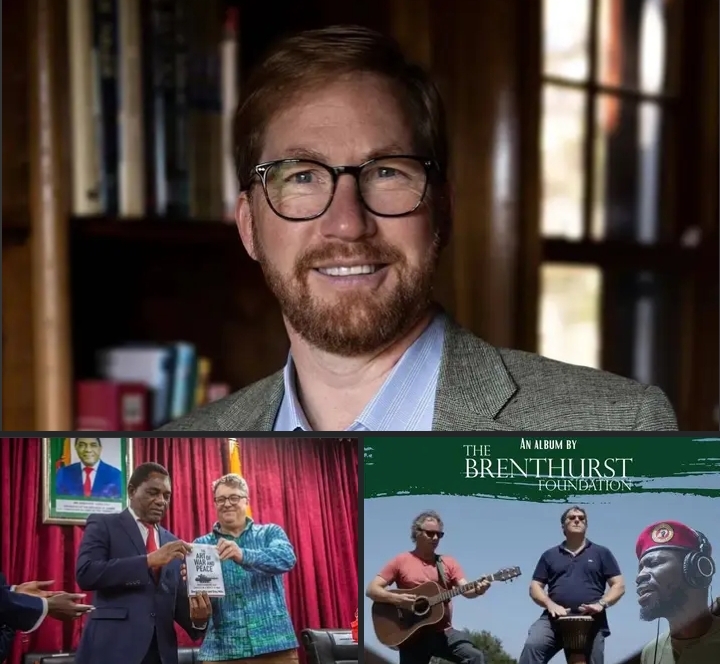
Generational wealth: Jonathan Oppenheimer founded the Brenthurst Foundation in 2004.
Jonathan Oppenheimer is heir-apparent to Africa’s third-largest fortune. The Brenthurst Foundation was his attempt to turn that money into political influence.
In July, after a screaming match at its head office, Oppenheimer shut it down. It had failed to deliver value for money. The Continent’s International Editor Simon Allison witnessed first-hand how the foundation wielded extreme luxury like a weapon – to entice, to compromise, to influence – while seemingly failing to understand that politics is about more than just private jets and presidential photoshoots.
By several orders of magnitude, the richest man I ever met was Jonathan Oppenheimer. Now 55, he is the eldest son in the fourth generation of the mining dynasty that began with Ernest Oppenheimer in the early 1900s. The family is worth $10.4-billion, according to Forbes. Almost all of that money was made from gold and diamonds dug from beneath southern African soil.
The first time I met him was at the 2017 edition of the Tswalu Dialogue, held at Tswalu Kalahari. This is his personal safari lodge, and is the largest privately-held game reserve in South Africa.
The dialogue brought together about two dozen participants, all of whom were flown by private plane to the reserve’s airstrip.
The guests were chosen because of their perceived ability to shape Africa’s future. As the Mail & Guardian’s Africa Editor at the time, they decided this included me.
It was among my most surreal reporting experiences. I had lunch one day sitting next to former South African president Kgalema Motlanthe. On the next day, it was Nick Carter, the then-head of the British army. I made small-talk with former Nigerian president Olusegun Obasanjo over drinks. The other guests were ambassadors, ministers or mining bosses, with at least one arms dealer in the mix, and a few attachés who looked suspiciously like intelligence officers.
On the opening night, Jonathan Oppenheimer gave a welcome speech. He invited us to appreciate the majesty of our surroundings, and explained how Tswalu Kalahari has flourished in recent years, even as the rest of the Northern Cape – among South Africa’s poorest provinces – battled a crippling drought.
Then he told a joke. It went something like this: When the drought bites, and the families who live around Tswalu can no longer afford to keep cows, they sell the cows and buy goats. When they can no longer afford the goats, they buy chickens. And when they can no longer afford the chickens, they sell their land to the Oppenheimers.
Most of the audience laughed dutifully; others exchanged wide-eyed glances across tables laden with silverware and crystal glasses.
This is a family that built its wealth on the labour of millions of young black men being funnelled underground, where they spent the prime of their lives working for a pittance in back-breaking conditions, destroying not just their lungs but also the social fabric of the communities from which they were drawn.
Much of that labour was in service of the Oppenheimers’ personal fortune, and the taxes from their vast mining operations funded various colonial and apartheid-era regimes.
These power dynamics were symbolised, perhaps unwittingly, by an art installation in the lobby of the Oppenheimers’ offices in Johannesburg. Visitors were greeted by a giant bust of Ernest Oppenheimer, surrounded by smaller busts of unnamed African tribal leaders positioned to gaze in supplication upon him.
In modern South Africa, the Oppenheimers remain close to political power – as a major donor to the ruling ANC and other major political parties – but are no longer at its centre.
Generational shift
Unlike his recent ancestors, Jonathan has shown little affinity for either business or mining, so much so that he was passed over for the board of directors of Anglo-American, the company founded by his great-grandfather. In person, he’s socially awkward and diffident – someone who might have preferred teaching history in a high school to being born a billionaire.
In the early 2000s, as the family began to withdraw from the day-to-day running of De Beers and Anglo-American, Jonathan came up with a plan to extend its influence on the continent through a political foundation.
He called it the Brenthurst Foundation, after the family’s lavish mansion in central Johannesburg. Several sources have said that this was implemented over the objections of his father, Nicky, who worried about making the family’s political interests so explicit.
The foundation described itself as a think tank dedicated to “strengthening Africa’s economic performance”, and advocated fairly standard neoliberal, western-leaning policies. In practice it seemed more like a lobby group – although what exactly it was lobbying for was always slightly unclear.
One foundation, many presidents
On its website, the foundation boasts of directing “numerous reform projects” with African heads of state, including in Rwanda, Mozambique, Eswatini, Malawi, Kenya, Lesotho, Liberia, Zambia, Zimbabwe, Ghana, Ethiopia and Nigeria; and being involved “almost continuously at various levels of government in South Africa from the foundation’s outset”.
Its board included seven former African presidents or prime ministers: Olusegun Obasanjo, Ellen Johnson Sirleaf, Ernest Bai Koroma, Kgalema Motlanthe, Ian Khama, Hailemariam Desalegn and Moeketsi Majoro. Serving alongside them was Richard Myers, a former chair of the joint chiefs of staff in the United States; the aforementioned Nick Carter; and Rory Stewart, the UK’s former secretary of state for international development and now a popular podcast host.
Brenthurst also maintained relationships with prominent opposition leaders across the continent, including Raila Odinga, John Steenhuisen, Tundu Lissu and Bobi Wine.
Covering their tracks: Album art for the Brenthurst Foundation’s musical adventure with Bobi Wine.
Wine, who was a reggae star in Uganda before turning to politics, produced an album with the foundation’s director, Greg Mills, a veteran researcher. Tracks included Jambo Express, Mama Afrika and Don’t Pay Our Oppressor. Mills contributed lyrics and djembe drums. He was also the public face of the organisation, with Oppenheimer rarely giving interviews or public speeches.
But even at its peak, the foundation’s actual influence was always in question. At the launch of Making Africa Work, which Obasanjo, a former board chair, co-authored with Mills, I asked which African countries were already making it work. Obasanjo responded without hesitation: Rwanda and Ethiopia. The book makes the opposite argument, however, singling out both as authoritarian regimes destined to fail.
I had read the book. Obasanjo, despite his byline on the cover, had not.
‘Evergreen democracy’
Given how little he speaks publicly, it is hard to know much about Oppenheimer’s worldview, or what he wanted the foundation to achieve. I got an unexpected insight in late 2019 at a Brenthurst conference in Mombasa.
A small plane took me from Moi International Airport to a fancy golf estate further up the coast, , where suites come with their own rooftop hot tubs. Desalegn, the former Ethiopian prime minister, sat opposite me on the flight.
One night, Jonathan Oppenheimer sat at my table and spoke at length about two subjects on his mind. The first was taxes. He believes in the theory of taxes – you pay the government, and the government gives you basic services in return – but thinks this social contract is broken in South Africa. “Why the fuck should I pay any tax? I shouldn’t pay any fucking tax. You’re in breach,” he said. “You are stealing from me and giving me nothing in return. You are taking my money and giving me bullshit.”
So far, so unsurprising: few billionaires like to pay tax. He became animated, however, when talking about his “radical solution” to the problem of poor democratic governance – something he described as “evergreen democracy”.
Some Tzu: Greg Mills, ex-Brenthurs foundation director, and Zambia’s President Hakainde Hichilema.
The premise of his argument was that it is too easy for incumbents to lose out to challengers who make wild promises. Instead, he thought voters should first be asked whether they want to keep the current government in power. Only if they actively choose to remove the current government should an election- be held. “If the incumbent guys manage the economy reasonably, they could be in charge for a hundred years.”
The limits of wealth
In mid-July, the Brenthurst Foundation announced the retirement of its director, Mills, and its closure. A spokesperson said: “From helping individual leaders navigate moments of real crisis, to bringing international best practice policy advice to governments across Africa, we can be rightly proud of the impact the foundation has made.”
Not proud enough, apparently. The decision to close it came after Jonathan Oppenheimer and Mills had a screaming match at the foundation’s office in Johannesburg. Oppenheimer allegedly told Mills that the foundation had failed to deliver on his investment.
Oppenheimer and Mills had a screaming match in Johannesburg. Oppenheimer allegedly told Mills that the foundation had failed to deliver on his investment.
Oppenheimer’s spokesperson did not disclose the exact scale of that investment, or what exactly was expected in return. Mills did not respond to The Continent’s request for comment.
The conspiracy theorists on YouTube – with their takes on the “$10-Billion Family That Secretly Controls Africa” – are wrong.
The actual lesson from Jonathan Oppenheimer’s experiment in trying to reshape Africa’s political landscape is that money can buy access, but it doesn’t necessarily buy real influence.
His mistake was to be so tone deaf that it took him more than two decades to figure this out for himself.
Mwamba report facts and not what you want to spin as facts.
What you foeget is that information is now not the preserve of a few that you can skew. Information in the giga age is very available one just to make an effort to look for it.