
🇿🇲 EXCLUSIVE | From Rural Plates to Urban Tables: Hichilema Expands School Feeding Programme
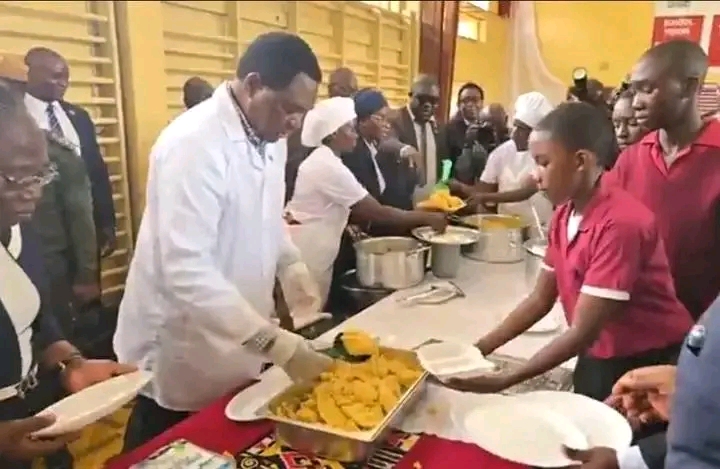
When President Hakainde Hichilema stood behind serving tables at Kabulonga Boys Secondary School and dished food onto pupils’ plates, the symbolism was deliberate. This was not merely a ceremonial launch. It was a political statement about the architecture of his education reforms and the evolution of free education into a broader social investment programme.
The school feeding initiative, first rolled out in 2022 in rural and vulnerable communities, has now entered urban public schools. The expansion marks a strategic shift. Government is moving from access alone to quality, from enrolment figures to retention and performance metrics.
Addressing learners, officials and education stakeholders today, President Hichilema framed the programme as reinforcement of free education rather than an isolated welfare measure.
“Quality education is not just about sitting in a classroom,” he emphasised.
Nutrition, attendance, concentration and dignity are interconnected pillars in learning outcomes.
The logic is grounded in global evidence. School feeding programmes across Africa and Latin America have consistently improved attendance rates, reduced dropout levels and enhanced cognitive performance.
Within the Zambian context where free education has already pushed enrolment beyond 2.5 million learners, the next policy challenge is sustaining classroom participation while managing pressure on infrastructure and teaching capacity.
By introducing home-grown food procurement into the programme, government is also tying agriculture into education. The multiplier effect matters. Local farmers supply produce. Schools create predictable demand.
Communities benefit from structured markets. It is a policy design that merges social protection with productive value chains.
The Lusaka urban roll-out signals confidence in fiscal space. With improved domestic revenues, stabilising inflation and mining receipts rising, the administration appears willing to deepen flagship reforms ahead of the 2026 general elections.
Education remains one of the clearest political differentiators of the New Dawn government.
The imagery of pupils chanting the now-familiar youth phrase “Salt Sana” reflects more than campaign energy. It illustrates how education policy has become a generational identity marker in current politics. Free education and expanded bursary schemes have altered household economics. For many families, school fees were once a structural barrier.
Today, nutrition is being integrated into the same reform pipeline.
Critics will question sustainability. Feeding programmes require predictable funding streams, efficient supply chains and oversight mechanisms to avoid leakages. Urban scale presents logistical complexity that rural pilots did not fully encounter. The success of this expansion will depend on procurement transparency and consistent budget allocation.
But politically and economically, the signal is clear. Government is repositioning education as a full ecosystem intervention. Access, affordability, nutrition and long-term human capital formation are being woven into a single policy narrative.
If the first phase of free education was about opening classroom doors, this second phase is about ensuring learners stay inside, focused, nourished and prepared.
While economic debates dominate, the school feeding expansion becomes both a social programme and a strategic investment in Zambia’s demographic future.
© The People’s Brief | Francine Lilu
The humility of this President leaves me with tearful eyes. I thank God for him. Zambia is truly blessed through this gift. He has my vote this August, God granting me breath.
Salt saana! Salt saana imweee!